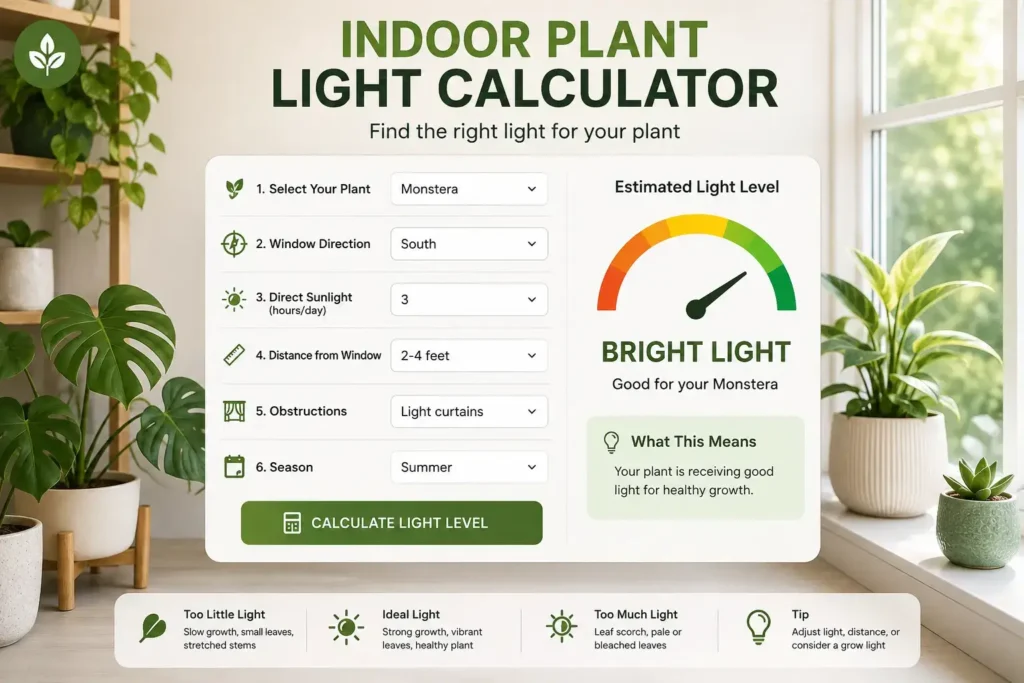
Indoor Plant Light Calculator: Find the Right Light for Your Plant
Not sure if your indoor plant is getting enough light? It can be difficult to judge light levels just by looking at a window or grow light.
Too little light can cause slow growth, weak stems, small leaves, or stretched growth. Too much intense light can lead to pale, bleached, curled, or scorched leaves.
Our Indoor Plant Light Calculator helps you estimate whether your plant is getting low, moderate, bright, or very bright light based on its growing conditions.
You can enter details such as your plant type, window direction, direct sunlight, distance from the window, season, and other conditions. If you already have a grow-light or PPFD reading, you can also use that information.
What Is an Indoor Plant Light Calculator?
An Indoor Plant Light Calculator estimates the amount of usable light available to a plant based on its environment.
Instead of looking at only one factor, the calculator considers several conditions that can change how much light reaches your plant, including:
- Plant type
- Window direction
- Hours of direct sunlight
- Distance from the window
- Curtains or blinds
- Trees or buildings blocking the window
- Season
- Growing conditions
- Grow-light intensity when applicable
The calculator then gives you an estimate of whether the available light is likely to be suitable for your plant.
Important: The result is an estimate. Natural light changes throughout the day because of weather, seasons, window glass, shadows, and the position of the plant.
How to Use the Indoor Plant Light Calculator
Using the calculator is simple.
1. Select Your Plant
Start by choosing the plant you want to check.
Different plants have different light requirements. For example, a Snake Plant can handle lower light than a Fiddle Leaf Fig or a Desert Cactus.
The calculator adjusts its recommendation based on the plant you select.
2. Choose Your Window Direction
Select the direction of the main window where your plant is located.
The four common directions are:
- North
- South
- East
- West
Window direction can affect both the intensity and timing of sunlight.
3. Enter Direct Sunlight Hours
Estimate how many hours of direct sunlight reach the plant.
A window may receive sunlight, but the plant itself might not receive direct rays because of curtains, furniture, trees, buildings, or its distance from the glass.
4. Enter the Distance From the Window
Enter approximately how far the plant is from the window.
Plants placed close to a bright window generally receive more usable light than plants several feet away.
Even moving a plant a small distance can make a noticeable difference in the amount of light it receives.
5. Consider Obstructions
Tell the calculator if something blocks or reduces the available light.
Common examples include:
- Curtains
- Blinds
- Nearby buildings
- Trees
- Tinted or heavily shaded windows
These factors can reduce the amount of light reaching your plant.
6. Select the Season
Light conditions can change significantly during the year.
The same window may provide different conditions in summer and winter because of changes in the sun’s position and daylight duration.
Why Does Window Direction Matter?
Window direction is one of the easiest ways to estimate indoor light conditions.
In general:
- East-facing windows often provide gentle morning sunlight.
- West-facing windows can receive stronger afternoon sunlight.
- South-facing windows can provide bright conditions, especially in the Northern Hemisphere.
- North-facing windows generally provide lower light.
However, window direction alone does not determine how much light your plant receives.
Your location, season, weather, nearby buildings, trees, curtains, window glass, and plant distance can all change the result.
This is why the calculator looks at several conditions instead of relying on window direction alone.
How Far Should Indoor Plants Be From a Window?
There is no single distance that works for every plant.
A plant sitting directly beside a bright window may receive considerably more light than the same plant placed several feet into the room.
Consider moving the plant closer to the window if you notice:
- Slow growth
- Long spaces between leaves
- Stretched stems
- Smaller new leaves
- Loss of variegation
- Weak growth
- Poor flowering
These signs can indicate that the plant needs more light, although light is not always the only possible cause.
How Much Light Does an Indoor Plant Need?
Different indoor plants have different light preferences.
Here is a general guide:
| Plant | General Light Level |
|---|---|
| Cast Iron Plant | Low |
| Snake Plant | Low to Medium |
| ZZ Plant | Low to Medium |
| Pothos | Low to Medium |
| Peace Lily | Low to Medium |
| Spider Plant | Medium |
| Monstera | Medium |
| Rubber Plant | Medium to Bright |
| Fiddle Leaf Fig | Bright |
| Aloe Vera | High |
| Jade Plant | High |
| Bird of Paradise | High |
| Hibiscus | High |
| Desert Cactus | Very High |
These categories are general starting points rather than exact requirements.
A plant’s response can also depend on the specific variety, season, temperature, watering, and other growing conditions.
Signs Your Plant May Need More Light
Your plant may not be receiving enough light if you notice changes such as:
- Slow or weak growth
- Stretched stems
- Larger gaps between leaves
- Smaller new leaves
- Loss of leaf variegation
- Leaning toward a window
- Poor flowering
One symptom by itself does not prove that insufficient light is the problem.
For example, slow growth can also be related to watering, temperature, nutrients, or the plant’s natural growth cycle.
Signs Your Plant May Be Getting Too Much Light
Excessive or very intense light can also cause problems.
Look for signs such as:
- Bleached leaves
- Pale patches
- Brown or crispy areas
- Leaf scorch
- Curling leaves
- Sudden leaf stress after moving the plant into stronger light
If you move a plant from a low-light location to strong direct sunlight, increase the light gradually when possible. A sudden change can stress the leaves.
What Is DLI?
DLI stands for Daily Light Integral.
It describes the total amount of photosynthetically useful light a plant receives over a 24-hour period.
DLI is useful when you already know the plant’s light intensity and want to understand its total daily light exposure.
However, you do not need to calculate DLI manually to use this Indoor Plant Light Calculator.
If you already have a reliable PPFD reading and know how many hours your grow light runs each day, our Indoor Plant DLI Calculator is a better tool for that specific calculation.
Indoor Plant Light Calculator vs. DLI Calculator
These two calculators are related, but they answer different questions.
Indoor Plant Light Calculator
Use this calculator when you want to know:
“Is my plant getting enough light where it is?”
You can enter information about:
- Plant type
- Window direction
- Direct sunlight
- Distance from the window
- Season
- Obstructions
- Growing conditions
The calculator uses these details to estimate the plant’s light environment.
Indoor Plant DLI Calculator
Use the DLI Calculator when you already have a PPFD measurement and want to calculate the plant’s daily light exposure based on the number of hours the light is on.
In simple terms:
Indoor Plant Light Calculator: Plant + environment → estimated light conditions
DLI Calculator: PPFD + light hours → daily light exposure
If you already measured PPFD, use the Indoor Plant DLI Calculator to calculate DLI.
Using a Grow Light for Indoor Plants
A grow light can be useful when natural light is not enough.
You may consider adding a grow light if your plant is:
- Far from the window
- In a dark room
- Near a low-light window
- Growing during a darker season
- A high-light plant that cannot get enough natural light
Grow-light performance depends on factors such as intensity, coverage area, distance, and operating time.
If your grow light provides a PPFD reading, you can use that measurement with the DLI Calculator to estimate daily light exposure.
Can a Light Meter Help?
A light meter can provide a more measurable way to evaluate indoor light.
Some meters measure:
- PPFD
- Lux
- Foot-candles
For plants, a PAR/PPFD meter is generally more directly useful because PPFD measures the amount of photosynthetically active light reaching the plant.
Lux and foot-candle readings can also provide useful information, but converting them into plant-usable light is only an approximation because different light sources have different spectral characteristics.
How to Improve Indoor Plant Lighting
If the calculator suggests that your plant may need more light, you have several options.
Move the Plant Closer to a Window
One of the simplest solutions is moving the plant closer to a suitable bright window.
Avoid moving a plant suddenly from very low light into strong direct sunlight.
Remove Light Obstructions
Check whether curtains, blinds, furniture, trees, or nearby buildings are blocking available light.
Opening curtains during the day may make a difference.
Add a Grow Light
A grow light can help when natural light is consistently too low.
This can be especially useful for:
- Dark rooms
- Plants far from windows
- Winter growing
- High-light plants
Monitor the Plant
Do not rely only on the calculator result.
Watch new growth and leaf condition over time. Your plant’s response can help you determine whether the current lighting setup is working.
Why the Calculator Gives an Estimate
Indoor light is constantly changing.
The actual amount of light reaching your plant can be affected by:
- Clouds
- Weather
- Season
- Latitude
- Window glass
- Curtains
- Buildings
- Trees
- Room layout
- Plant position
- Time of day
Because of these variables, the calculator should be treated as a practical estimate rather than a laboratory measurement.
If you have a reliable PPFD reading taken at the plant’s leaf level, that measurement gives you a better starting point for calculating daily light exposure.
Use the Indoor Plant Light Calculator
Not sure whether your plant is sitting in the right spot?
Use the Indoor Plant Light Calculator to estimate its light conditions based on your plant, window, sunlight, distance, and growing environment.
If you already know your PPFD measurement and want to calculate daily light exposure, use the Indoor Plant DLI Calculator instead.
The two tools work together:
Light Calculator → Find out whether the location is suitable
DLI Calculator → Calculate daily light exposure from PPFD and light hours
Start with the Indoor Plant Light Calculator to find the best lighting conditions for your plant.