How Much Light Do Indoor Plants Need? A Room-by-Room Guide
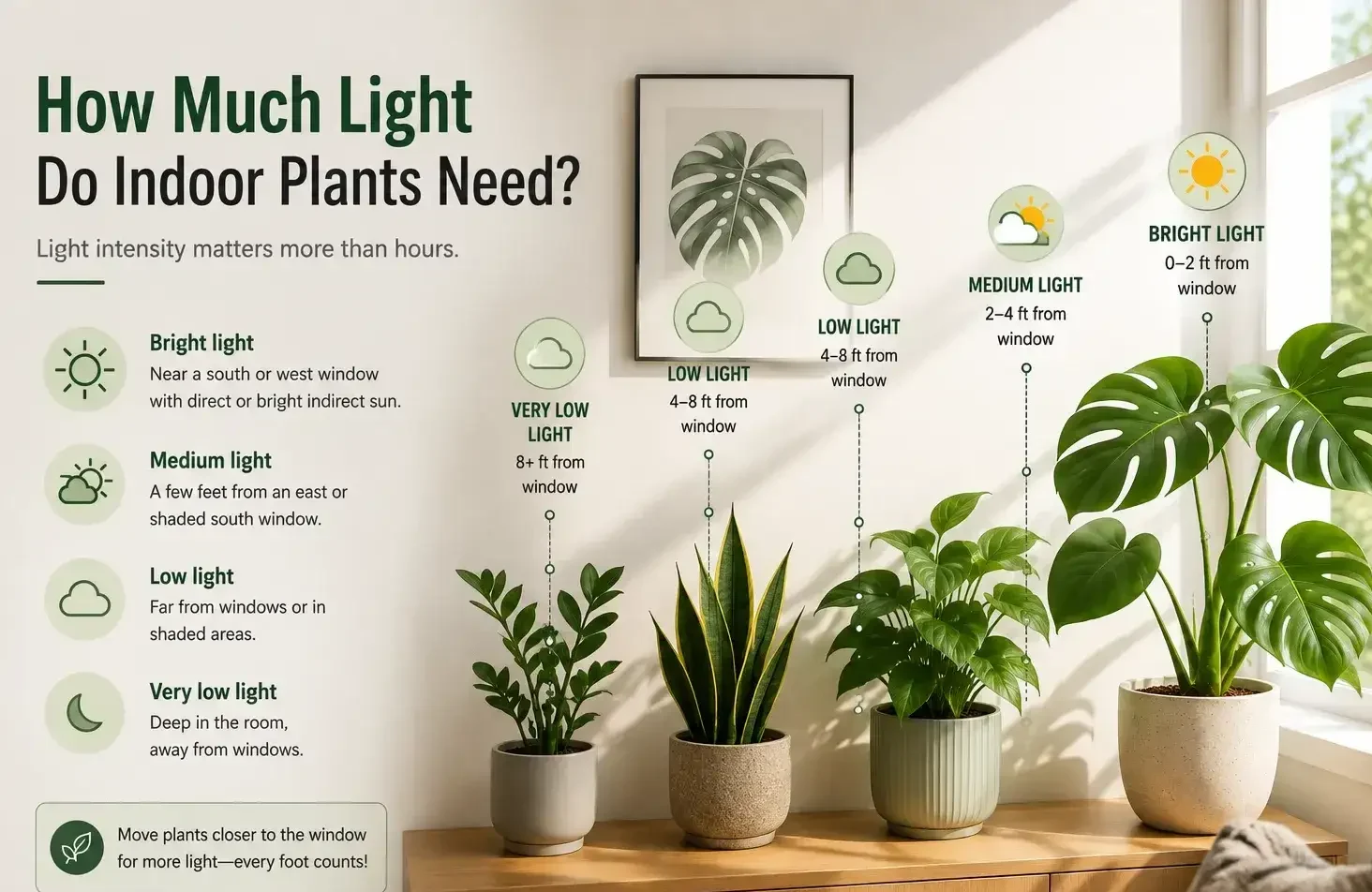
There isn’t one fixed number of hours that applies to every plant. Light intensity matters as much as duration; a few hours of strong, direct sun can equal or exceed a full day of dim light. Low-light-tolerant plants manage fine in dimmer spots; sun-loving plants need much brighter, more direct conditions to thrive.
Here’s the scenario that trips up almost every new plant owner: a fiddle leaf fig sits three feet back from a “bright” living room window. It looks fine for a few weeks. Then the lower leaves start dropping, one by one, and the owner assumes it’s a watering problem. It isn’t. It’s light, and the room looked bright to human eyes, which is exactly the trap.
Most indoor plant light-requirement charts you’ll find online treat “bright,” “medium,” and “low” light as fixed categories tied to room type. They’re not. A north-facing bedroom in a sunny climate can out-light a south-facing office buried behind a neighbouring building. What actually determines whether your plant thrives or slowly declines is a combination of window direction, distance from that window, and the season, not what the room is called on a floor plan.
(Note: the window-direction guidance in this article assumes a Northern Hemisphere home. In the Southern Hemisphere, north-facing windows tend to get the strongest light and south-facing windows the weakest; the relationship flips.)
If you’re wondering exactly how much light do indoor plants need, this guide breaks all of that down: what ‘enough light’ really means, how to read your own space room by room, how natural light compares with grow lights, and how to spot the difference between too little light and too much before your plant tells you the hard way.
What determines how much light indoor plants need
Three factors set a plant’s light requirement: species and native habitat (understory plants evolved for shade; desert natives evolved for intense sun), growth stage and season (which changes how a plant responds to and uses available light), and leaf characteristics (variegation and leaf thickness affect light sensitivity, though not in one uniform direction).
Species and native habitat
A plant’s native habitat gives you an important clue about the light it can tolerate and where it tends to perform best, though it’s a clue, not the whole picture. Pothos and philodendrons evolved on rainforest floors, filtering light through a dense canopy above them, which is a big part of why they tolerate low light indoors without complaint. Succulents and cacti evolved in open, exposed terrain with little shade, and generally do best in brightly lit spots like a south- or southwest-facing window. Moving a plant well outside the light range its habitat prepared it for, in either direction, tends to cause stress.
Growth stage and season
Growth stage and season affect how a plant responds to light. During active growth, adequate light is especially important for producing new leaves and stems, while many houseplants grow more slowly in winter, and their light demand tends to ease off with it. This isn’t a fixed rule for every species, but it’s a pattern worth watching for.
Leaf characteristics and acclimation
Variegated leaves contain less chlorophyll in their pale areas, and some variegated plants are more sensitive to intense light than their solid-green counterparts. Their ideal exposure varies by species and cultivar, though, so it’s not accurate to say all variegated plants need less direct light; some actually need brighter conditions to maintain strong variegation in the first place. Acclimate any plant gradually to a new light level rather than assuming a category applies uniformly across every variegated variety.
How much light does each room in your home actually provide?
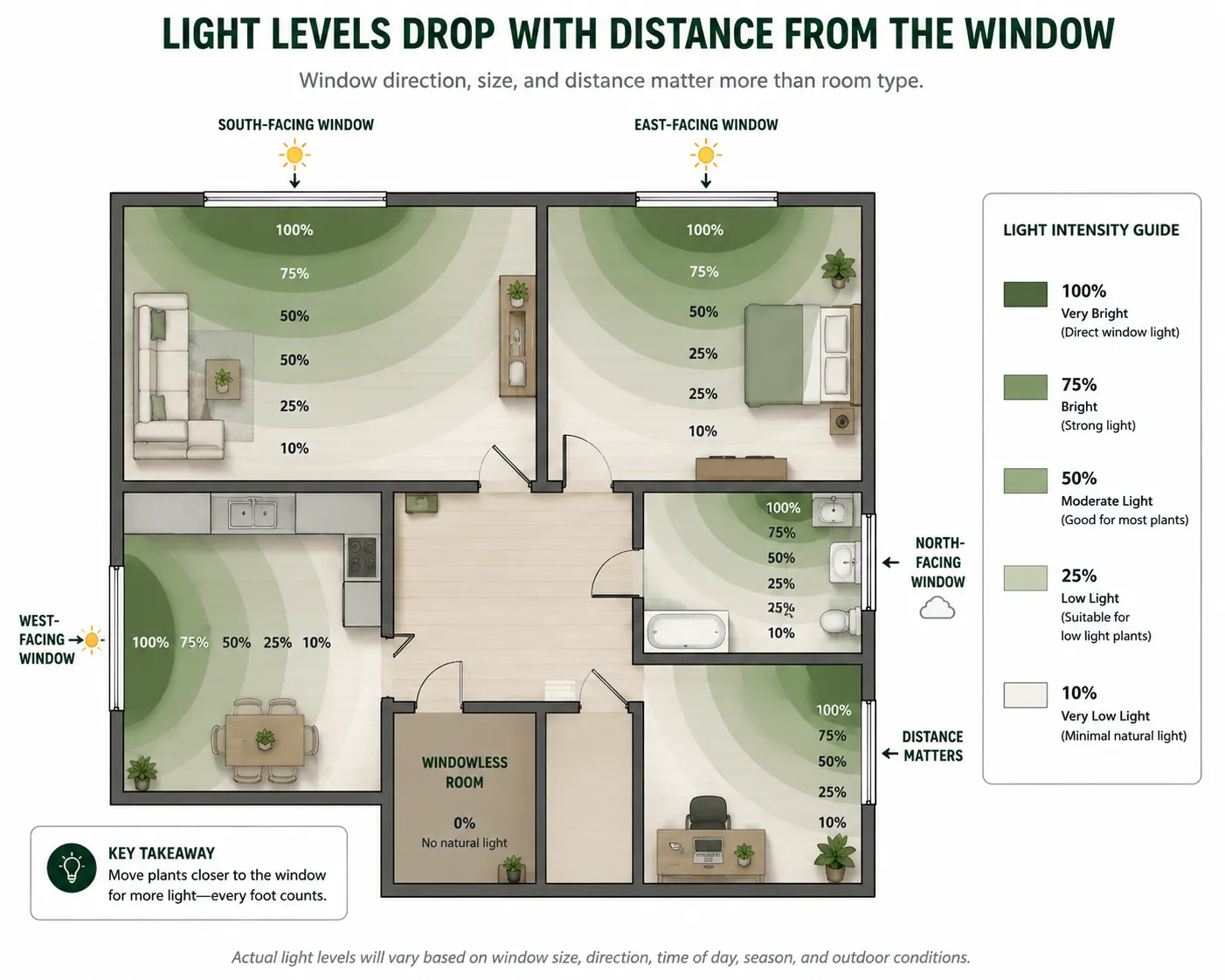
Room type alone doesn’t determine light; window direction, size, and distance from that window matter far more. A bedroom with a large south-facing window can out-light a “bright” living room with small windows. Assess each space by its windows, not by what the room is typically used for.
Living room
Usually the biggest opportunity in the house, simply because living rooms tend to have the largest windows. But large north-facing windows can still provide useful light; they generally receive less direct sun than south-facing windows in the Northern Hemisphere, though the exact level varies with latitude, season, and any obstructions outside.
Bedroom
People default to calling bedrooms “low light” because they’re used for sleeping, not living. That has nothing to do with the physics. A south-facing bedroom window delivers the same light a south-facing living room window would.
Kitchen
Kitchens often get treated as a light afterthought, but watch for two things beyond brightness: heat from cooking and stove exhaust, and afternoon sun through west-facing windows that can bake a plant sitting right on the sill.
Bathroom
If you want plants to grow long-term in a windowless bathroom, you’ll need a suitable artificial light source. A bathroom with a real window, even a small one, can support far more than people expect.
Home office
This is where the “bright room” trap shows up most. A home office can feel bright because the lights are on and the walls are pale, while the actual plant sits eight feet from the only window. Move plants toward the glass, not toward wherever the desk happens to be.
Windowless or interior rooms
A genuinely windowless room can’t provide the light needed for sustained plant growth, so you’ll need supplemental lighting for long-term success. A plant can coast for a while on stored reserves, but that’s a temporary buffer, not a growing condition.
Natural window light vs grow lights: which is better for growing plants indoors?
Window light varies by direction, season, weather, and distance; it’s free but inconsistent. Grow lights deliver steady output regardless of season, but their real strength depends on wattage, fixture quality, and distance from the plant, not on the product label alone. Most homes end up needing both rather than choosing one.
|
Light Source |
What Affects Its Strength |
Consistency |
Best Use |
|
South-facing window |
Season, weather, distance, shading |
Variable |
Bright-light plants |
|
East-facing window |
Morning sun, season, distance |
Variable |
Many foliage plants |
|
West-facing window |
Afternoon sun, heat, season |
Variable |
Bright-light plants |
|
North-facing window |
Latitude, season, distance |
Usually lower, variable |
Low-light tolerant plants |
|
Full-spectrum LED grow light |
Wattage, fixture, distance, coverage area |
High |
Supplementing or replacing window light |
Here’s the part most best-light-for-growing-plants-indoors advice skips: lux and footcandles measure illuminance based on the sensitivity of the human eye. PPFD photosynthetic photon flux density measures the amount of photosynthetically active radiation reaching the plant, expressed as photons per square meter per second. Because lux is weighted for human vision rather than plant photosynthesis, PPFD is generally the more useful metric when comparing grow-light performance.
That’s the honest reason grow light shopping gets confusing. Two fixtures can claim similar wattage and produce very different PPFD at the distance your plant will actually sit. If you’re comparing grow lights, look for PPFD specs at a stated distance, not just total wattage on the box.
How do you measure the light in your home without a meter?
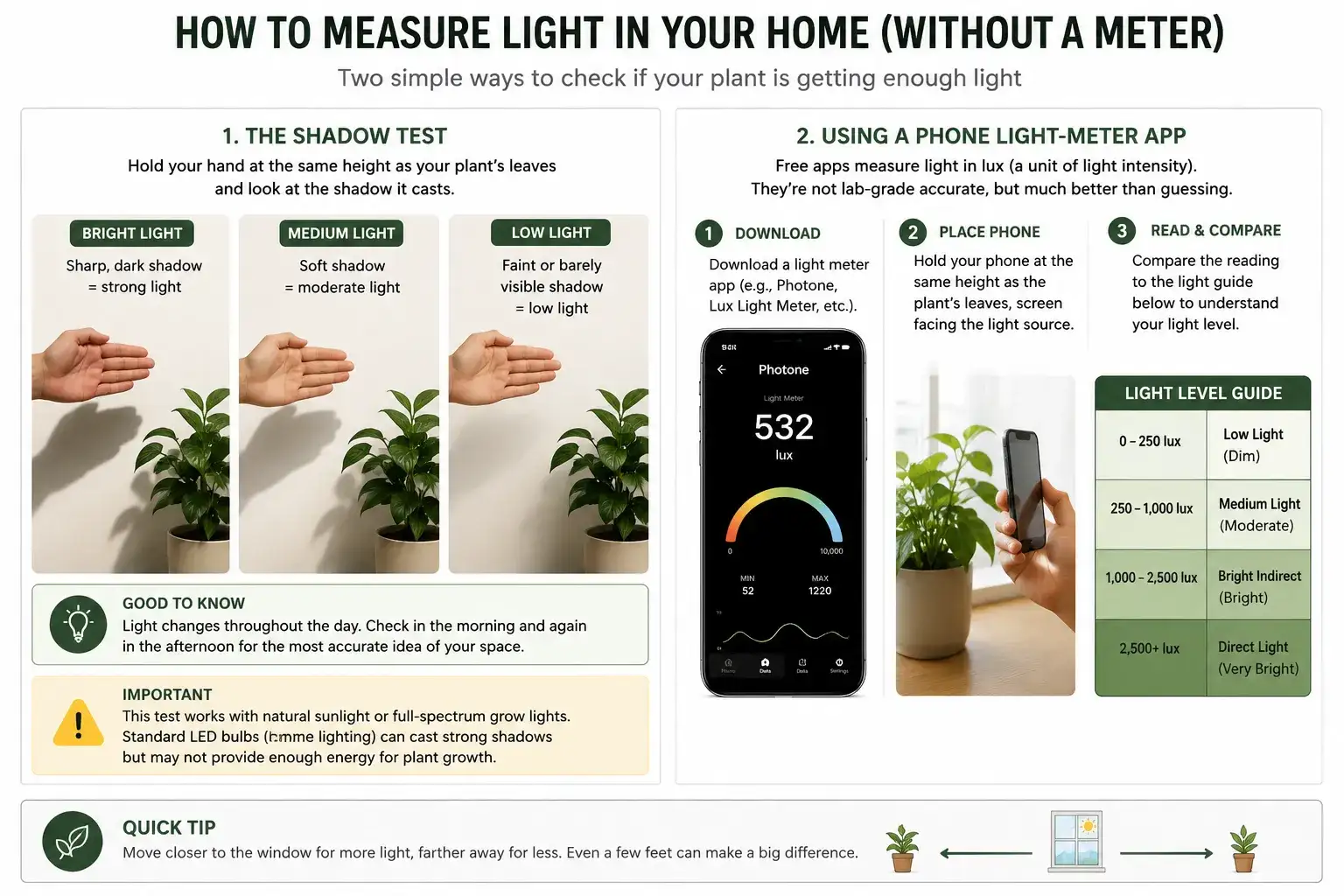
Hold your hand at roughly the same height as the plant’s leaves and look at the shadow it casts. A sharp, defined shadow suggests brighter light; a soft or barely visible shadow suggests dimmer light. This gives a rough sense of relative brightness, not a precise substitute for an actual light meter.
The shadow test
Don’t treat this as anything more than a starting point. It’s a rough visual indicator, not a measurement. Light changes throughout the day, so it’s worth repeating the test in the morning and afternoon if you’re on the fence about a spot.
the shadow test only works with natural sunlight or full-spectrum lights that cast shadows. Standard LED home bulbs often cast very defined shadows but do not provide enough energy for photosynthesis. Beginners sometimes test a dark corner lit by a reading lamp and assume a “sharp shadow” means it’s a good spot for a plant.
Using a phone light-meter app
Free lux-meter apps exist for most phones and get you closer to an actual number than eyeballing a shadow. They’re not lab-grade accurate, but they’re a solid upgrade from guessing, and they’re free.
Understanding footcandles, lux, and PPFD
This is the one technical detail most plant-care articles skip entirely, and it’s the one that actually matters. Lux and footcandle meters, including phone apps, measure light the way the human eye perceives it. PPFD measures the photon count a plant can actually use for photosynthesis. Those two things don’t always move together, which is why PPFD, not lux, matters when you’re evaluating a grow light rather than judging how bright a room feels.
What do low, medium, bright indirect, and direct light actually mean? (Indoor Plant Light Requirements Chart)
Low light means several feet from any window, or a north-facing window, which tends to be dimmer depending on latitude and nearby obstructions. Medium light means a few feet from an east or shaded south window. Bright indirect means near a south or west window but out of direct rays. Direct means hours of unfiltered sun hitting the leaves.
According to the University of Minnesota Extension, low light falls in the range of roughly 50 to 250 footcandles, medium light generally runs from about 250 to 1,000 footcandles, and high light exceeds 1,000 footcandles. These aren’t hard boundaries a plant crosses and suddenly suffers; they’re reference ranges, and real spaces vary with obstructions, window size, and season.
Low light plants and placement
Snake plant, pothos, ZZ plant, and cast iron plant tolerate low light well. Place them several feet from any window, or near a north-facing one. Growth will be slower here; that’s normal, not a sign of a problem.
Medium light plants and placement
Peace lily and many philodendrons do well a few feet back from an east window or a shaded south-facing one. This is the most forgiving light category and the easiest to get right by accident.
Bright indirect light plants and placement
Monstera, many ferns, and other tropical foliage plants generally prefer bright to moderate indirect light. An east-facing window, or a spot a few feet from a brighter south or west window, can work well depending on the species and how intense the direct sun actually is.
Direct light plants and placement
Succulents, cacti, and sun-loving plants like jade and hibiscus want hours of unfiltered sun, typically right against a south-facing window with nothing in the way. Shade- and medium-light plants can scorch if you move them suddenly into that same spot without a gradual transition.
How does light change with the seasons?
Natural light is often substantially weaker indoors during winter, since days are shorter and the sun follows a lower path across the sky, even at the same window. Moving plants closer to windows or adding a grow light can help maintain consistent exposure once natural light drops off noticeably.
Why winter light is weaker
It’s not just shorter days. The sun’s lower angle in winter reduces how much direct light reaches through a given window. The size of that effect varies by window direction, latitude, weather, and surrounding obstructions; some windows see a much bigger seasonal swing than others.
When to add supplemental lighting
Skip the calendar-based rule of thumb. A better trigger is the plant itself: new growth slowing to a crawl, leaves turning pale, or a plant leaning hard toward the window are all signs that natural light has dropped below what it needs. That often lines up with winter in temperate climates, but “often” isn’t “always,” and a plant several feet from a small window might need supplemental light well before winter even arrives.
But how do you know if that light drop is actually the cause, or if something else is going on? That depends on the symptoms you’re seeing, which is exactly what the next section untangles.
What are the signs your plant isn’t getting enough light or is getting too much?
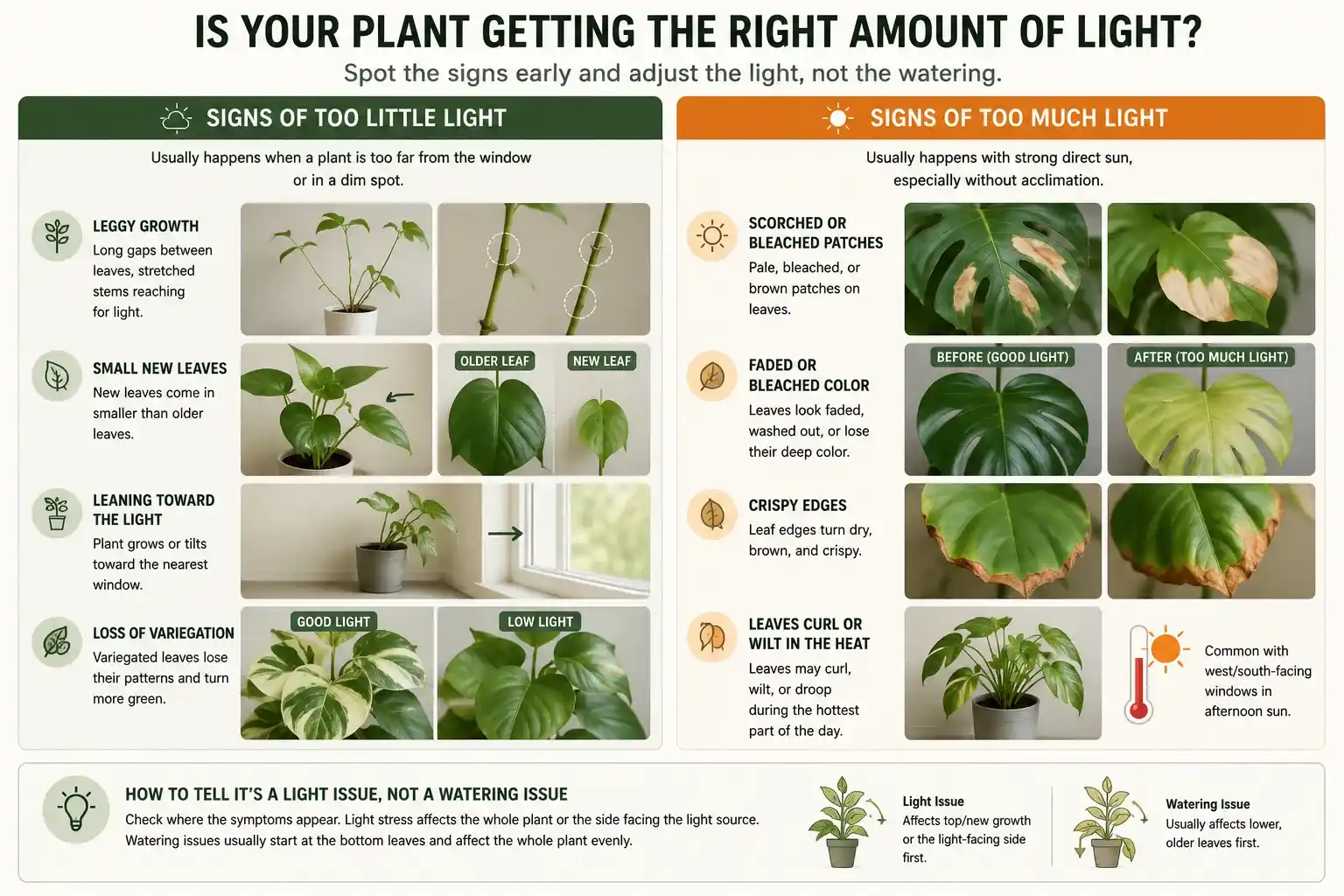
Too little light causes leggy stems, small new leaves, leaning toward windows, and loss of variegation. Too much light causes scorched patches, bleached or faded colour, and crispy edges. This distinction matters because both are frequently mistaken for a watering problem, leading owners to make the wrong fix.
Signs of too little light
New leaves come in smaller than the ones before them. Stems stretch out and get leggy, with longer gaps between leaf nodes as they reach toward the nearest light source. Variegated plants often lose their variegation, reverting toward solid green as the plant maximises chlorophyll to compensate.
Signs of too much light
Leaves develop pale, bleached patches, sometimes before any visible scorching shows up. Edges go crispy and curl inward. This tends to happen fastest on plants recently moved into a brighter spot without a gradual transition.
How to tell it’s a light issue, not a watering issue
Here’s the assumption that trips up more plant owners than almost anything else: yellowing leaves always mean overwatering. That’s not accurate. Too much direct light can bleach or yellow foliage, and people routinely misdiagnose it as a watering problem. Yellowing or bleaching concentrated on the sun-facing side of the plant, especially soon after moving into brighter light, points to light stress worth checking before you change your watering routine.