
Best Water for Indoor Plants: How Tap, Distilled, and Rainwater Compare
A new houseplant can turn a simple watering routine into a surprisingly complicated decision. Tap water, distilled water, rainwater, filtered water, spring water. Which one is actually best?
The best water for indoor plants depends on the plant and the chemistry of the water. Rainwater and appropriately filtered water are strong general choices, while many common houseplants tolerate suitable tap water. Distilled water is useful when very low mineral content is needed, but it is not automatically the best choice for every plant.
The trick is to stop treating water quality as a purity contest. Plant sensitivity, mineral buildup, pH, PPM, and your local water source matter more.
What is the best water for indoor plants?
The best water for indoor plants depends on the plant and the water chemistry. Rainwater and appropriately filtered water are strong general choices, while many common houseplants tolerate tap water. Distilled water is useful when very low mineral content is needed, but its lack of dissolved minerals makes proper fertilization more important.
For a beginner, that means there is no single bottle or water source that wins for every houseplant.
Rainwater is naturally low in dissolved minerals, and the Royal Horticultural Society recommends it for many plants, particularly plants that dislike hard water. Hard mains water can raise the pH of growing media and affect nutrient availability.
Tap water can still be perfectly practical for tolerant houseplants. The bigger question is what is in that tap water and how the plant responds over time.
Distilled or deionised water contains almost no dissolved minerals. That can be helpful for plants that need very soft water, but those minerals are not magically replaced. The RHS notes that plants receiving purified water still need an appropriate nutrient supply.
So the best water for plants is usually the water that fits the plant rather than the water that sounds most purified.
How do tap, distilled, and rainwater compare?
Tap, distilled, and rainwater each solve a different problem. Tap water is convenient and often adequate for tolerant plants. Distilled water removes almost all dissolved minerals. Rainwater is naturally soft and low in minerals, making it especially useful for plants that struggle with hard water or certain compounds in tap water.
| Water type | Mineral load | Best use case | Main drawback |
| Tap water | Varies by location | Most tolerant houseplants when local water is suitable | Hardness, dissolved minerals, or treatment chemicals can cause problems for sensitive plants |
| Distilled water | Very low | Sensitive plants or situations where very soft water is needed | Requires attention to plant nutrition |
| Rainwater | Usually low | Many houseplants, especially plants sensitive to hard water | Collection and storage need care |
| Filtered water | Depends on the filter | A practical middle ground for some sensitive plants | “Filtered” does not describe one consistent water chemistry |
There is an important distinction here. “Soft” does not necessarily mean “filtered,” and “filtered” does not necessarily mean “mineral-free.”
A good filter can change some parts of your water chemistry, but the result depends on the filtration method. That is why a filtered-water label tells a beginner much less than an actual water-quality measurement.
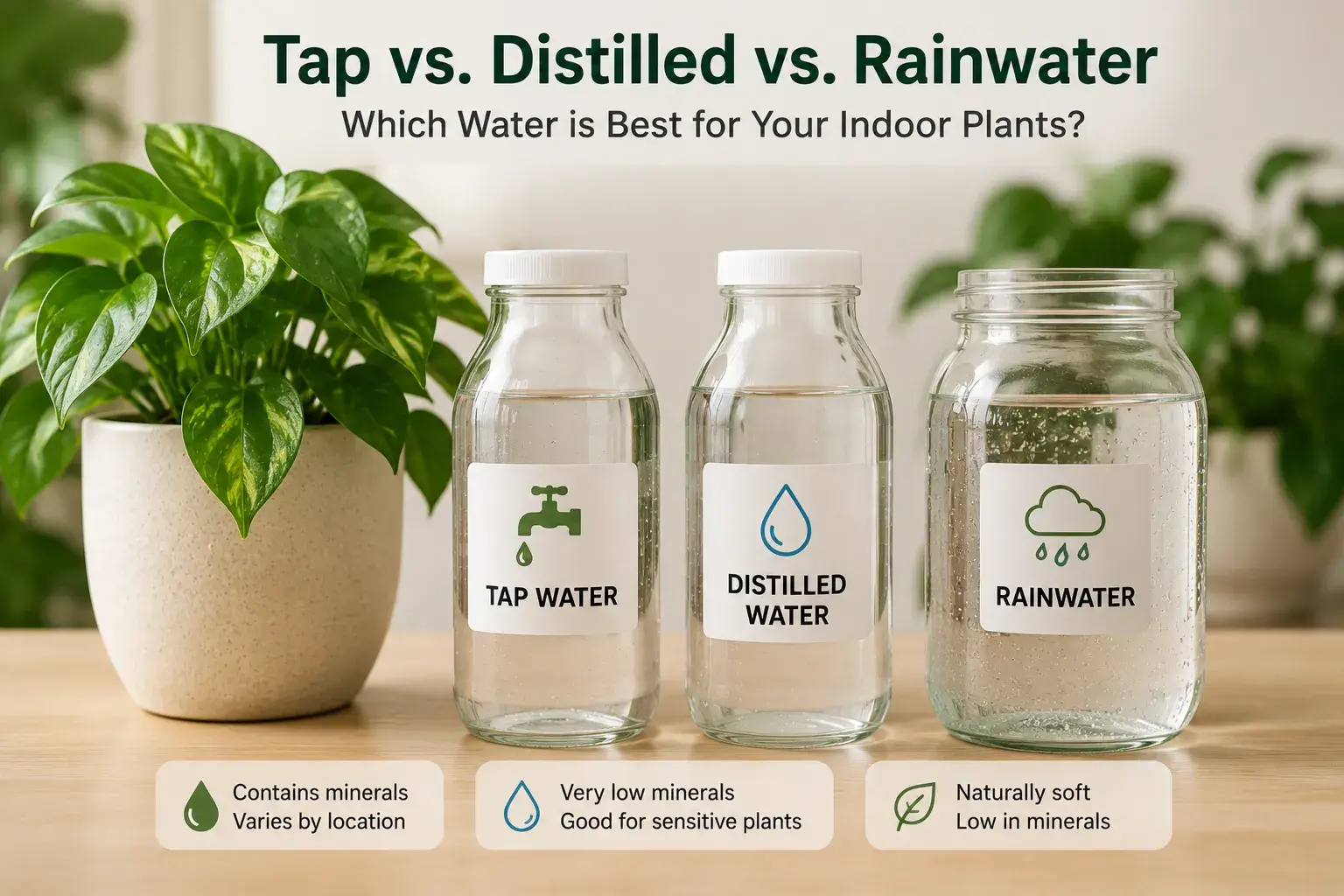
For most beginners, the comparison is simple:
Tap water wins on convenience. Rainwater wins on naturally low mineral content. Distilled water wins when very low dissolved solids are specifically useful.
The plant gets the final vote.
What do pH and PPM tell you about your plant water?
pH tells you how acidic or alkaline water is, while PPM or TDS gives an estimate of dissolved material. Neither number alone determines whether water is good for a houseplant. Together with the plant species and its symptoms, they can reveal whether water quality deserves attention.
How should you test tap, distilled, and rainwater?
For this article’s original data, use a simple three-source comparison rather than pretending a single reading proves anything.
Original test protocol for publication
- Collect tap, distilled, and rainwater in clean, identical containers.
- Use a digital pH meter and a TDS/PPM meter.
- Take 3 readings per water source.
- Test the samples under comparable conditions on the same day.
- Record every reading, then calculate the average for each source.
- Photograph the three samples and the meters during testing.
- Present the averaged results in a comparison table.
| Water source | pH reading 1 | pH reading 2 | pH reading 3 | Average pH | PPM/TDS 1 | PPM/TDS 2 | PPM/TDS 3 | Average PPM/TDS |
| Tap water | Measure | Measure | Measure | Calculate | Measure | Measure | Measure | Calculate |
| Distilled water | Measure | Measure | Measure | Calculate | Measure | Measure | Measure | Calculate |
| Rainwater | Measure | Measure | Measure | Calculate | Measure | Measure | Measure | Calculate |
This table deliberately does not invent results. The measurements need to come from the actual test before publication.
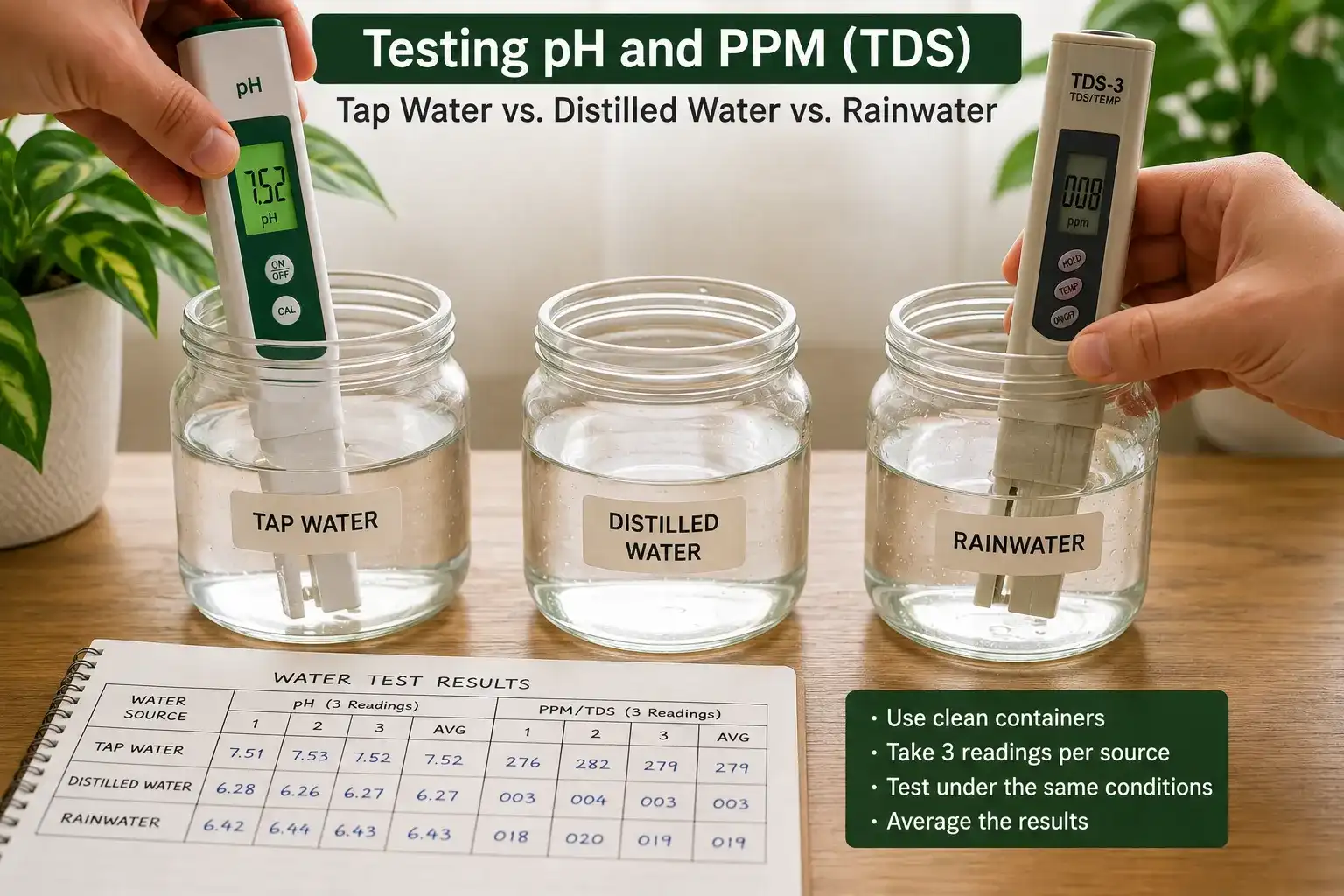
A useful test tells readers how the three sources differ. It does not justify declaring one universal PPM or pH number “perfect” for all houseplants. Different plants have different tolerances, and growing conditions change how they respond.
That is the part many water comparisons skip.
How should beginners interpret the results?
Think of pH and PPM as clues, not verdicts.
A higher dissolved-solids reading can indicate more material is present in the water, but it does not tell you exactly which substances are responsible. Likewise, a pH reading does not tell you everything about nutrient availability in the potting mix.
The useful question is whether the measurement, plant type, and symptoms point in the same direction.
Indoor Plant Soil and Drainage Guide
And that leads to the more practical question: what happens when the water looks ordinary, but the plant does not?
Does Your New Pot Need a Drainage Hole?
For beginners: always choose a planting pot with a drainage hole. Without one, water has nowhere to go, and you lose the ability to gauge when the soil has been watered thoroughly. If you love a decorative pot without drainage, use it as an outer cachepot set the planted pot inside rather than planting directly into the decorative container. Empty water that collects in the cachepot/saucer. Penn State Extension recommends exactly this approach for situations where aesthetics and drainage need to coexist.
When in doubt, go only slightly larger and choose terracotta if you know you tend to overwater.
When is tap water good enough, and when should you switch?
Tap water is often good enough when a houseplant is growing normally and the water does not create persistent mineral or salt buildup. Switching becomes more reasonable when a sensitive species shows recurring symptoms, local water is particularly hard, or testing suggests a water-quality issue that matches the plant’s needs.
Which plants are more likely to react?
Not every houseplant reacts to tap water in the same way.
Some plants are especially sensitive to hard water or compounds found in treated water. The RHS notes that dracaenas can be damaged by fluoride in tap water and recommends rainwater or filtered water where possible.
Calatheas are another classic example. RHS guidance notes that they can tolerate tap water when it has been left to stand, while rainwater or suitable alternatives can be preferable.
By contrast, many ordinary houseplants can be managed successfully without turning watering into a laboratory exercise.
For a beginner, the practical pattern is straightforward. Users with a sensitive plant and persistent brown tips often start changing everything at once. That makes diagnosis harder. A better approach is to change one variable, observe the plant, and keep the rest of the care routine consistent.
What symptoms can point to water-quality problems?
Water quality can contribute to:
- Brown or dry leaf tips
- White mineral residue on soil or containers
- Poor growth
- Salt crust around the soil line or drainage holes
The University of Maryland Extension explains that soluble salts can accumulate as water evaporates and can contribute to brown leaf tips, reduced growth, wilting, and other symptoms. It also points out that the severity depends on the plant and growing conditions.
Here is the practitioner detail that is easy to miss: brown tips do not automatically mean “bad tap water.” Fertilizer salts can create a similar problem. So can root stress, inconsistent watering, poor drainage, or environmental problems.
The water source should be treated as one suspect, not the entire crime scene.
How can you improve tap water without buying distilled water?
You can improve tap-water suitability by understanding what treatment your local water receives and choosing an appropriate filtration method. Letting water stand may help with chlorine in some situations, but it is not a universal solution. Filtration can be useful when mineral content or other compounds remain a concern.
Does letting tap water sit actually help?
Sometimes, but the advice is often repeated too broadly.
RHS guidance recommends letting tap water stand in an open container for at least 24 hours to allow chlorine to dissipate. University of Maryland Extension also recommends drawing water the day before watering as one way to reduce chlorine.
That does not mean standing water transforms hard water into soft water.
If the problem is mainly dissolved minerals, leaving a container on the counter does not magically remove them. Boiling is not a universal substitute either. The RHS notes that boiling may remove some calcium in hard water but generally does not make the water ideal for plants that require soft water.
So if chlorine in water is the concern, standing it may help. If mineral buildup is the concern, look at the water chemistry instead.
Is filtered water better than distilled water for everyday use?
It can be a practical compromise, but only if the filtration method addresses the issue you actually have.
Filtered water for plants is not one fixed category. A filter may reduce some contaminants while leaving other dissolved minerals behind. Distilled water is much more stripped down.
That makes filtered water attractive for routine use when a household wants a simpler middle ground. Distilled water makes more sense when the plant genuinely benefits from very soft water and the grower can manage nutrition appropriately.
If the goal is simply to make ordinary tap water “safe,” buying distilled water by the case may be solving a problem that the plant never had.
Which water should a beginner choose for common houseplants?
For most beginners, the easiest starting point is to use good-quality tap water unless the plant is known to be sensitive or the water leaves obvious signs of mineral buildup. Filtered or rainwater can be a sensible upgrade, while distilled water is better treated as a targeted option rather than a universal requirement.
For common, low-maintenance houseplants
Start with the water already available.
If a pothos, philodendron, ZZ plant, or another tolerant houseplant is growing well, there is little value in creating a complicated water routine just because a social-media post said tap water is bad.
Watch the plant. Watch the soil. Watch for deposits.
Good plant care is often less about finding the fanciest input and more about avoiding unnecessary changes.
For sensitive plants
A different strategy makes sense for plants that repeatedly show problems associated with hard water or specific compounds.
Calatheas, some dracaenas, orchids, and other sensitive plants may respond better to rainwater or suitably filtered water. RHS guidance specifically recommends softer water for several of these plants.
Specialized edge case: Some plants have unusually strict water-quality requirements. Keep those exceptions in their species-specific care guides rather than treating them as the standard for every indoor plant.
The contrarian truth about “pure” water
The assumption that the purest water is always the best water is wrong.
Distilled water contains almost no dissolved minerals. That sounds ideal until you remember that plants still need nutrients. The RHS specifically notes that purified water can help plants requiring very soft water, but fertilizer is needed to meet nutritional requirements because purified water itself contains almost no minerals.
Purity is a tool, not a goal.
The right question is whether the water chemistry supports the plant.
What should you do with rainwater, distilled water, or RO water?
Alternative water sources can be useful, but each comes with trade-offs. Rainwater can be excellent when collected and stored appropriately. Distilled and RO water are very low in dissolved minerals and may suit plants that need soft water. Choose an alternative for a clear reason rather than assuming more purification is always better.
How should you collect and store rainwater?
Rainwater is often an excellent option for houseplants because it is naturally soft and low in minerals. The RHS recommends collecting it from relatively clean roof surfaces and keeping storage containers covered to reduce debris and unwanted growth.
For indoor plants, the important part is not simply “collect rain.”
Use a clean container. Keep stored water covered. Avoid visibly dirty or stagnant water. If the stored water smells bad, clean the container rather than trying to rescue it with additives.
When does distilled or RO water make sense?
Distilled water for plants and reverse-osmosis water make the most sense when very low mineral content is useful for a particular plant or growing system.
The RHS describes purified water, including distilled and deionised water, as containing almost no dissolved minerals. It can be useful for plants that need very soft water, while regular nutritional support remains necessary.
Spring water for plants is a different proposition. It may contain substantial dissolved minerals, so “spring water” should not be treated as a synonym for distilled or purified water.
The same applies to bottled water. The best bottled water for plants is not automatically the most expensive bottle on the shelf. Without knowing its mineral profile, the label tells a beginner surprisingly little.
What is the simplest water decision for most indoor plant owners?
Start with the water you already have, observe how your plants respond, and test when there is a reason to suspect water quality. Use filtered or rainwater when chemistry or plant sensitivity calls for it, and reserve distilled or RO water for situations where very low mineral content is genuinely useful.
A simple decision process works better than a universal rule:
- Identify the plant. Check whether it is known to be sensitive to hard water or particular compounds.
- Check your water source. Look for hard-water issues, treatment information, or visible mineral buildup.
- Test when needed. Compare pH and PPM/TDS when symptoms or plant requirements justify it.
- Watch the plant. Brown tips and residue can be clues, but they have multiple possible causes.
- Change one variable. Try filtered or rainwater before rebuilding the entire care routine.
The best water for indoor plants is the water that solves the plant’s actual problem.
For a tolerant houseplant that is thriving, tap water may be all that is needed. For a sensitive plant in a hard-water home, rainwater or suitable filtered water may be the smarter choice. Distilled water has its place, but it is not a trophy for being the purest option.
And for anyone searching for the best water for indoor plants indoors, the answer is surprisingly practical: test first when there is a reason, match the water to the plant, and don’t create a complicated routine your plants don’t need.