
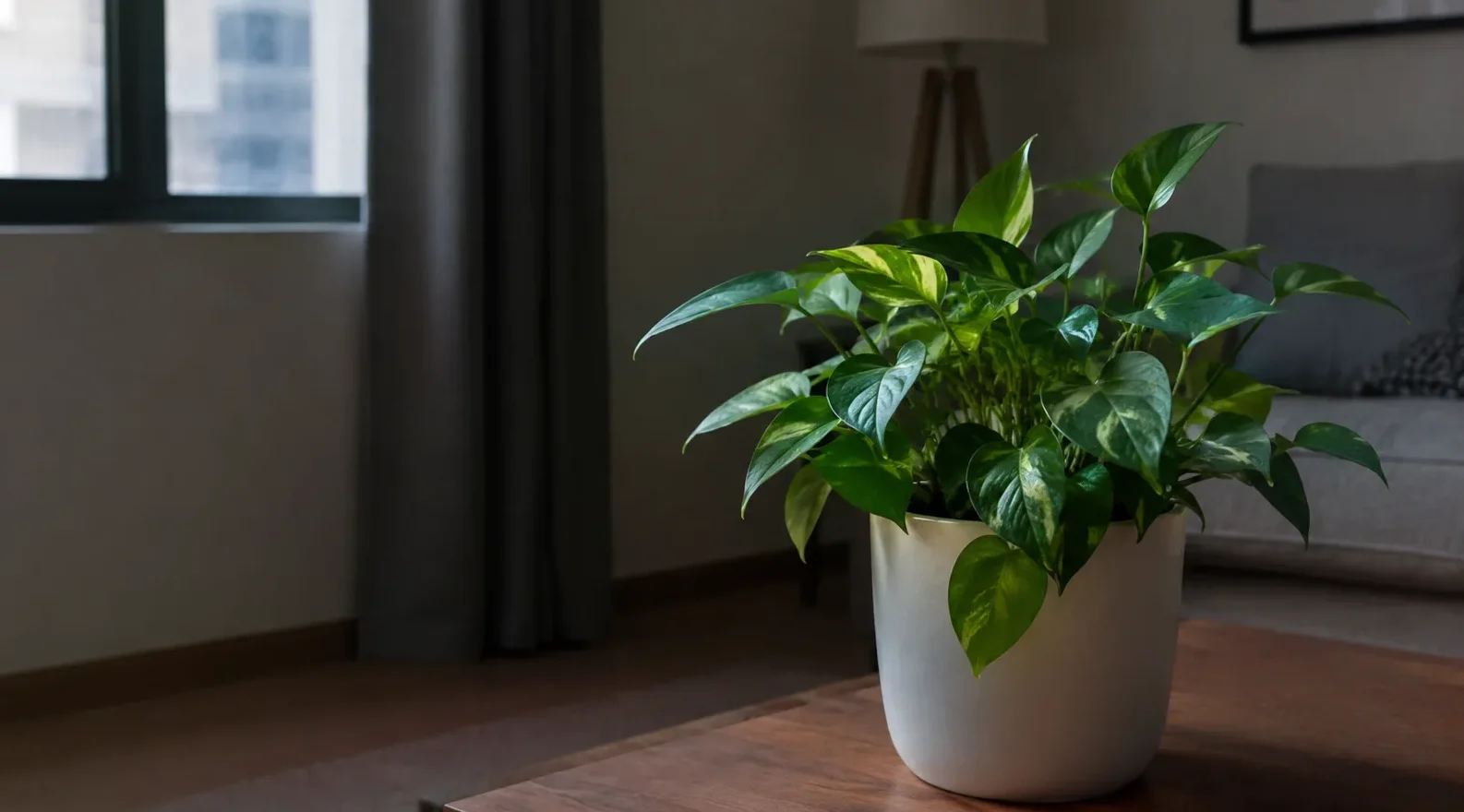
Can Indoor Plants Survive Without Sunlight? What Actually Works in Dark Rooms
A windowless bathroom, dark hallway, or shaded office can feel like a natural home for plants because the temperature and humidity seem comfortable.
Then the leaves start stretching.
The honest answer to Can Indoor Plants Survive Without Sunlight? is yes, but only if “without sunlight” means without direct or natural sunlight, not without usable light altogether. Plants need light for photosynthesis. Some houseplants tolerate very low light, and appropriate artificial lighting can make a windowless room workable. Complete darkness cannot support normal plant growth.
That distinction is the key to choosing the right plant and avoiding one of the most common houseplant mistakes: putting a so-called “low-light” plant in a genuinely dark room and assuming the label means no light is required.
Can indoor plants survive without sunlight?
Yes, some indoor plants can survive without direct sunlight, but no ordinary green houseplant can live indefinitely without usable light. Plants need light for photosynthesis, so a windowless room needs an artificial light source if it receives little or no natural light.
This is why searches for plants that don t need sun, indoor plants no sunlight, or plants that require no sunlight can be misleading.
The plant does not need sunlight specifically. It needs light energy.
A room can have:
- Direct sunlight through a window
- Bright indirect daylight
- Dim natural light
- Artificial light with no daylight
- Almost complete darkness
Those are very different growing environments.
RHS recommends artificial lighting for houseplants in dark or windowless spaces and explains that ordinary domestic bulbs may not provide enough light for plant growth.
So zero sunlight plants is a useful search phrase, but it isn’t a useful botanical category. There are plants that tolerate low light. There are plants that can be grown with artificial lighting. There are not green houseplants that simply stop needing light.
That matters because indoor plants that don’t need sun is usually shorthand for “plants that tolerate little natural light.”
The same rule applies to a without sunlight plant.
The missing ingredient isn’t sunlight itself. It’s usable light.
The practical rule: If the room has no natural light, plan for artificial light from the beginning rather than choosing a plant first and hoping it copes.
What is the difference between low light, shade, and no light?
Low light means a plant still receives some usable light, while no light means there is essentially no usable light reaching the leaves. Shade does not automatically mean darkness. A plant can grow in shade because shaded spaces still contain light that supports photosynthesis.
This distinction clears up several confusing search phrases at once.
No direct sunlight does not mean no natural light.
No natural light does not mean no artificial light.
And 100% shade does not necessarily mean 100% darkness.
A shaded outdoor spot can still receive enough ambient daylight for plants to photosynthesize. A dark closet with the door closed does not become suitable simply because a plant is known as a shade plant.
Photosynthesis is the plant’s energy-making system. Light quantity and quality affect how effectively plants can photosynthesize. RHS also notes that pale, variegated foliage usually contains less chlorophyll than green foliage, which can make heavily variegated plants less suited to very dark conditions.
Why “survive” and “thrive” are different
This is one of the most useful distinctions for very low light indoor plants.
A plant can stay alive without producing the kind of strong, regular growth people expect from a healthy houseplant.
That means “the leaves haven’t fallen off” is a weak success test.
A better test asks:
- Is the plant producing healthy new growth?
- Is existing foliage holding its color and structure?
- Is the plant stretching aggressively toward light?
- Is it losing leaves faster than it replaces them?
- Does it remain stable over time?
Users in dark apartments and offices typically get better long-term results when they treat light as a growing requirement instead of treating a “low-light” label as permission to ignore lighting.
That’s the practical pattern.
A quick decision guide
| Room condition | Best approach |
| Bright daylight, no direct sun | Choose a broad range of houseplants |
| Dim room with some daylight | Choose low-light tolerant foliage plants |
| Windowless room with usable artificial light | Choose low-light plants and provide consistent artificial lighting |
| Windowless room lit only by occasional ceiling light | Add dedicated plant lighting |
| Closet or room with virtually no usable light | Do not expect a living green plant to grow normally |
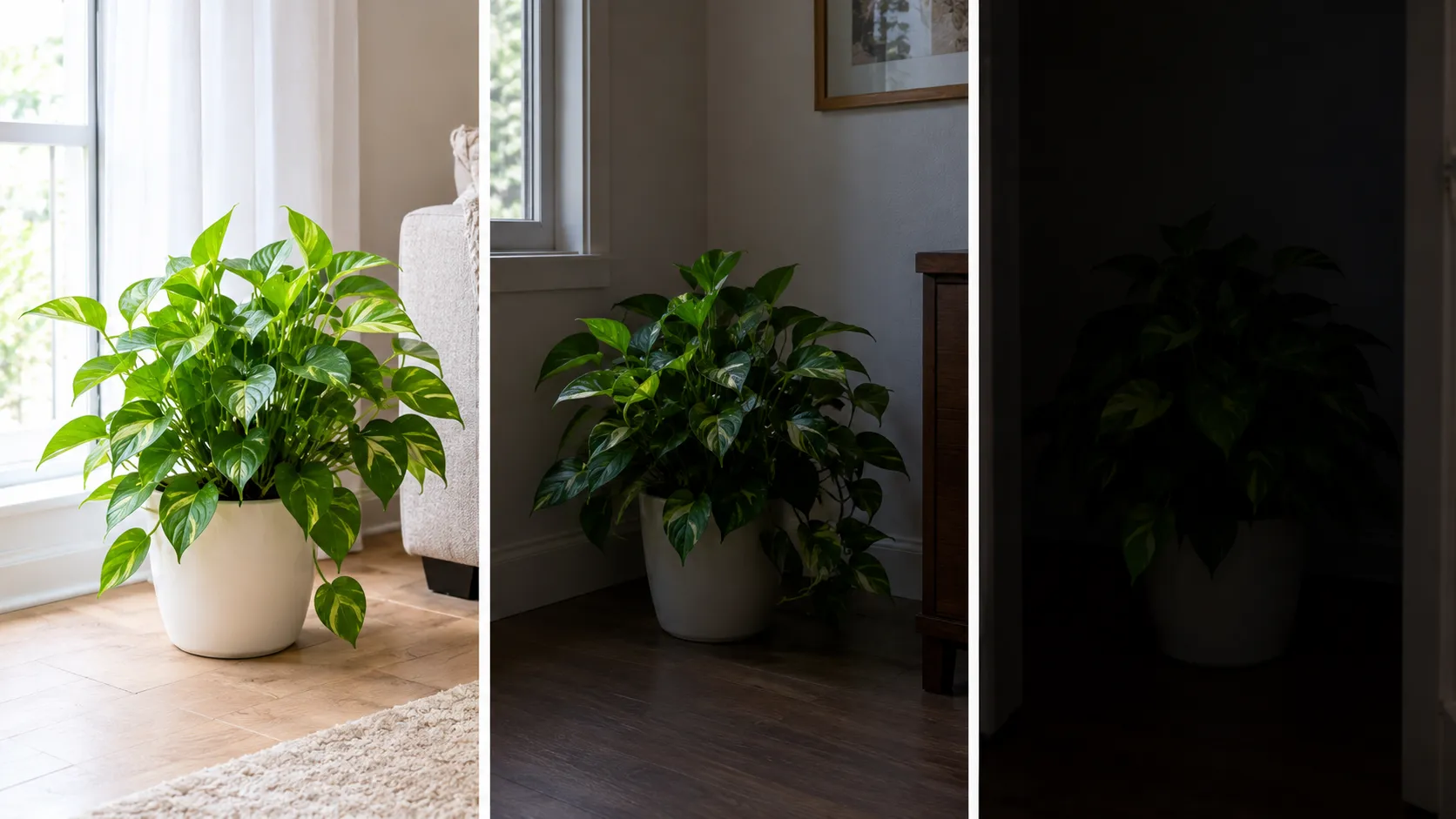
The important distinction: Low light is a difficult growing condition. Zero usable light is not a growing condition.
Which indoor plants are best for dark rooms?
The best candidates for dark rooms are resilient foliage plants such as snake plant, ZZ plant, cast iron plant, pothos, and Chinese evergreen. They tolerate lower light better than many houseplants, but they still need usable light to remain healthy over time.
For readers searching for the best indoor plants for dark rooms, these five are useful starting points because they give different shapes, sizes, and care profiles rather than offering another giant list of nearly identical plants.
Snake plant
Snake plant is one of the strongest choices for a dim indoor location. Illinois Extension lists it among low-light houseplants. Its upright shape also works well when floor space is limited.
Choose it when the goal is a tall, architectural plant that does not need to sit beside a bright window.
One catch: its ability to tolerate low light does not mean it can thrive in a completely dark room.
ZZ plant
ZZ plant is another strong option for low-light environments. Illinois Extension’s January 2026 guidance describes it as tolerant of low light while noting that it grows better in brighter indirect light.
It is especially useful for people who tend to overwater.
In a dim room, that matters. A slow-growing plant may not use water as quickly as someone expects from a weekly routine.
Cast iron plant
Cast iron plant, Aspidistra, is one of the better choices for difficult indoor positions because it tolerates low-light conditions and some neglect. RHS describes it as an easy-care houseplant suitable for low light.
It is not the choice for rapid growth.
It is the choice for resilience.
Pothos
Pothos is adaptable and commonly recommended for low-light rooms. It can be a good choice for shelves, offices, and spaces where a trailing habit is useful.
But don’t confuse adaptability with a complete lack of light requirements.
Pothos is one of the more common house plants that don’t need sun in online searches, but the useful interpretation is that it tolerates limited light.
Chinese evergreen
Chinese evergreen, or Aglaonema, is another solid option for dim interiors. Proven Winners specifically includes Chinese evergreen among low-light houseplants and notes that it can work with artificial lighting.
That makes it especially relevant for apartments, offices, and windowless rooms.
What about variegated plants?
This is where a lot of low-light plant lists oversimplify the issue.
White areas of variegated leaves contain less chlorophyll. RHS notes that variegated plants often need brighter conditions to maintain strong growth and their coloration.
So if two plants are equally attractive, the greener form can be the safer choice for a very dark room.
A heavily variegated pothos is not automatically a better dark-room choice just because another pothos handles low light well.
Which plant should you choose?
| Need | Best starting choice |
| Tall, upright plant | Snake plant |
| Low-light room and forgiving watering habits | ZZ plant |
| Tough foliage for an awkward corner | Cast iron plant |
| Trailing plant for shelf or office | Pothos |
| Bushier foliage for artificial-light rooms | Chinese evergreen |
These are low-light candidates, not zero-light plants.
For large indoor plants that don t need sunlight, the strongest practical strategy is to choose a mature specimen from one of these tolerant groups and give it suitable artificial light rather than searching for a supposedly light-free species.
For small indoor plants that don t need sunlight or small plants that don t need sunlight, the same principle applies. Small size changes the space requirement, not the plant’s biological need for light.
Can plants survive in a windowless bathroom?
Yes, some plants can be maintained in a windowless bathroom when appropriate artificial light replaces the missing daylight. Humidity can suit many houseplants, but high humidity does not compensate for inadequate light.
This is the exact scenario behind searches for plants that can survive without sunlight in bathroom.
The bathroom itself isn’t the problem.
The light is.
RHS recommends artificial lighting for plants in windowless environments and explains that domestic lighting may not provide sufficient intensity for healthy plant growth.
That leads to an important rule:
A humid bathroom can solve a humidity problem. It cannot solve a light problem.
Dark and humid is different from dark and dry
Humidity can benefit many tropical houseplants, particularly where household air is otherwise dry.
But choosing a plant because it likes humidity does not make a dark bathroom suitable for it.
This is why a fern might look like an obvious bathroom plant and still perform poorly in a windowless bathroom if the lighting is inadequate.
The 30-day bathroom test
No verified 30-day test results are available for this article, so the results should not be invented.
The useful alternative is a repeatable protocol.
Test these five plants:
- Snake plant
- ZZ plant
- Cast iron plant
- Pothos
- Chinese evergreen
Then keep the experimental conditions as consistent as possible.
- Photograph each plant before the test.
- Record the lighting setup and bulb specifications.
- Keep plant positions fixed whenever practical.
- Record watering dates and soil condition.
- Photograph each plant weekly from a similar angle.
- Record new growth, leaf loss, stretching, and color changes.
- Compare the final condition with the baseline.
The test should define “survival” before it begins.
A plant that stays green but produces no healthy new growth tells a different story from a plant that continues producing new leaves.
The test should also record the actual lighting environment. A bulb being labeled “LED” does not tell you whether the plant receives enough useful light.
How to make the test useful
Do not change the bulb halfway through.
Do not move the plants next to a window for a recovery period.
Do not give one plant dramatically different watering.
And don’t use the result to claim that one plant universally survives all windowless bathrooms.
The experiment would answer a narrower and more defensible question:
How did these five plants perform under this specific artificial-light setup in this specific bathroom?
That makes the result useful rather than theatrical.
What kind of artificial light do indoor plants need?
A useful plant-light setup depends on light intensity, placement, duration, and the plant being grown. An ordinary LED bulb should not automatically be treated as a grow light. For a windowless room, dedicated horticultural lighting is the more reliable approach.
This is where many indoor plants for home without sunlight guides become too vague.
Saying “use artificial light” is only half the advice.
The source needs to provide enough useful light to the foliage, and the plant needs to receive it consistently.
RHS recommends specialist horticultural lighting where natural light is inadequate and discusses LED lighting as one option. It also emphasizes that light intensity reaching the plant matters, not merely whether a bulb is switched on.
Don’t choose a bulb from color temperature alone
A common shortcut is to say:
Buy a 5000K bulb.
That can sound precise, but color temperature alone does not establish whether the plant is receiving enough light.
The more useful questions are:
- How much light reaches the leaves?
- How far is the light from the plant?
- How long is it operated?
- Does the light cover the whole plant?
- Is the source intended for plant growth?
A plant can sit beneath a bright-looking household fixture and still receive inadequate growing light.
The practical setup
For a dark room, use a dedicated plant light when ordinary room lighting is insufficient.
Place the light according to the manufacturer’s guidance, keep the coverage consistent, and monitor the plant rather than assuming the setup is correct because the foliage looks illuminated.
If several plants are grouped together, make sure the plants at the edges receive meaningful light too. A bright central spot can leave the outside leaves in a much darker zone.
What about offices?
Office lighting deserves its own mention because a room can look bright to people while still being a poor growing environment.
Human vision adapts extremely well to indoor lighting.
Plants don’t measure brightness the same way people do.
An office without windows should therefore be treated like another artificial-light environment. If the goal is long-term plant health, select a tolerant plant and establish consistent supplemental lighting rather than relying on ceiling fixtures by default.
How long can indoor plants go without sunlight?
There is no universal number of days that tells you how long an indoor plant can survive without sunlight. Survival depends on the species, its condition, the amount of usable artificial light available, and whether the darkness is temporary or continuous.
This answers the PAA How long can plants survive without sunlight more honestly than a made-up timeline.
A plant being transported through a dark room is not the same as living for months in a windowless office.
A low-light plant can tolerate reduced light.
That does not mean it stops needing light.
Watch the trend rather than waiting for a dramatic collapse.
A plant can show warning signs before it dies.
Those signs may include weak growth, stretching, poor color, reduced new growth, and leaf loss. RHS identifies weak, pale, or spindly growth as signs that light may be too low.
So when someone asks How long do indoor plants go without sunlight?, the better answer is not a fixed number.
It is:
Until the amount and duration of usable light become insufficient for the plant’s ongoing needs.
That is why long-term placement matters more than a short dark period.
How should you care for indoor plants in very low light?
Low-light plants are easiest to maintain when watering, lighting, and placement are treated as one system. Use a plant suited to the room, provide consistent usable light, and check the growing medium before watering instead of following a fixed calendar.
The biggest mistake is often extra water
Most people see a struggling plant and reach for the watering can.
That can make the situation worse.
When growth slows, water demand can change. A plant in a dim room may not dry at the same rate as the same plant growing in brighter conditions.
So the answer is not:
Water every 3–4 weeks.
It is:
Check the plant and growing medium, then water according to the plant’s needs and the conditions around it.
There is no universal low-light watering schedule that works for every pot and species.
What should you do when a plant starts failing?
- Check the light.
- Check the recent growth pattern.
- Check soil moisture before watering.
- Improve the light if it is inadequate.
- Monitor the plant for continued change.
The mistake to avoid is changing everything at once.
If the plant has weak growth, more water may not solve the underlying problem.
Better light is the first variable worth investigating when light is clearly inadequate.
What should “healthy” look like?
Don’t measure success only by leaf survival.
A plant that holds onto old leaves but stops producing useful new growth may be surviving rather than performing well.
A healthier sign is continued, appropriate new growth without progressive decline.
That is especially useful for plants that don’t need a lot of light because low-light tolerance often gets mistaken for an ability to remain unchanged forever.
How can you tell if an indoor plant is getting too little light?
Common signs of insufficient light include stretched growth, leaning toward the available light, weak or sparse new growth, pale foliage, and ongoing leaf loss. These signs can overlap with other problems, so they should be interpreted alongside watering, roots, pests, and recent changes.
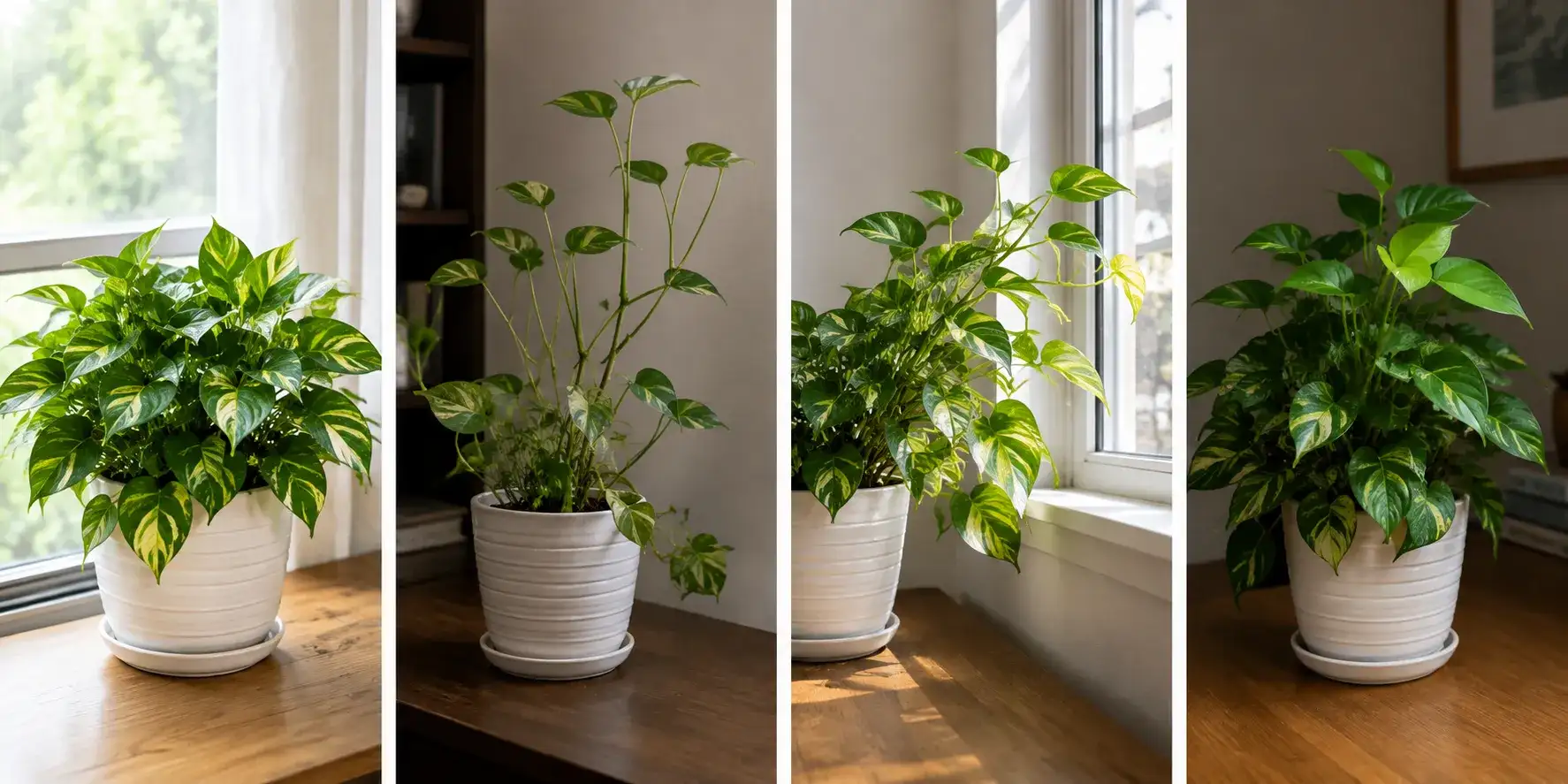
Stretched or leggy growth
When stems become unusually elongated as the plant reaches for light, the plant is telling you something useful.
RHS lists weak, pale, or spindly growth among the signs associated with inadequate light.
Leaning toward the light source
A plant can reveal the strongest available light simply by growing toward it.
This is especially noticeable with a plant beside a single lamp or window.
Weak new growth
Look at what the plant is producing now rather than judging only older leaves.
New growth is often more useful for evaluating whether current conditions are working.
Loss of variegation
Variegated plants may become greener when light is too low. RHS notes that reversion toward green can occur when light levels are insufficient and explains why white-variegated areas contain less chlorophyll.
That makes heavily variegated plants a less forgiving option for very dark rooms.
Are low-light plants safe for homes with cats and dogs?
Not all popular low-light houseplants are pet-safe. Snake plant, pothos, and several other common houseplants are listed as toxic to cats and dogs by the ASPCA, so plant selection should consider both lighting and household pets.
ASPCA lists snake plant as toxic to dogs and cats. It also lists golden pothos as toxic to dogs and cats, with insoluble calcium oxalates identified as the toxic principle.
ASPCA also includes Chinese evergreen among plants containing insoluble calcium oxalates.
This doesn’t mean these plants should never be grown indoors.
It means a household with curious pets should not choose a plant solely because it performs well in low light.
For pet owners, lighting suitability and toxicity suitability are separate filters.
That is particularly important when searching for best indoor plants for dark rooms, because the most commonly recommended plants are not automatically the safest choices for every home.
What about plants that grow without sunlight outdoors?
The phrase plants that grow without sunlight outdoor needs a correction.
Outdoor shade is not the same as darkness.
A plant growing beneath trees, beside a wall, or in deep shade may receive much less direct sun than a plant in an open field, but it still receives ambient light.
So 100% shade should not automatically be interpreted as 0% light.
That is why outdoor shade plants and indoor plants for completely windowless rooms should not be treated as the same category.
The principle is simple:
Shade reduces light. Darkness removes it.
Can indoor plants grow without sunlight?
Yes, indoor plants can grow without natural sunlight when artificial light provides the usable light required for photosynthesis. The important distinction is that the plant is growing without sunlight, not without light.
That is how indoor plants survive without sunlight in offices, windowless rooms, and other artificial-light environments.
The same explanation answers how do indoor plants grow without sunlight and how do house plants survive without sunlight.
They don’t replace photosynthesis with another process.
They replace the natural light source with an artificial one.
This is also why saying that a particular indoor plants no sunlight setup works is incomplete unless the artificial-light conditions are described.
Which indoor plants can survive without sunlight?
Snake plant, ZZ plant, cast iron plant, pothos, and Chinese evergreen are among the better-known low-light candidates, but none should be described as needing zero light. In a windowless room, their long-term performance depends on the artificial light available and the conditions around the plant.
For a practical shortlist:
Choose snake plant for upright form and strong tolerance of dim interiors.
Choose ZZ plant when forgiving care matters.
Choose cast iron plant for a difficult low-light corner.
Choose pothos when a trailing plant works better for the room.
Choose Chinese evergreen when a fuller foliage plant suits the space.
This is more useful than a generic list of 25 plants because it tells the reader what each option is actually good for.
It also avoids pretending that plants that require no sunlight are a real biological category.
They are not.
They are low-light plants being used in places where natural sunlight is limited or absent.
Final answer: can a plant really live in a room with no windows?
Yes. A room with no windows can support some indoor plants when it provides suitable artificial light. A room with no windows and no usable light cannot support normal long-term growth from ordinary green houseplants.
That is the answer behind almost every variation of this search:
The best strategy is to stop shopping for a plant that supposedly needs “zero sunlight” and start matching the plant to the actual light in the room.
For a dim room, choose a low-light tolerant plant.
For a windowless room, add appropriate artificial light.
For a dark bathroom, remember that humidity does not replace light.
For a pet household, check toxicity before bringing a plant home.
And for anyone who wants real evidence instead of another recycled plant list, run the 30-day bathroom protocol and publish the measured results rather than inventing them.
That’s the difference between plants that don’t need sun as a search phrase and a plant setup that actually works.