
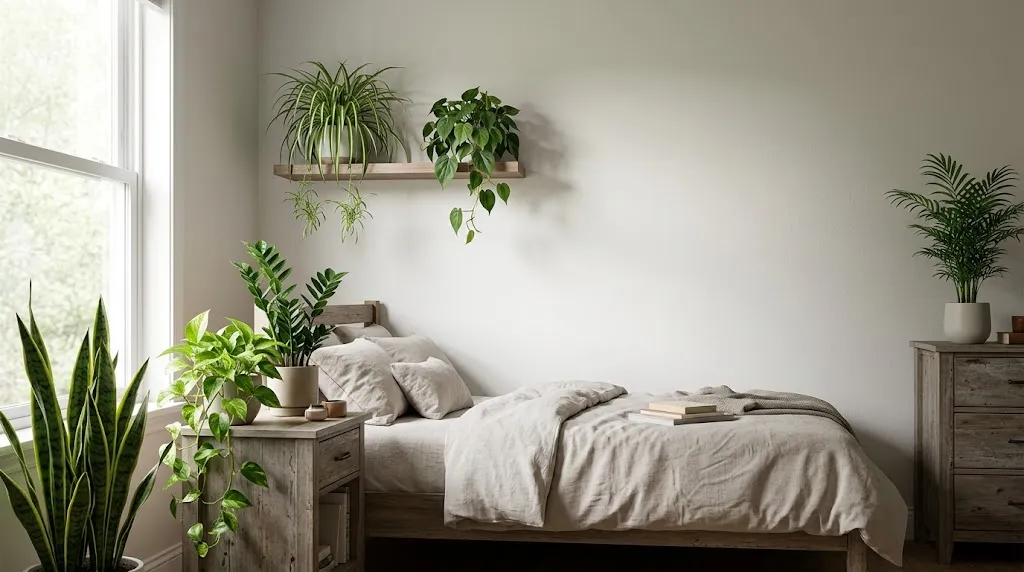
Best Plants for the Bedroom: Low-Light Picks for a Sleep-Friendly Space
A bedroom can be one of the hardest rooms in the home to choose plants for. Light may be weak, floor space may be tight, and anything beside the bed becomes part of the sleep environment.
So what are the best plants for the bedroom indoors? The best choices match the room’s real light, fit the available space, and avoid problems with pets, strong fragrance, or unrealistic air-quality claims.
And what about the old fear that plants steal oxygen while you sleep? Ordinary houseplants don’t make a normal bedroom unsafe. Overnight bedroom CO₂ is shaped far more by human occupancy and ventilation than by a few potted plants.
What makes the best plants for the bedroom a good choice?
The best bedroom plants are not simply plants marketed for “air purification” or better sleep. Choose plants that match the room’s actual light, fit the available space, create little disruption near the bed, and account for pets, fragrance, and maintenance demands.
Which factors matter most when choosing a bedroom plant?
Start with light. A bedroom that looks bright to human eyes can still provide weak usable light for a plant, especially when it sits several feet from the window. Limited indoor light can cause plants to stretch toward it. In contrast, pothos, philodendrons, and snake plants are generally more tolerant of lower-light indoor locations than many high-light plants.
Then look at placement. A compact plant works differently on a nightstand than a tall plant in a floor corner. A trailing plant can soften a shelf, while an upright plant can use vertical space without spreading across the room.
People choosing plants for dim bedrooms generally do better when they match the plant to the light available at its actual position, because a low-light label does not mean a plant can thrive in darkness.
That sounds obvious. It gets missed constantly.
Size, scent, pet access, and visual density matter after light. Use those factors to decide which ordinary indoor plants become genuinely bedroom-friendly choices.
Should helps you sleep be treated as a plant-selection criterion?
Not by itself. A sleep-friendly environment is a better standard than a magical sleep-improving plant.
Research published in Frontiers in Psychology in 2025 found that adults rated domestic interiors with greenery as more restorative and associated them with more positive affect. That supports a reasonable well-being and environment angle, not a claim that a specific houseplant treats insomnia.
For readers interested in plants to keep in bedroom for positive energy, there is a separate cultural layer. Feng Shui traditions may favor particular plants for symbolism, growth, luck, or balance. These are cultural preferences, not measurable plant traits, so treat them as such.
Takeaway: Choose bedroom plants first for the room they actually have to live in. Sleep and atmosphere come after that.
Which plants are best for a low-light bedroom?
For a low-light bedroom, the strongest shortlist starts with tolerant foliage plants rather than sun-loving herbs or flowering species. Snake plant, ZZ plant, pothos, spider plant, heartleaf philodendron, and parlor palm offer different shapes and placement options, while brighter rooms can support more demanding aromatic choices.
| Plant | Bedroom fit | Low-light suitability | Best placement type | Sleep-environment angle | Pet note |
| Snake plant | Excellent | Tolerates low light | Nightstand or floor | Upright and visually quiet | Toxic to cats and dogs |
| ZZ plant | Excellent | Tolerates low light | Dresser or floor | Structured, low-disruption form | Verify species-specific pet guidance |
| Pothos | Excellent | Tolerates lower indoor light | Shelf or dresser | Soft trailing foliage | Toxic to cats and dogs |
| Spider plant | Very good | Moderate indoor light tolerance | Shelf or nightstand | Pet-friendlier option | Non-toxic to cats and dogs |
| Heartleaf philodendron | Very good | Tolerates lower indoor light | Shelf or dresser | Soft trailing shape | Verify species-specific pet guidance |
| Parlor palm | Very good | Tolerates lower indoor light | Floor corner | Softer, calmer silhouette | Non-toxic to cats and dogs |
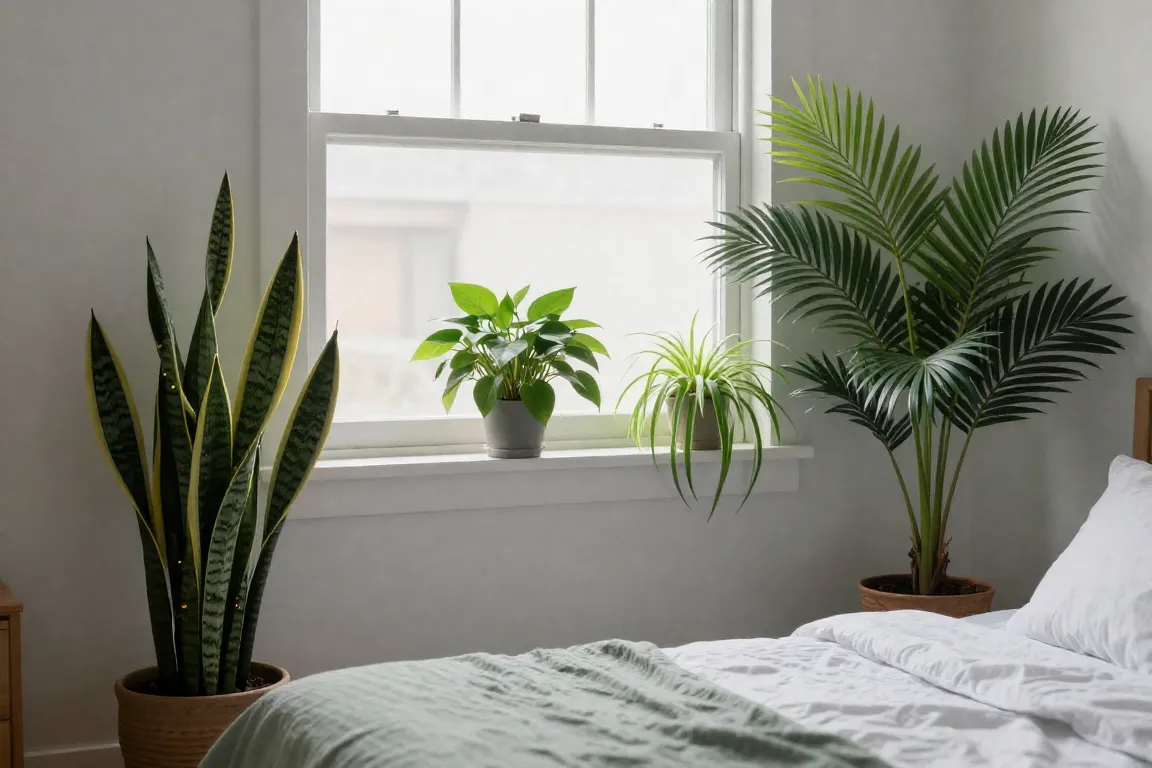
Snake plant best for the darkest practical bedroom
Snake plants are among the more tolerant choices for dim indoor locations, but “low-light tolerant” does not mean “no light required.” A dim bedroom may keep a snake plant going while still providing too little usable light for strong, active growth.
The common name snake plant now usually refers to Dracaena trifasciata. Older sources often use Sansevieria trifasciata, so that you may see both names in research.
For pet owners, this otherwise useful bedroom plant has a catch. ASPCA lists snake plant as toxic to cats and dogs and identifies saponins as the toxic principle.
ZZ plant best for a low-light bedroom look
The ZZ plant, Zamioculcas zamiifolia, is a practical choice for bedrooms where appearance matters but bright natural light isn’t available. University of Minnesota Extension describes it as a houseplant that tolerates dry conditions, which helps explain why it is often considered more forgiving than many thirstier indoor plants.
Its upright stems and glossy leaflets make it especially useful beside a dresser or in a floor corner. It looks deliberate without demanding much visual space.
Pothos best trailing option
Pothos, Epipremnum aureum, earns its place because it works in spaces where a floor plant doesn’t. A shelf, dresser, or hanging spot gives the vines room to trail without taking over walking space.
Pothos is commonly regarded as tolerant of lower-light indoor conditions, making it a practical option for shelves and dressers set away from the brightest windows.
For pet owners, though, pothos isn’t the carefree choice it seems. ASPCA lists golden pothos as toxic to cats and dogs because of insoluble calcium oxalates.
Spider plant best pet-friendlier shortlist option
Spider plant, Chlorophytum comosum, is one of the easiest choices to justify for a bedroom where pets may have access to the foliage. ASPCA lists it as non-toxic to cats and dogs.
Its arching leaves make it especially useful on a shelf or nightstand where a softer shape works better than an upright plant.
Heartleaf philodendron best for softer foliage
Heartleaf philodendron, Philodendron hederaceum, suits the same visual role as pothos. Its trailing form works well on shelves and elevated planters, and it commonly grows well in lower-light indoor spots. That makes it a good bedroom candidate when light is limited.
This isn’t the place to turn that recommendation into a care manual. The useful question here is simply whether the plant’s form and light tolerance match the bedroom.
Parlor palm best for a softer floor-corner effect
Parlor palm, Chamaedorea elegans, brings a taller, softer silhouette without the scale of a true large palm. It works best when a bedroom needs height in a floor corner rather than another small plant clustered around the bed.
ASPCA lists parlor palm as non-toxic to dogs and cats.
Takeaway: The best low-light plants for the bedroom aren’t the ones with the most dramatic claims. They are the ones whose light tolerance, size, shape, and practical limits actually fit the room.
Do bedroom plants really steal oxygen at night?
No. Plants respire at night and release carbon dioxide, but ordinary houseplants do not make a normal bedroom oxygen-depleted. Humans are a major source of overnight CO₂, while ventilation controls how much accumulates.
What actually happens to a plant after the lights go out?
Photosynthesis needs light. Once usable light disappears, photosynthetic carbon fixation stops, but cellular respiration continues.
That means plants still use oxygen and release carbon dioxide at night. Some plants use CAM photosynthesis, a specialized strategy that changes when they exchange gases. That physiological difference does not mean an ordinary bedroom plant should be treated as a meaningful overnight oxygen source.
The phrase plants for bedroom oxygen is therefore a poor way to choose a plant. A plant’s nighttime gas exchange is real, but scale matters.
What would an overnight bedroom CO₂ measurement actually tell us?
A useful overnight test would compare real bedroom CO₂ under controlled conditions rather than simply placing a meter beside a plant and watching the number change.
- Measure baseline CO₂ before the test begins.
- Record overnight readings with normal bedroom occupancy.
- Repeat under comparable ventilation conditions.
- Compare plant-present and control conditions.
- Report the actual readings without inventing a “plant effect.”
- Interpret changes alongside room size, occupants, and ventilation.
A useful reference point comes from a 2021 Indoor Air study. Researchers estimated an average sleeping-person CO₂ emission rate of 11.0 ± 1.4 L/h per person. The authors said the result should be confirmed in other age groups and populations.
That gives the myth a much better frame. A bedroom’s overnight CO₂ budget is already being shaped by the person sleeping in it.
Here, a CO₂ monitor is better understood as an indicator of indoor occupancy and ventilation conditions, not a direct oxygen meter. Room volume, air exchange, doors, windows, and sensor placement can all affect the reading, which is why a plant-versus-no-plant test needs controlled conditions.
Does the NASA study prove bedroom air is cleaner with plants?
The assumption that NASA proved ordinary houseplants significantly purify normal bedroom air is wrong.
NASA’s well-known research, published in 1989, examined indoor plants’ ability to remove benzene, trichloroethylene, and formaldehyde from indoor air. The published experiment used sealed chambers over a 24-hour exposure period. That work is worth knowing, but it doesn’t prove that a few houseplants can replace ventilation or an air-cleaning system in a normal bedroom.
NASA’s technical record describes the project as a study of interior landscape plants for indoor air pollution abatement. Because the reported tests used sealed experimental chambers, those results should not be treated as proof that a few houseplants will clean the air of an ordinary occupied bedroom at the same rate.
So when a page claims that a houseplant is one of the best plants for bedroom to purify air, the smarter question is: under what conditions was that purification measured?
Takeaway: Plants do respire at night. That fact is real. The leap from that fact to “plants make bedrooms oxygen-poor” is not supported by the scale of normal bedroom conditions.
Do bedroom plants actually help you sleep better?
Bedroom plants may contribute to a calmer and more restorative-feeling environment, but they should not be presented as a proven treatment for poor sleep.
What benefits are reasonable to claim?
The strongest claim is environmental.
A 2025 Frontiers in Psychology study recruited 331 adults to evaluate digitally rendered domestic interiors, including bedrooms and living rooms, with different greenery conditions. After removing incomplete responses, the researchers analyzed 304 questionnaires. Rooms with greenery were perceived as more restorative and were associated with more positive affective qualities.
Rooms containing greenery were rated as more restorative and associated with more positive affect. That supports the idea that plants can change how a space is perceived. That supports a narrower claim: greenery can influence how people perceive and evaluate a domestic space. The study did not measure whether participants subsequently slept longer or slept better in those rooms. It does not prove that a snake plant beside the bed improves sleep duration or treats a sleep disorder.
A feasibility study published in Complementary Therapies in Medicine in 2024 examined indoor therapeutic horticulture among 30 people with sleep problems, with half also experiencing anxiety problems. Participants took part in horticultural activities over two weeks, so the findings should not be interpreted as proof that simply keeping a houseplant in a bedroom improves sleep.
The intervention involved horticultural activity, not simply placing a plant in a bedroom, so the findings shouldn’t be turned into a blanket claim about houseplants curing poor sleep.
That distinction matters.
What about lavender, jasmine, and other fragrant plants?
Fragrance is where bedroom advice often gets too enthusiastic. Lavender and jasmine are commonly mentioned in sleep-related plant recommendations, but that doesn’t automatically make them suitable for a dim bedroom. Light requirements still determine whether the plant fits the room.
A bright room can make those plants plausible choices. A dark room cannot.
For the best air purifying plants for the bedroom, the same caution applies. Air cleaning, pleasant fragrance, and sleep support are three different claims. Don’t bundle them just because the plants look attractive in a bedroom photo.
Takeaway: Greenery can make a bedroom feel more restorative. That is a useful benefit. Calling a plant a sleep treatment goes far beyond the evidence.
Which bedroom plants are better for pets, very dark rooms, or sensitive sleepers?
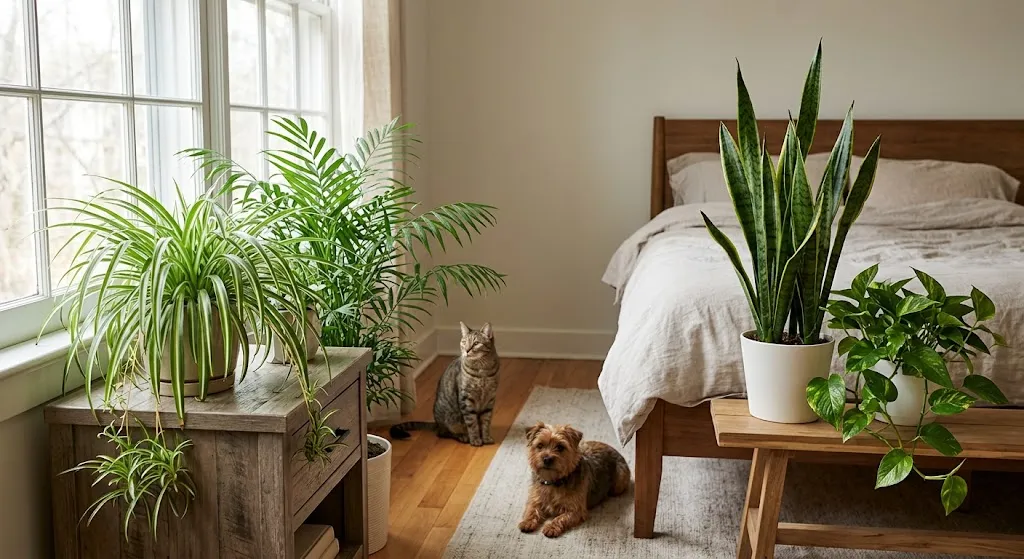
The best choice changes when the bedroom is shared with pets, has very little natural light, or places foliage close to the sleeper. Pet owners should verify species toxicity before buying. At the same time, a genuinely dark room may need a different solution rather than forcing a low-light-tolerant plant into conditions with almost no usable light.
Pet owners should verify plant toxicity before buying, while a genuinely dark room may need a different strategy rather than forcing a sun-loving plant into unsuitable conditions.
Best pet-friendlier choices
For pet households, spider plant and parlor palm stand out because ASPCA lists both as non-toxic to dogs and cats.
Snake plant and pothos sit on the other side of that decision. ASPCA lists both as toxic to cats and dogs. Pothos contains insoluble calcium oxalates, while snake plant contains saponins.
“Non-toxic” does not mean a plant should become a pet snack. The ASPCA explains that its non-toxic designation refers to the toxic hazard classification, but animals can still have problems after eating plant material.
What should you do when the bedroom is genuinely too dark?
There is a big difference between low light and no useful light.
A windowless bedroom, heavily shaded room, or plant placed far from its available light source may provide too little usable light for sustained healthy growth. “Low light” still means some usable light is available. It does not mean a plant can live indefinitely without light. Calling such a room “low light” can hide the real problem.
The same rule applies to the best small plants for the bedroom as it does to the best large plants for the bedroom or the best tall plants for the bedroom. Size changes the visual role, but it doesn’t erase the plant’s light requirement.
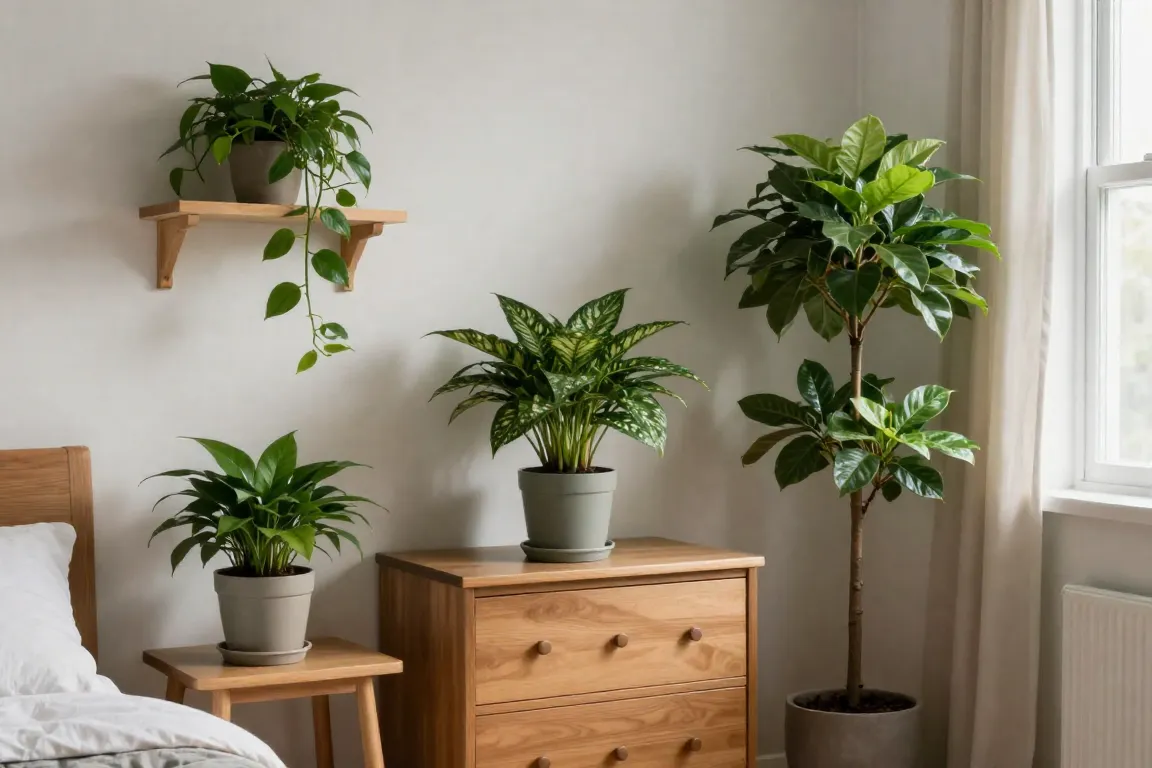
The same is true for best hanging plants for the bedroom. Hanging a plant farther from the window can turn a decent location into a poor one.
But how do you know whether your bedroom is actually low-light enough for these plants?