
How to Measure Light for Indoor Plants: Lux & PPFD
A room can look brilliantly bright to people but provide a plant with far less useful light than expected. How to Measure Light for Indoor Plants starts with one simple rule: measure at the foliage level, then choose the measurement that matches the decision you need to make. Lux can help compare locations. PPFD is more directly tied to the light reaching leaves for photosynthesis.
The tricky part is knowing what the number actually means. A phone reading, a lux-meter reading, and a PPFD reading aren’t interchangeable. And a larger number isn’t automatically better.
What do lux, PPFD, PAR, and PPF actually measure?
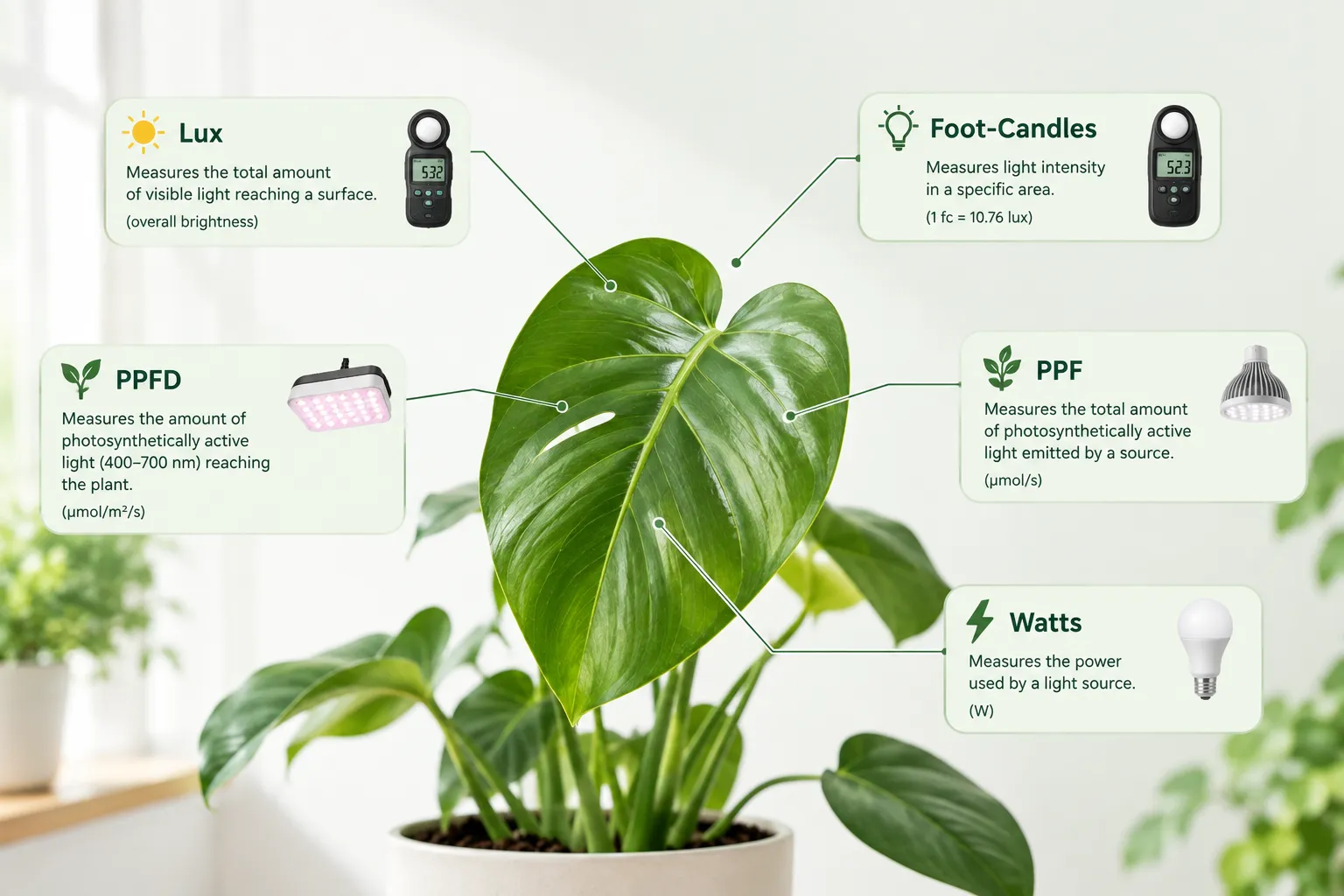
Lux measures illuminance, while PPFD measures photosynthetic photon flux density at a surface. PAR refers to the plant-relevant portion of light used in photosynthesis, while PPF describes the total photosynthetic photon output from a light source. These measurements answer different questions, so you shouldn’t treat them as interchangeable.
What is lux?
Lux is a unit of illuminance. It describes lumens falling on a square meter, so it tells you about light as measured through the human visual system rather than directly counting plant-useful photons. Iowa State Extension classifies lux and foot-candles as useful measurements, but says PPFD is more useful for assessing plant-light intensity.
Foot-candles measure the same general quantity but use a different area unit. NIST gives the conversion as 1 foot-candle = 10.764 lux in its 1997 Photometric Calibrations publication.
What is PPFD?
PPFD stands for photosynthetically active radiation flux density. It expresses the amount of photosynthetically relevant light reaching a surface in µmol/m²/s.
That makes PPFD especially useful for the question indoor growers actually care about: how much plant-relevant light reaches the leaves at the measurement point?
Iowa State Extension describes PPFD as the amount of PAR provided over a surface area. It identifies it as one of the most useful measurements for determining indoor plant light intensity.
What is PAR and why is it different from PPFD?
PAR means photosynthetically active radiation. It describes the portion of the light spectrum considered in standard photosynthetic light measurements.
PPFD is the quantity that tells you how densely those photons arrive at a surface. So PAR and PPFD are related, but they are not simply two names for the same measurement.
What is PPF?
PPF stands for photosynthetic photon flux. It describes the total photosynthetic photon output from a light source and is measured in µmol/s.
PPFD adds the area component. That’s why a fixture’s PPF rating doesn’t tell you exactly what a plant receives at its leaves. Distribution and placement still matter. Iowa State Extension gives the relationship between PPF, area, and PPFD when calculating supplemental lighting.
Takeaway: Lux describes illuminance, PPF describes total photon output, and PPFD describes photon density reaching a surface. For plant-light intensity, PPFD is usually the most directly useful of the three.
How to Measure Light for Indoor Plants (Lux & PPFD): Which measurement should you use?
Use PPFD when you want a plant-focused measure of light reaching the leaves. Use lux when you need a practical way to compare locations or when a PPFD measurement isn’t available. Don’t use wattage as a substitute for either because electrical power consumption doesn’t directly describe the light reaching the plant.
Which measurement is best for plant care?
The easiest way to choose is to ask what question the number needs to answer.
| Measurement | What it tells you | Best use | Main limitation |
| PPFD | Photosynthetic photon density at a surface | Measuring light reaching plant foliage | Needs a suitable PPFD measurement method |
| Lux | Illuminance | Comparing brightness between locations | Depends on human visual response |
| Foot-candles | Illuminance | Traditional light-level references | Same basic limitation as lux |
| PPF | Total photosynthetic photon output | Understanding fixture output | Doesn’t show distribution at the canopy |
| Watts | Electrical power use | Comparing energy consumption | Not a direct measure of plant-light intensity |
Iowa State Extension specifically states that watts aren’t a reliable indication of light intensity and that PPFD is a more useful measure for indoor supplemental lighting.
When is lux good enough?
Lux is useful when the goal is comparison rather than precise plant-light quantification.
For example, a grower deciding between 2 windowsill locations can use consistent lux readings to identify which spot is brighter. That can be more useful than guessing from sight alone.
The catch is that lux is tied to human visual response. Two light sources with different spectral characteristics can produce different lux readings even when their plant-useful photon output doesn’t change in the same way.
UF/IFAS uses foot-candles as a practical way to group indoor light levels. Still, it stresses that labels such as “low,” “medium,” “high,” and “bright indirect light” are general descriptions, not scientific categories.
When should you use a light meter for plants?
A dedicated light meter for plants is especially useful when the setup needs plant-focused measurement.
That is especially true with grow lights, shelves, multiple fixtures, or situations where the difference between an adequate reading and a marginal one matters. A quantum or PPFD meter is designed around the photon-based measurement rather than ordinary illuminance.
Apogee, for example, describes its quantum meters as PPFD instruments designed for measuring photosynthetic radiation from sources including LEDs and sunlight.
Why is wattage a poor substitute?
The assumption that a higher-wattage grow light automatically delivers more useful plant light is wrong.
Watts measure the fixture’s energy use. They don’t tell you how the emitted light is distributed or how much reaches the leaves. Iowa State Extension makes the same distinction between electrical power and light intensity.
That’s why comparing 2 fixtures by wattage alone can lead to a poor placement decision.
Takeaway: Choose the measurement that fits the question. Use watts for power, lux for illuminance comparisons, and PPFD when you want to measure plant-relevant light at the foliage.
How do you measure indoor plant light with a phone or lux meter?
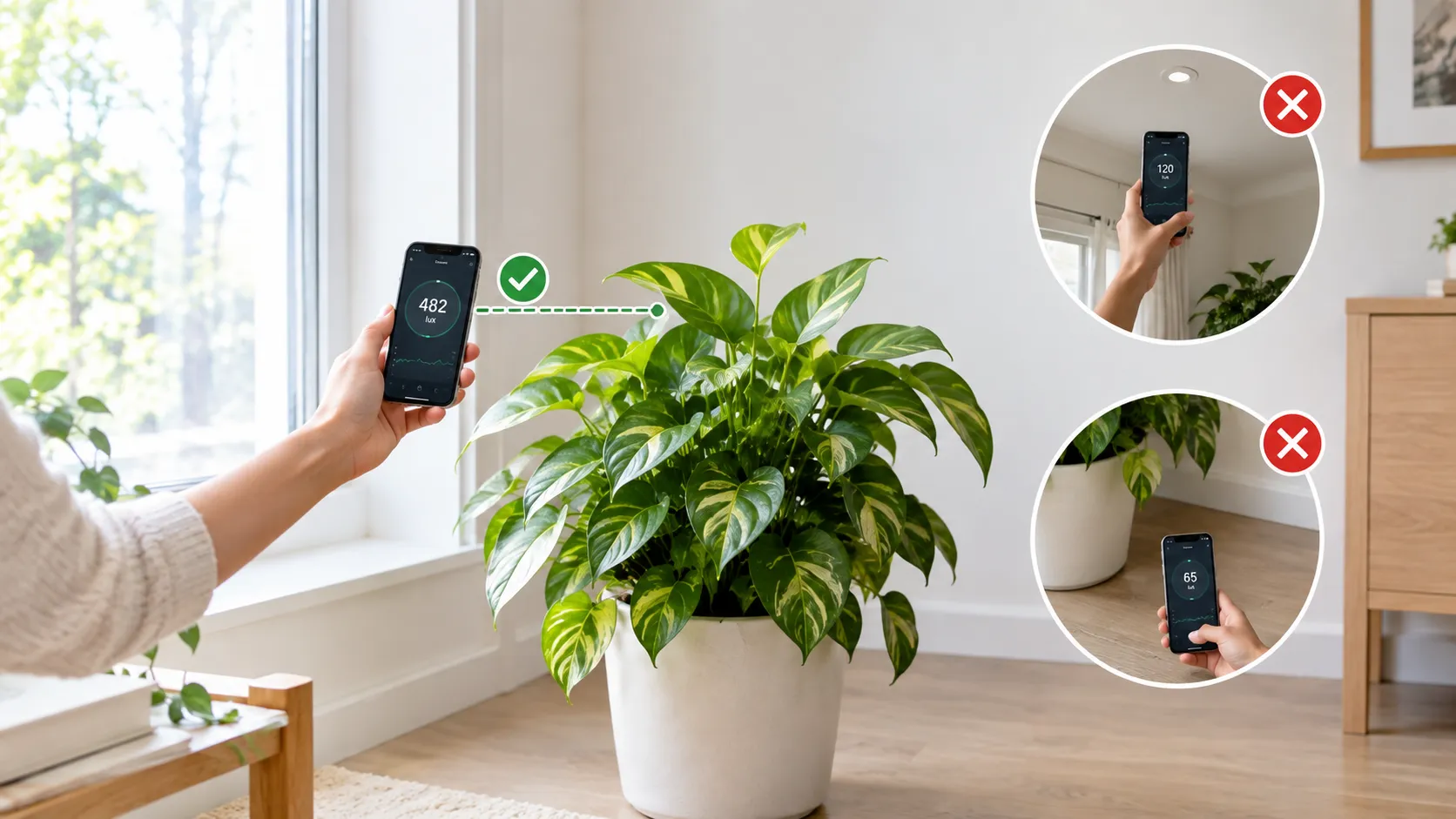
Place the sensor where the plant’s leaves receive light, keep its measurement setup consistent, and take readings at more than one position when coverage is uneven. Smartphone apps can provide useful plant-light measurements, but the method and calibration still matter.
How do you measure light step by step?
- Place the sensor at the plant’s foliage level.
- Orient the sensor consistently toward the incoming light.
- Identify the main light source.
- Measure the primary canopy position.
- Check another point near the canopy edge.
- Record the reading, time, unit, and location.
- Repeat later if changing daylight affects the space.
The biggest practical mistake is measuring the room instead of measuring the plant’s growing position. Iowa State Extension specifically recommends foliage-level measurement for the most accurate reading and advises adjusting the meter or app for the light source being measured.
Phone-based measurements can be useful for comparing changes in light levels, but accuracy varies by device and calculation method, so treat them as approximations.
Can a phone measure light accurately enough?
A smartphone can be useful for measuring plant light at home. Iowa State Extension says smartphone apps can measure lux, PPF, and PPFD and describes their accuracy as adequate for the typical home gardener. It also stresses correct settings or calibration for the type of light being measured.
Photone is one current example. Its official site says the app can measure PAR/PPFD, lux, foot-candles, and DLI using a smartphone, and it currently supports iPhone, iPad, and Android smartphones.
That doesn’t make every phone reading automatically precise. A phone app still depends on the device, the measurement method, and the light source being assessed.
How many readings should you take?
One reading can work for a small, evenly lit position.
A larger shelf is different. Measuring only the center can hide variation near the edges, especially when the light source is directional, or the plant sits farther from the fixture.
Users setting up plants on shelves or near large windows typically get more useful placement information from several canopy-level readings than from one bright-looking spot because indoor light changes with distance, angle, obstructions, and position under the source.
What measurement mistake causes the most confusion?
The sensor should represent the leaf plane being evaluated.
This is a small detail with a big effect on usefulness. A reading taken above the canopy can describe a different light environment from the one the lower leaves actually receive.
Takeaway: A repeatable measurement method is more useful than a perfect-looking number taken from the wrong place.
How do you measure PPFD, and can you convert lux to PPFD?
Measure PPFD directly with a suitable quantum or PPFD meter when you need a plant-focused reading. You can convert lux to an estimated PPFD, but the conversion depends on the light spectrum, so a universal lux-to-PPFD number doesn’t apply to every light source.
How do you measure PPFD directly?
Place the sensor at the foliage level and measure the light where the leaves actually sit.
For a single plant, one central reading may provide a useful starting point. For a shelf, panel, or wider growing area, several readings give a better picture of light distribution.
Iowa State Extension gives several approaches, including direct PPFD measurement, estimating PPFD from PPF and area, and converting lux or foot-candles with an appropriate conversion factor.
A PAR meter for indoor plants is therefore useful when the reader wants direct plant-light measurement instead of relying on illuminance.
How does lux-to-PPFD conversion work?
Lux and PPFD measure different properties of light, so the conversion depends on the light source’s spectral power distribution.
Waveform Lighting states that lux cannot be converted to PPFD absolutely accurately without the source’s SPD. Its calculator instead provides approximate conversions based on spectrum assumptions.
That matters with LEDs. A lux to ppfd full spectrum led calculator may give a different estimate from a calculator set for another spectrum because the relationship between illuminance and photon flux changes with spectral output.
The same issue explains why people searching for a lux to PPFD chart LED can find multiple conversion values online. The chart is only meaningful in the context of the light spectrum and conversion method.
What about 50,000, 25,000, and 20,000 lux?
Searches such as 50000 lux to ppfd, 25000 lux to ppfd, and 20000 lux to ppfd look like simple math problems, but they aren’t complete measurement questions.
Without knowing the spectrum, those lux values cannot produce one universally correct PPFD result. A calculator can provide an estimate when its spectral assumption is appropriate. For that reason, Waveform Lighting explicitly describes its conversion tool as approximate.
That is why a plant light requirements chart lux can be useful for reference, but it is not a substitute for measuring the actual plant position.
When should you stop converting and measure PPFD directly?
Here is the more useful rule: conversion is a convenience, not a measurement.
A conversion is fine when the reader needs a rough estimate and understands its limits. Direct PPFD measurement makes more sense when the setup depends on tighter measurement, especially with grow lights or different spectral outputs.
The goal isn’t to collect the most technical number. It’s to make a better plant-placement decision.
Takeaway: Converted PPFD is an estimate tied to the light source and conversion method. Direct PPFD measurement removes one important source of uncertainty.
How do you interpret a light reading for an indoor plant?
A light reading becomes useful only when matched to the plant’s needs and the amount of time that light is available. PPFD describes light intensity at a moment, while DLI combines intensity with duration to describe the plant’s accumulated daily light exposure.
Should you use a generic low, medium, or high light category?
Broad categories help organize a reading, but they shouldn’t replace plant-specific requirements. A plant light requirements chart in lux can provide a starting point, while placement, duration, and plant species determine whether that light level is suitable.
What do foot-candle readings mean for houseplants?
| Midday foot-candles | UF/IFAS light category | Typical light situation |
| 25–100 ft-c | Low | Very little natural light, often farther from windows |
| 100–500 ft-c | Medium | Near a window without direct sunlight |
| 500–1,000 ft-c | High | Bright areas that may receive softened or filtered direct light |
| Over 1,000 ft-c | Direct sunlight | Areas receiving direct sun through clear glass |
These ranges help interpret a meter reading, but they aren’t universal requirements for every houseplant. Window direction, outdoor shading, weather, season, and the plant’s exact position can all change how much light reaches the leaves.
What does DLI add to a PPFD reading?
PPFD tells you the light intensity reaching the measurement point. DLI puts that intensity into a daily time context.
Iowa State Extension’s 2023 guidance gives the formula:
DLI = PPFD × hours of light × 0.0036
The same source explains that DLI is measured in mol/m²/day and represents the amount of photosynthetic light delivered over a day.
That distinction matters. A plant receiving one PPFD level for a longer period has a different daily light exposure from a plant receiving the same intensity for a shorter period.
So the final interpretation should look like this:
Measure the light → identify the plant’s needs → account for duration → adjust the setup → measure again.
Consider light when choosing a houseplant, not only after a plant starts struggling. UF/IFAS recommends thinking about the available light first because indoor light can be difficult to change compared with factors such as watering or fertilization.
A useful reading isn’t the end of the process. It’s the point where the next decision becomes easier.