
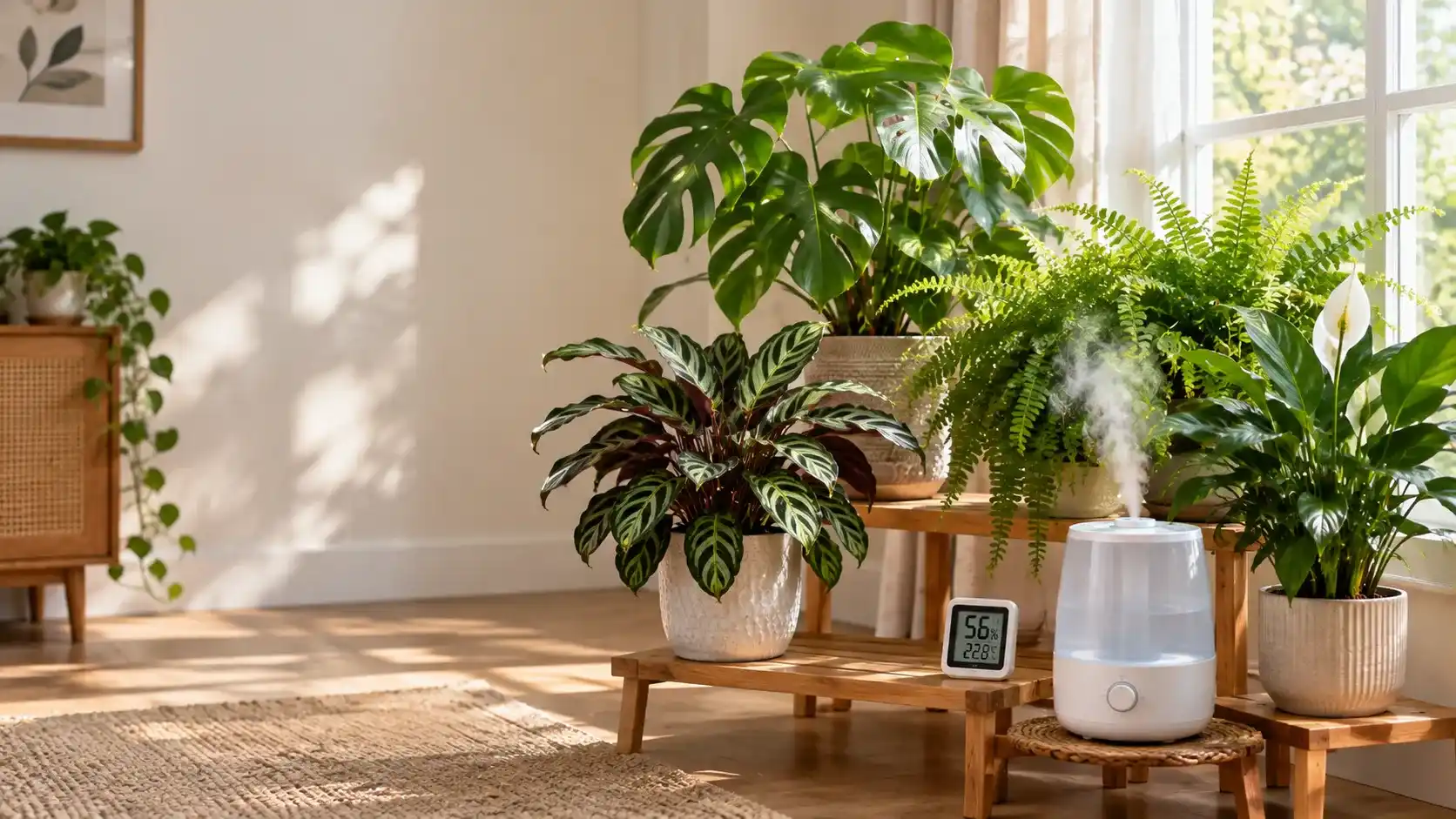
Do Indoor Plants Need Humidifiers? Pros, Cons, and What Happens at 3 and 6 Feet
Your calathea’s leaf edges crisp up every January. The heating runs all day, the room feels dry, and the plant looks worse each week. So do indoor plants need humidifiers?
Probably not, unless you’re growing a humidity-loving plant in a very dry room. Most houseplants cope with air that feels comfortable to you. A humidifier for houseplants helps a specific group, so you don’t need to buy one until you know your plant and your room. Below you’ll find who benefits, the real pros and cons, and how far a humidifier should sit from your plants.
Humidity for Indoor Plants: Complete Guide
Do indoor plants need humidifiers?
No, most indoor plants do not need a humidifier. Many tolerate normal home air, and if the humidity feels comfortable to you, most houseplants will cope. A humidifier mainly helps humidity-loving tropical plants in dry rooms, especially during winter heating, when indoor air can fall below 30% relative humidity.
Here’s the truth: for most plants, light and watering matter far more than humidity. Indoor humidity generally lands between 30% and 50%. HVAC dry air is the usual reason a heated home dips under that, because forced heating warms cold air without adding any water, so the relative humidity falls.
Plenty of guides claim every houseplant wants 60% humidity or more. That’s not accurate for most. It describes rainforest conditions, and plants sold as houseplants earned their spot partly because they tolerate ordinary home air.
If your room feels fine, fix light and watering before you spend money. The better takeaway is to solve the basics first, then add humidity only if the plant still needs it.
Which indoor plants benefit from a humidifier?
Humidity-loving tropical plants benefit most: ferns; prayer plants such as calathea and maranta; fittonia; alocasia; and bromeliads. Succulents, cacti, snake plants, and ZZ plants tolerate dry air and do not need one. Brown leaf tips can hint at dry air, but watering and salt build-up cause them too.
Rainforest natives show stress first. A hygrometer, a small gauge that reads relative humidity, tells you whether the air is the problem before you blame it. If you do need one, keep the thirsty plants together so a single small unit can serve them all. For a plant that sits between the two groups, see the peace lily care guide. If you grow tough, dry-tolerant plants, the snake plant care guide shows how little extra care they need.
Group by need, and one gadget does the work of three. The takeaway: keep thirsty plants together so the humidifier works where it matters most.
Is a humidifier good for indoor plants? Pros and cons
Yes, for the right plants in a dry room. A humidifier steadily raises moisture in the air, which helps tropical leaves stay lush, but it also adds upkeep and cost and can cause mold, mineral dust, or soggy conditions if the air stays too humid for the plant.
Pros
- Steady moisture. A running unit maintains humidity for hours, while misting fades in minutes.
- The right type. A cool mist humidifier for plants, either ultrasonic or evaporative, is the usual pick. Warm mist units run hot, so growers keep them farther from leaves.
- Visible results, with a catch. The plant humidifier benefits growers mention most are softer, less crispy new leaves on tropical plants. Solid testing is thin, so treat that as a pattern rather than a promise.
Cons
- Upkeep. Tanks need regular cleaning per the manufacturer’s instructions, because dirty ones can spray microorganisms into the air.
- White dust. Ultrasonic units can throw tap-water minerals onto leaves and furniture, which is why distilled water is commonly recommended.
- Mold risk. Readings above 60% are treated as mold territory, so more humidity isn’t always better.
- Cost and reach. You pay for electricity and filters, and the effect fades beyond a few feet.
A humidifier solves one problem and can create two. The takeaway: use it only when the plant needs it, and keep humidity in range.
How far should a humidifier be from your plants, and how much does humidity actually rise?
Keep the humidifier a few feet from your plants and check a hygrometer at leaf height. Humidity gain fades with distance, so readings at 3 feet and 6 feet can differ. Use a humidistat or timer instead of running it nonstop.
How to measure it in your own room
- Place a hygrometer at leaf height among your plants and note the baseline reading.
- Set the humidifier to a fixed output and switch it on.
- Record the reading 3 feet (about 0.9 m) from the unit after one hour.
- Move the hygrometer to 6 feet (about 1.8 m), let it settle, and record again.
- Repeat on another day with doors and windows closed.
Common mistake: reading the hygrometer beside the mist outlet, which overstates what your plants actually get.
Readings run highest near the mist outlet and drop steeply with distance. Humidity also slides back toward baseline soon after the unit stops, because room air keeps exchanging. Cheap hygrometers can drift, so check two side by side before trusting a single number.
Where to place it and how long to run it
Room humidifier vs plant humidifier comes down to reach. A compact unit with a 500 ml to 1 litre tank, the kind sold for plants, serves a shelf or a small group. A full-room humidifier covers more floor space, but its effect thins out the farther plants sit from the mist, which is why the readings above matter.
Growers in small, closed rooms with winter heating typically park a compact cool-mist unit within a few feet of a plant group to get a local bump, because the added moisture spreads into room air quickly.
Timing follows growth phase. During active growth, roughly March to September in the Northern Hemisphere, many homes need a humidifier far less. In slower winter growth, roughly October to February, heated air is the stronger reason to use one, so set it to stop below 60% rather than running nonstop.
So would a bigger room, or a different humidifier type, change the gap? That’s the next test worth running.
Humidifier vs misting vs pebble trays vs grouping: which works?
A humidifier is the only common method that clearly raises room humidity. Misting lifts humidity for only minutes, and pebble trays barely change it. Grouping plants helps a little, depending on room size and how many plants you have, so choose based on your plant count.
Most people get this wrong: misting is the most overrated fix in houseplant care.
- Humidifier: It raises humidity steadily, but it needs cleaning and a hygrometer to keep it in range.
- Misting: Humidity climbs, then evaporates within minutes. Air plants are the exception, since misting is an accepted way to water them.
- Pebble tray: The evaporated water spreads through the whole room, so the plant above barely notices.
- Grouping plants: Cheap and still widely recommended. The payoff depends on how many plants you have and how big the room is.
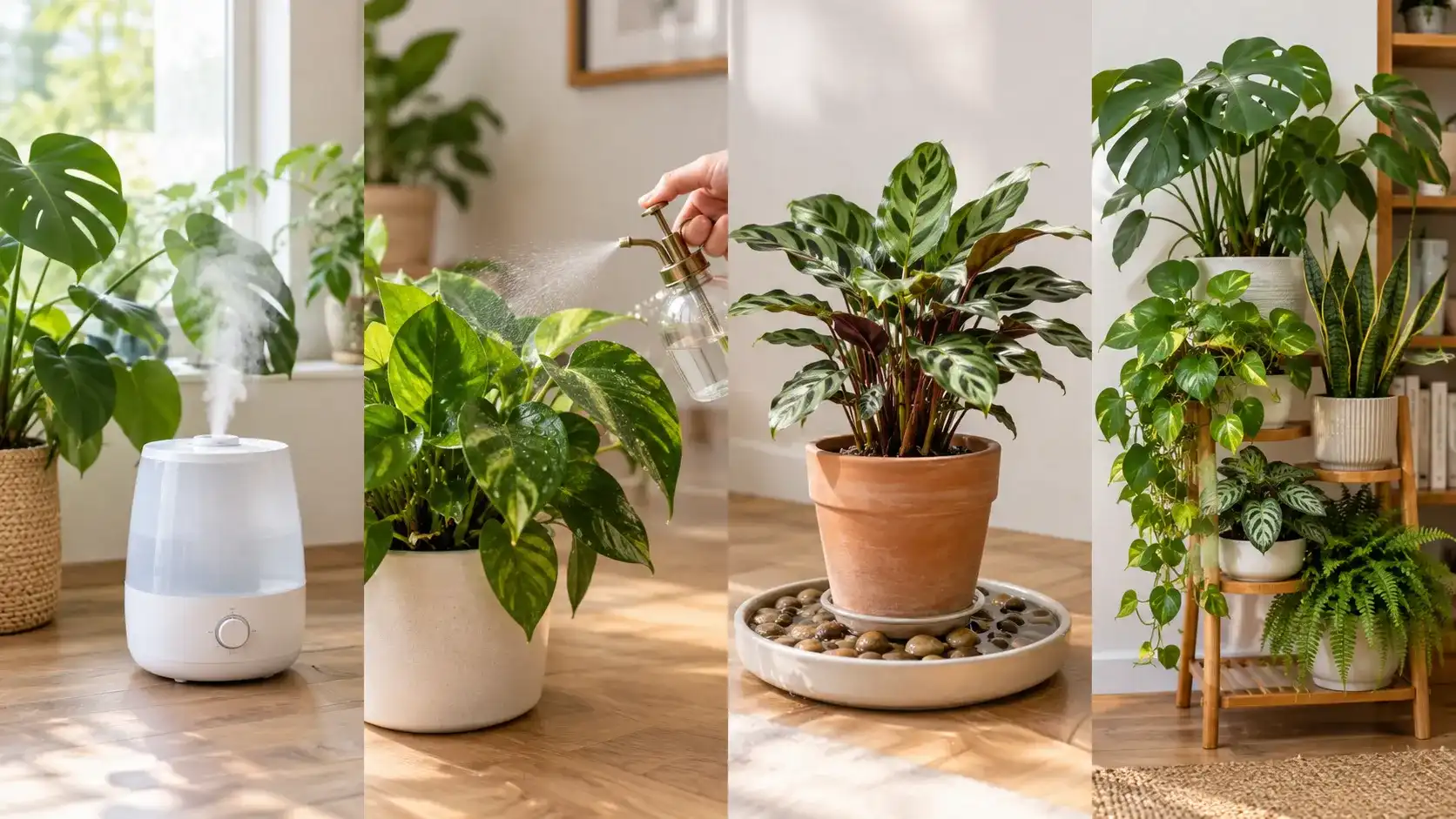
For the full how-to, see How to Increase Humidity for Indoor Plants.
Pick the method that matches your plant count, not the one that looks best on a shelf. The takeaway: choose the method that actually changes humidity enough for your plants.