
Ideal Humidity for Indoor Plants: Find the Right Range for Tropical and Desert Types
Your philodendron may look happiest beside a humidifier while a jade plant is perfectly comfortable in the same room. That difference is not always a watering problem. It can be a humidity problem.
So, what is the ideal humidity for indoor plants? For many common houseplants, a practical starting range is around 40–60% RH. Some dry-adapted plants tolerate much less, while certain humidity-sensitive tropicals benefit from roughly 70–80% under suitable conditions.
That does not mean your home needs to become a greenhouse. The smarter approach is to match the plant to its environment, monitor what is happening around the foliage, and adjust humidity only when the evidence says to.
What is the ideal humidity for indoor plants?
For most indoor plants, a practical target is about 40–60% relative humidity, but no single ideal level fits every species. Desert-adapted plants tolerate drier air, while humidity-sensitive tropicals often benefit from 60–80%. The right target depends on the plant, airflow, temperature, and leaf-zone conditions.
Relative humidity, or RH, tells you how much water vapor is in the air compared with how much moisture that air can hold at its current temperature. Warm air can hold more moisture than cool air, so RH is always a temperature-dependent measurement.
For many common houseplants, a useful starting point is around 40–60% RH. Many houseplants grow well around 50%, while some species need approximately 70–80%. These are working ranges, not universal survival lines.
The useful humidity level for houseplants becomes much easier to understand when you separate three ideas: tolerate, prefer, and need. Use those distinctions to keep the numbers in context.
A plant that tolerates dry air can remain reasonably healthy even when humidity is below its preferred conditions. A plant that prefers higher humidity may grow or look better when the air gets more moisture.
Most people get the number wrong before they get the plant right. A humidity percentage only matters once you know what the plant actually prefers.
Takeaway: Start with the plant’s workable range, then avoid chasing the highest RH your humidifier can produce.
How much humidity do tropical vs. desert houseplants need?
Tropical plants generally prefer more humid air because many evolved in moist forest environments, while desert and succulent plants are adapted to conserving water in dry air. Use habitat as a starting clue, not an exact prescription: many common tropical houseplants perform well around 40–60%, while some need higher humidity.
Tropical and arid plants begin with very different environmental backgrounds. Many tropical species grow in humid places where moisture is regularly available, while desert-adapted plants may face long dry periods.
Plants that are best adapted to high temperatures and low humidity grow in deserts and other arid habitats. Their water-conserving traits help explain why many cacti and succulents can cope with dry indoor air.
But native habitat does not give you a magic indoor percentage. Instead, use it as a clue to test against the plant’s actual response indoors.
A rainforest plant does not automatically need its room to reproduce rainforest conditions. Some tropical houseplants adapt surprisingly well to average household humidity. Others are much less forgiving when the air becomes very dry.
That’s why you should treat ideal tropical plant humidity as a target for a particular plant, not a universal number for every tropical species. Let habitat inform the starting point, then let the species decide the final target.
Philodendron humidity requirements are often summarized simply as “high.” The fuller picture is more useful. Philodendrons prefer high humidity, warm conditions, bright indirect light, and moist but well-drained soil, yet they usually can adapt to average household humidity.
Use those factors together when you look for the ideal temperature and humidity for tropical plants, because neither has one fixed answer. Temperature, humidity, light, soil moisture, and airflow interact, and the species still matters.
It also helps to compare humidity with precipitation. Rainfall describes how much water reaches a place over time. Relative humidity describes how much water vapor is present in the air at a particular temperature. They are related, but they are not the same measurement.
To identify plants that grow in hot deserts, look for traits such as thick, fleshy, waxy, or water-storing leaves. These traits are common among plants adapted to dry conditions.
What humidity range is typical for tropical houseplants?
Many tropical houseplants prefer moderate indoor humidity, while some humidity-sensitive species benefit from higher levels. Many common houseplants prefer around 40–60% RH, while some tropical species thrive around 70–80%. Find the exact preference for the species you own.
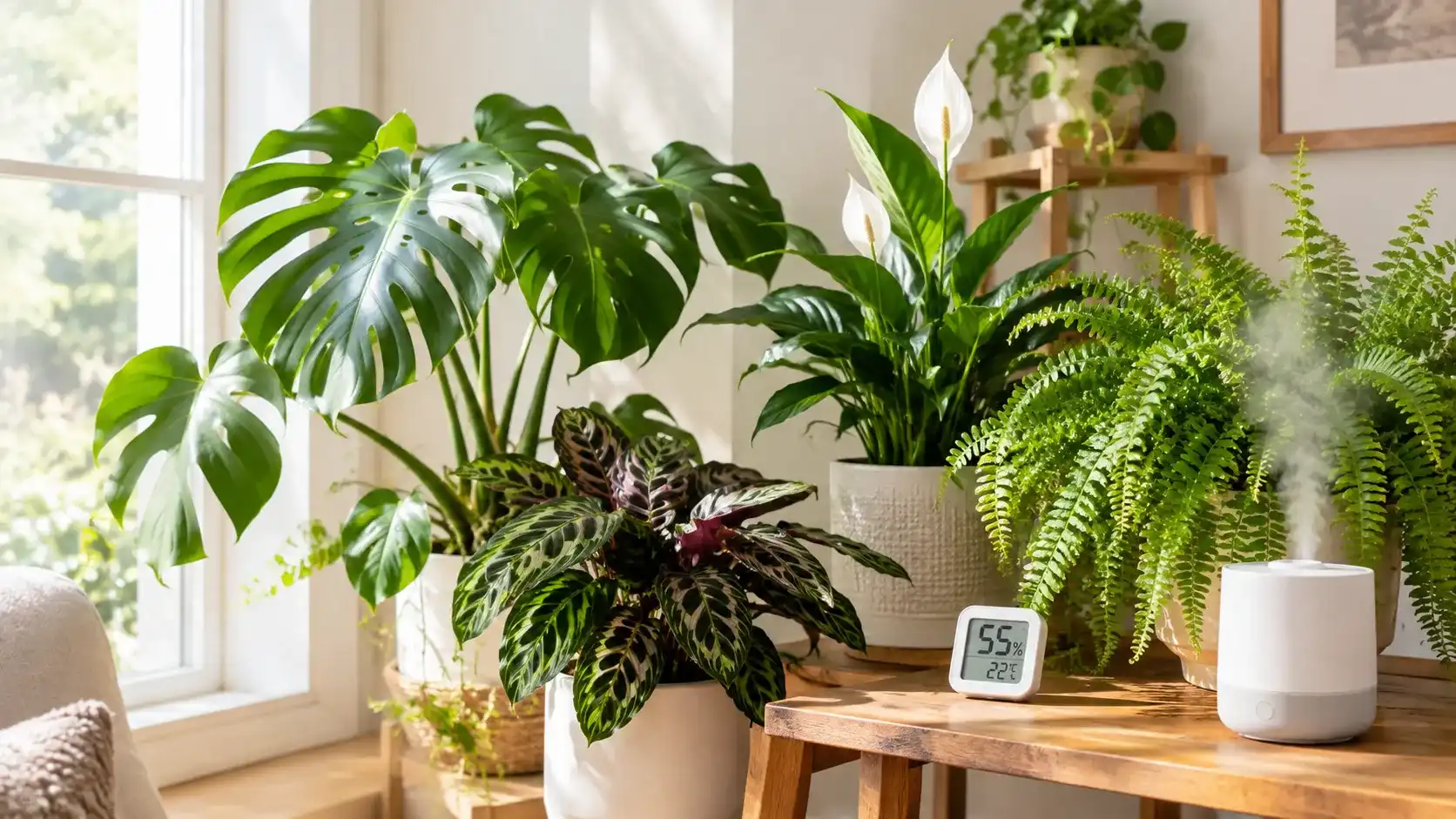
Examples include philodendrons, pothos, peace lilies, ferns, calatheas, marantas, anthuriums, alocasias, and orchids. Don’t treat them as one identical humidity group.
Pothos is a useful example of an adaptable tropical houseplant. A plant can appreciate extra humidity without making high humidity a strict requirement. Philodendrons show a similar pattern because they prefer high humidity but can adapt to average household conditions.
What humidity range suits desert and dry-adapted plants?
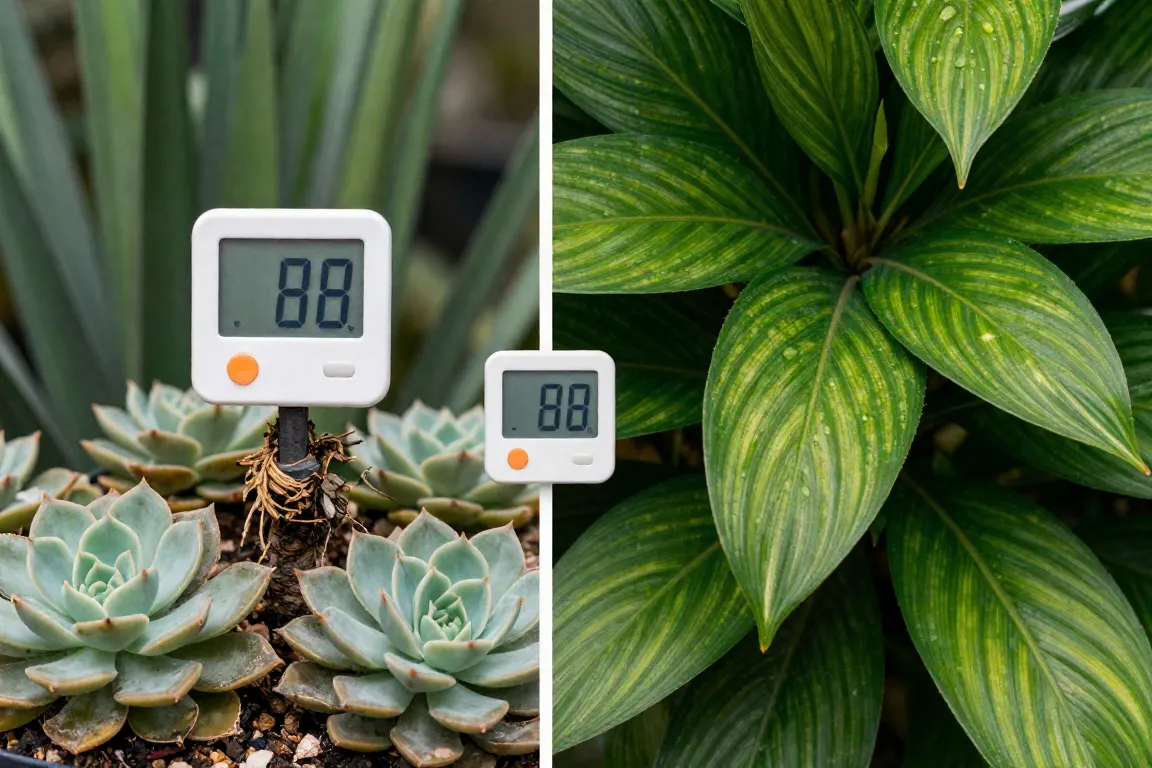
Dry-adapted plants usually fit homes with low indoor humidity. Cacti and succulents can live in homes with RH around 10–30%.
That does not mean every succulent should be assigned an exact low-humidity target. Jade is a useful example because it is intolerant of humidity and prefers ordinary household humidity around 25–35%.
Snake plant is another dry-air-tolerant example; it tolerates low humidity.
Why should habitat not become a fixed indoor percentage?
Native habitat helps predict broad tendencies, but indoor care works better when you combine habitat with species requirements, actual RH, airflow, temperature, and the rest of the growing environment. A desert origin suggests dry-air tolerance. It does not prove that the driest possible room is always best.
| Plant example | Working RH zone | Tier | Why it belongs here |
| Snake plant | Low humidity tolerance | Dry-air tolerant | It tolerates low humidity |
| Jade plant | About 25–35% | Dry-air tolerant | Useful example of a plant suited to drier household air |
| Pothos | Average household humidity | Middle range | Adaptable tropical example |
| Spider plant | Medium humidity | Middle range | Tolerates a broad range of indoor conditions |
| Philodendron | High humidity preferred | Middle to upper range | Prefers higher humidity but usually adapts to average homes |
The table uses qualitative placement when reliable species-level percentages aren’t consistently available. That is better than filling every row with a precise-looking number that the evidence does not support.
Takeaway: Use plant habitat to choose a starting tier, then let actual RH readings refine the target.
Which common houseplants fit the 40%, 50%, and 70% humidity tiers?
A useful three-tier framework is 40% for plants that tolerate dry indoor air, 50% as a practical middle target for many common houseplants, and 70% for humidity-sensitive tropicals. These are working ranges, not universal requirements, so confirm the plant’s species-specific preference before adjusting the whole room.
Here is the truth: the 40/50/70 framework is a practical decision tool, not an official horticultural standard.
It turns a complicated subject into three useful checkpoints, making it easier to move from general guidance to a specific choice.
The point isn’t that every plant at 40% will be happy, or every plant at 70% will be happier. The point is to decide which direction you should investigate before changing the environment, then adjust from there.
Tier 1: Around 40% for dry-air tolerant plants
Use around 40% RH as a practical dry-air reference for plants such as cacti, many succulents, jade, and other known dry-air tolerant plants. Cacti and succulents can handle much lower household humidity.
Snake plant belongs in this group too. Its current plant profile says it tolerates low humidity, so it is rarely a good reason to push an entire mixed collection toward very high RH.
Tier 2: Around 50% for a practical middle target
Around 50% RH is a useful middle target for many common houseplants. Many houseplants fall in this range, making it a sensible starting point for a mixed indoor collection.
Pothos, spider plants, and many philodendrons can fit comfortably into this middle category. Spider plants are described as preferring medium air humidity while remaining adaptable to a range of conditions.
Tier 3: Around 70% for higher-humidity tropicals
Around 70% RH is a useful higher-humidity target for humidity-sensitive tropical plants. Tropical species can thrive at approximately 70–80% RH, while some plants require that higher range.
The assumption that every tropical houseplant must live at 70% is wrong.
Some tropical plants adapt well to average household humidity. Philodendrons are a clear example because they prefer high humidity but usually adapt to average homes.
Trying to push a whole room to 70% can create a second problem if you ignore airflow, condensation, and wet surfaces. Match the intervention to the plant that actually needs it.
What does “tolerates,” “prefers,” and “needs” really mean?
“Tolerates” means the plant can handle the condition without that condition being ideal. “Prefers” points toward better performance under those conditions. “Needs” is stronger and should be reserved for cases where species-level evidence supports it.
That language matters because a humidity percentage can look scientific while still being misleading.
A reading of 50% does not automatically tell you whether a specific calathea is comfortable, whether a cactus needs anything changed, or whether a philodendron would benefit from slightly more moisture in the air.
For 2026, the useful goal is not to chase a perfect number. It is to place the plant in a sensible range and then watch the conditions around it.
Takeaway: Choose the tier first, then fine-tune the percentage.
Why does humidity matter even when your plant is watered?
Humidity changes how quickly a plant loses water through transpiration. When air is very dry, leaves can lose water faster. When humidity is extremely high, transpiration slows. Watering alone cannot correct every humidity problem. Light, temperature, airflow, and soil moisture still interact with humidity and must be assessed together.
Transpiration is the key link.
Plants release water vapor from their leaves, and the surrounding air affects how strongly that water moves away from the leaf surface. A drier atmosphere can increase the pressure for water loss from foliage.
That is why indoor plant humidity can matter even when the potting mix is moist. A plant can have wet soil while still sitting in relatively dry air.
Watering the pot again does not correct dry atmospheric conditions.
The reverse matters too. Very humid air reduces the driving force for water loss. When humidity stays high, airflow is weak, and surfaces remain wet, disease problems can become more likely.
Humidity is not a substitute for good watering.
If the soil is staying wet because light is poor or the potting mix drains slowly, raising humidity does not solve that underlying problem.
There is another reason to avoid dramatic changes. A plant may not respond visibly the same day the environment changes. A single yellow leaf or one dry margin is weak evidence on its own.
Look at the measured conditions and the larger care picture before blaming humidity.
Takeaway: Humidity changes the plant’s water-loss environment, but it does not replace good watering, light, or airflow.
How can you measure indoor humidity accurately around a houseplant?
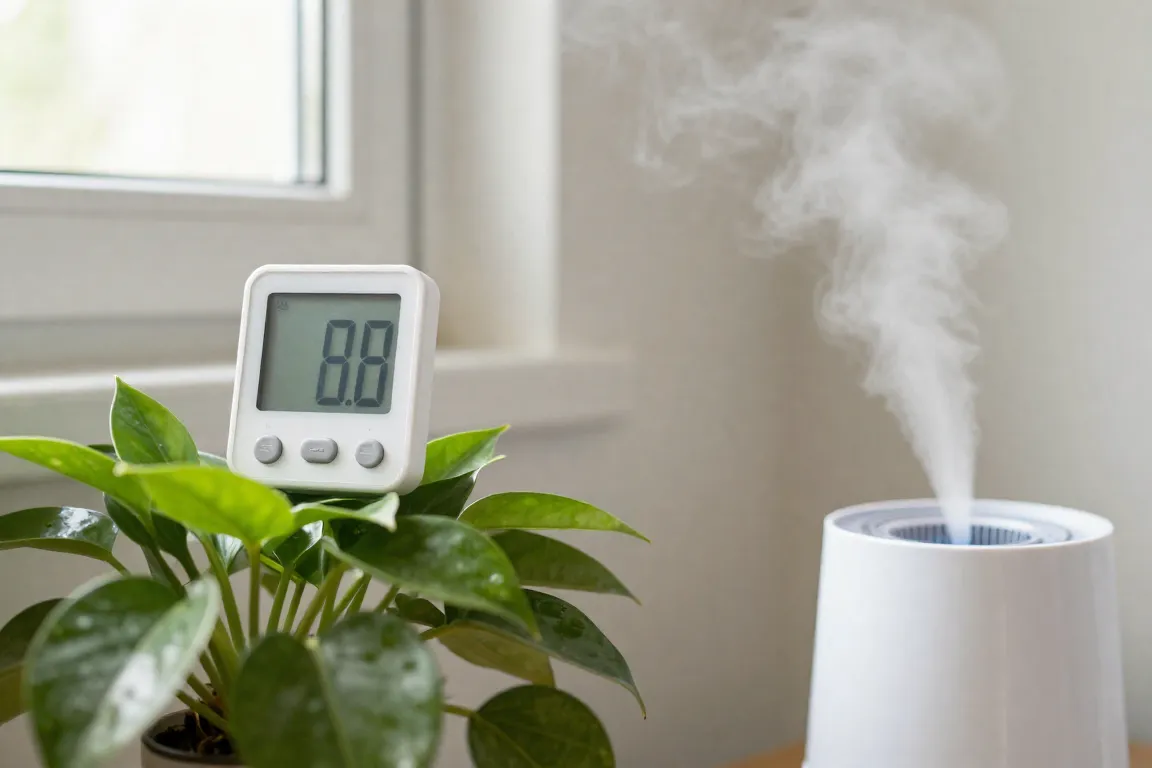
A digital hygrometer is the simplest way to measure indoor relative humidity. Place it close to the plant canopy, away from direct sun, heating or cooling vents, and humidifier output. Check readings at different times because humidity can shift through the day. For mixed collections, measure where plants actually sit.
A hygrometer tells you what the air is doing, not what the room feels like.
That matters because people are poor humidity sensors. A room can feel perfectly normal while a plant beside a radiator or air-conditioning vent experiences a very different microclimate.
Where should a hygrometer go?
Place the hygrometer near the foliage, not across the room.
Keep it away from direct sunlight, hot drafts, cooling vents, outside doors, and the immediate output of a humidifier. Those locations can produce readings that represent a small local pocket rather than the air surrounding the plant.
Should you measure the room or the plant’s microclimate?
For one plant, the plant zone matters most.
For a larger collection, room-level readings still help, but you should also check representative plant locations.
Here is the non-obvious detail people miss: two plants in the same room can experience different humidity because windows, walls, vents, heat sources, plant density, and foliage all alter the local air. Leaves can create a small humid microclimate around the canopy.
How often should you check humidity?
Check at different points during the day and whenever room conditions change.
A single reading is a snapshot. A small log can show whether humidity stays low, spikes after a shower or humidifier cycle, or changes sharply near heating and cooling sources.
Takeaway: Measure the air where the plant lives, not where the hygrometer is most convenient.
What should you do when humidity is too low or too high?
When humidity is too low, measure it first, reduce exposure to drafts or heat sources, and use a humidifier when you need a sustained increase. Grouping plants can create a small microclimate. When humidity is too high, improve airflow and ventilation rather than treating the percentage alone as the problem.
How can you raise humidity safely?
Measure the plant zone before changing anything.
Move plants away from drying heat sources and drafts.
Use a humidifier for sustained, controllable humidity.
Group compatible plants to create a local microclimate.
Use a pebble tray as a modest local humidity aid.
Use a terrarium or cloche for suitable compact plants.
Recheck the hygrometer after conditions settle.
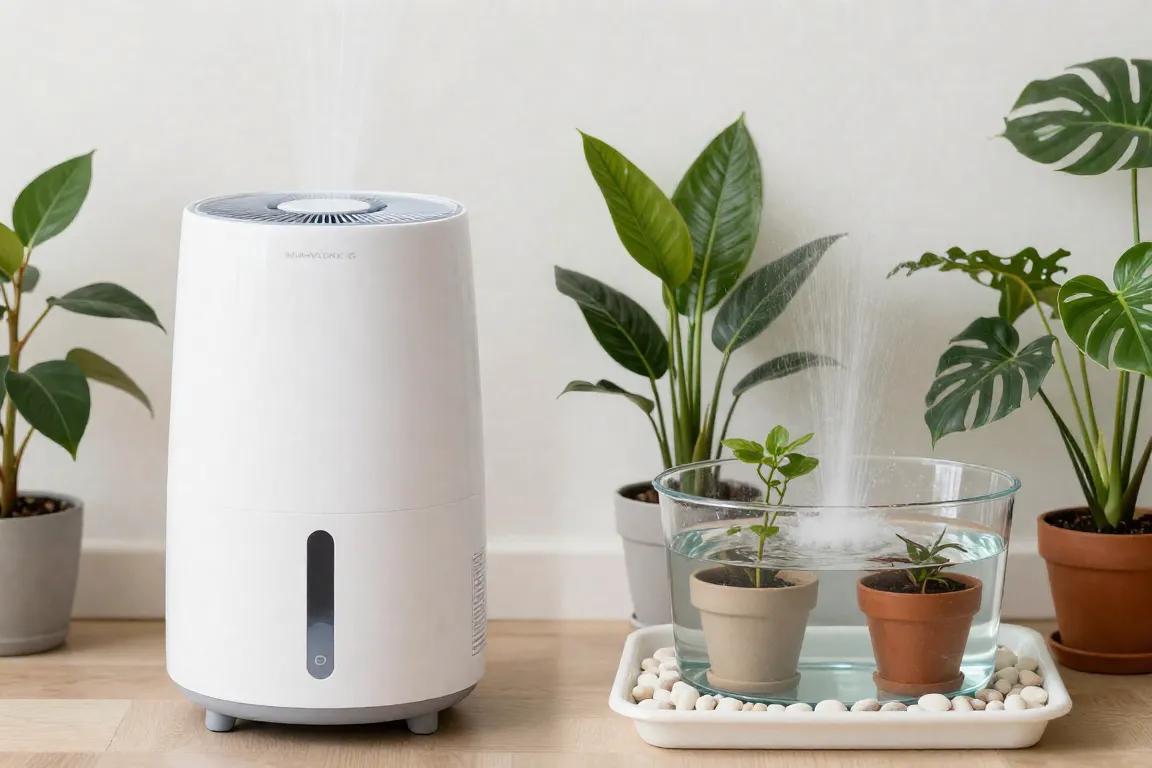
Humidifiers are the most controllable option when you need a real increase. Grouping plants can help by concentrating moisture from soil and foliage around the collection. Pebble trays can provide a small local effect, but they should not be treated as whole-room humidifiers.
Does misting actually raise humidity?
Misting is not an effective long-term humidity strategy. Foliage dries quickly after misting, so you’d need repeated applications to maintain the effect.
That makes misting a poor substitute for measurement and sustained environmental control.
A spray bottle can make leaves look wet. It cannot reliably turn a dry room into a humid one.
How should you respond when humidity is too high?
Verify the reading with a hygrometer.
Increase gentle air movement around the foliage.
Improve ventilation when practical.
Reduce overcrowding between plants.
Review watering and soil-drying conditions.
Use dehumidification if excessive humidity persists.
High humidity deserves context, not panic. The bigger concern is often the combination of humid air, weak airflow, wet foliage, condensation, or soil that stays damp too long. Good air circulation around grouped plants helps reduce the chance of foliar disease.
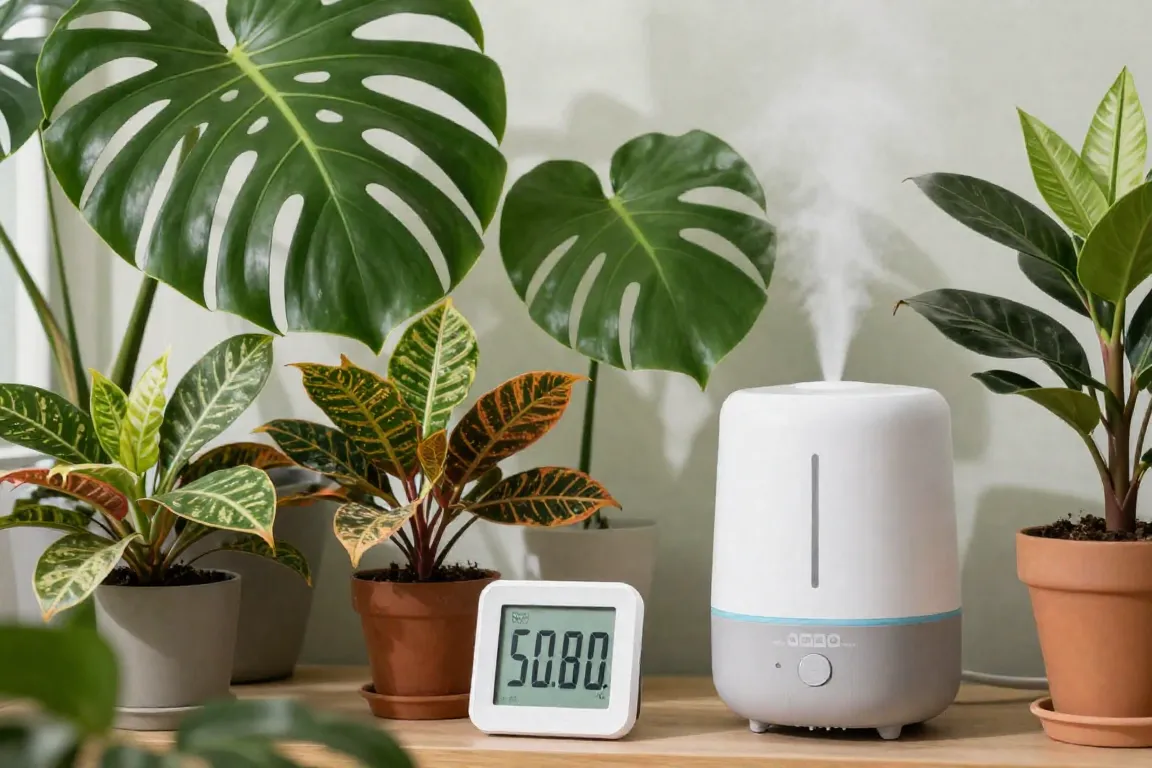
Takeaway: Change the environment gradually and verify the result with a meter.
How should humidity change by season and room?
A reading that is fine in one room may not be fine beside a radiator, air conditioner, sunny window, or humidifier. Seasonal heating can lower indoor humidity, while humid weather can raise it. Adjust plant placement and humidity targets to the local microclimate, while keeping airflow adequate around leaves.
During active growth, especially roughly March to September in the Northern Hemisphere, plants may use more water and respond differently to their indoor environment. During slower growth or dormancy, especially roughly October to February, heating can dry indoor air while lower light can reduce water use.
Those month ranges are planning conventions, not universal biological dates.
Moving plants indoors changes light, humidity, watering, and temperature at the same time. A plant can therefore respond to the move even when humidity is not the only variable involved.
Bathrooms, kitchens, and laundry areas can be more humid during certain periods, but short humidity spikes are not the same as a consistently suitable plant environment. A bathroom still needs adequate light, and a humid room with poor airflow isn’t automatically ideal.
Growers managing mixed collections typically place humidity-sensitive tropicals in naturally or artificially humid zones while keeping dry-adapted plants in drier spaces. That approach matches the environment to the plant instead of forcing every species into one room-wide target.
That raises a more interesting question: what should a hygrometer reading of 90% actually mean for a houseplant?
What humidity mistakes should you avoid?
Common humidity mistakes include treating every houseplant the same, chasing a high percentage without measuring it, relying on occasional misting, and increasing watering to compensate for dry air. Another mistake is ignoring airflow when humidity rises. Good management means measuring, matching the plant, and changing one variable at a time.
- Assuming every tropical plant needs 70% RH.
- Assuming 40% RH is harmful to every tropical plant.
- Treating misting as a room-humidification system.
- Watering more because the air feels dry.
- Placing a hygrometer beside a vent or humidifier outlet.
- Assuming one room reading represents every plant.
- Ignoring airflow when humidity stays high.
- Treating native habitat as an exact indoor care recipe.
Most people get this wrong because humidity is easy to express as one number.
Plants are not one-number systems.
Takeaway: Measure first, identify the plant, choose a sensible range, adjust the environment, and reassess.
Conclusion
No universal perfect humidity exists for houseplants.
Start with the practical middle range, use a lower target for dry-adapted plants, and reserve higher humidity for plants that genuinely benefit from it. A hygrometer turns guesswork into a measurable care decision.