How to Get Rid of Gnats in Indoor Plants A Practical Guide for Every Household Type
You notice tiny flies hovering around your plant’s soil, even though you rarely water it. A closer look reveals small white specks in the dirt. You suspect gnats, but the real worry sets in: you have a cat and two young kids at home, and you’re not sure which treatments are safe. Is this going to kill your plant? Will it take weeks to fix? Should you throw the plant away?
Most beginner plant owners catch this problem too late, usually after seeing significant activity on sticky traps, sometimes weeks after the first gnats appeared. The delay isn’t a personal failure; gnats don’t announce their presence dramatically. But once you spot them, the clock starts.
Here’s what actually works: Fungus gnats thrive in moist soil with decomposing organic matter. The fastest, safest combination is:
1. Allow soil to dry 1 inch below the surface,
2. Deploy yellow sticky traps to catch flying adults,
3. Use Mosquito Bits or BTI in soil to kill larvae.
Together, these methods eliminate gnats in 2–4 weeks without harmful chemicals. For pet and child homes, all three are safe when used as directed.
You might worry this approach takes too long or won’t work; random spraying and guesswork fail constantly. Science-backed methods beat luck every time.
What you’ll learn here: how to identify gnats accurately, which method works for your specific situation, severity matters, and so does your household type, and why treating adults alone guarantees failure. Most importantly, you’ll understand why gnats keep coming back without a real prevention strategy.
What Are Fungus Gnats & Why They’re a Problem
How to get rid of gnats in indoor plants starts with understanding what they are. Fungus gnats are small (1/8-inch), dark flies that breed in wet soil. Unlike fruit flies, they don’t pose a disease risk to humans, but they’re an early signal that soil drainage, watering habits, or plant health has slipped. The real problem: they damage roots and spread mold, which weakens plants. For beginners, they’re overwhelming more than deadly.
Physical identification: Adults are tiny, dark-bodied flies with long legs and antennae. You’ll spot them hovering near soil at soil level, especially in early morning or dusk. Larvae are translucent white, 1/4-inch long, with visible black heads. Eggs and pupae are invisible to the naked eye and visible only under a microscope or when you closely inspect soil crevices.
Why they matter: Gnat larvae feed on fungi and organic matter in soil, but they also damage fine root hairs, reducing nutrient uptake. A heavily infested plant won’t die quickly, but it will weaken. More importantly, seeing gnats signals that your soil environment moisture, decomposition, airflow has become conducive to pests. That same environment attracts other problems. Fixing it stops multiple issues before they start.
Life span and speed: Adult gnats live 7–10 days. A single female lays 200+ eggs. The complete lifecycle from egg to adult takes approximately 17–20 days at room temperature 75°F, according to UC IPM and Kansas State University. This means a full 4-week treatment window is necessary to catch all life stages; stopping early guarantees failure, as larvae and pupae remain dormant in soil longer than the visible adult stage.
How to Identify Gnats at Every Life Stage
If you’re learning how to get rid of gnats in indoor plants, the first step is accurate identification. Fungus gnat larvae are translucent, 1/4-inch white worms with black heads, found in the top 1 inch of soil. Adults are 1/8-inch dark flies, slow fliers, usually seen near the soil surface at dusk. The Potato Slice Test: A potato slice left on soil overnight will show larvae clustering underneath if infestation exists.
Larvae identification: Inspect the top 1 inch of soil after watering. Small white specks are possible eggs; small white worms are larvae. You’ll only see larvae in moist soil; they hide deeper in dry soil, which is one reason drying the surface alone doesn’t always work.
Adult gnat behavior: Early morning or dusk near soil; attracted to light, they hover near windows. Slow fliers, unlike fruit flies. Often mistaken for fungus flies, but fungus gnats are the most common indoor plant pest in this size range.
The Potato Slice Test: Place a raw potato slice directly on soil, leave it for 24 hours, and flip it. If larvae are present, they’ll cluster underneath, feeding on the starch. This confirms infestation without needing a microscope.
Quick comparison to other tiny flies: Fruit flies are tan/brown, fast fliers, breed in decaying fruit, hover near kitchens. Drain flies are fuzzy, breed in pipes, hover near sinks. Gnats are dark, slow, breed in soil, hover at plant level: different pests, different solutions. Misidentifying them leads to wasted treatment.
Treatment Decision Matrix Choosing the Right Method
Choosing the best way to get rid of gnats in indoor plants depends on your infestation severity and household type. Mild infestations 1–2 plants, few visible flies respond to sticky traps + soil drying in 2 weeks. Moderate infestations need traps + Mosquito Bits for 3–4 weeks. Severe infestations: widespread larvae, visible flies everywhere, multiple plants; need all three methods + hydrogen peroxide drench for 4–6 weeks.
| Method | Mild | Moderate | Severe | Pet-Safe? | Child-Safe? | Speed |
| Yellow Sticky Traps | ✓ Start here | ✓ Secondary | ✗ Insufficient | ✓ Yes | ✓ Yes | 3–4 weeks |
| Soil Drying 1″ below surface | ✓ Pair with traps | ✓ Essential | ✓ Essential | ✓ Yes | ✓ Yes | 2–4 weeks |
| Mosquito Bits BTI | ✓ Primary | ✓ Primary | ✓ Safe for pets | ✓ Non-toxic | 3–4 weeks | |
| Hydrogen Peroxide Drench 3% | ✗ Overkill | ✓ Rapid boost | ✓ Quick larvae kill | ✓ Yes | ⚠ Irritant | 1–2 weeks larvae |
| Diatomaceous Earth Food-Grade | ⚠ Slow | ✓ Supplementary | ✓ Yes | ⚠ Inhalation risk | 2–3 weeks | |
| Neem Oil Spray | ⚠ Slow | ⚠ Supplementary | ✗ Avoid toxic to cats | ⚠ Skin irritant | 3–5 weeks | |
| Sand/Perlite Top Layer | ✓ Preventive | ✓ Preventive | ✓ Preventive | ✓ Yes | ✓ Yes | 2–4 weeks preventive |
Severity assessment:
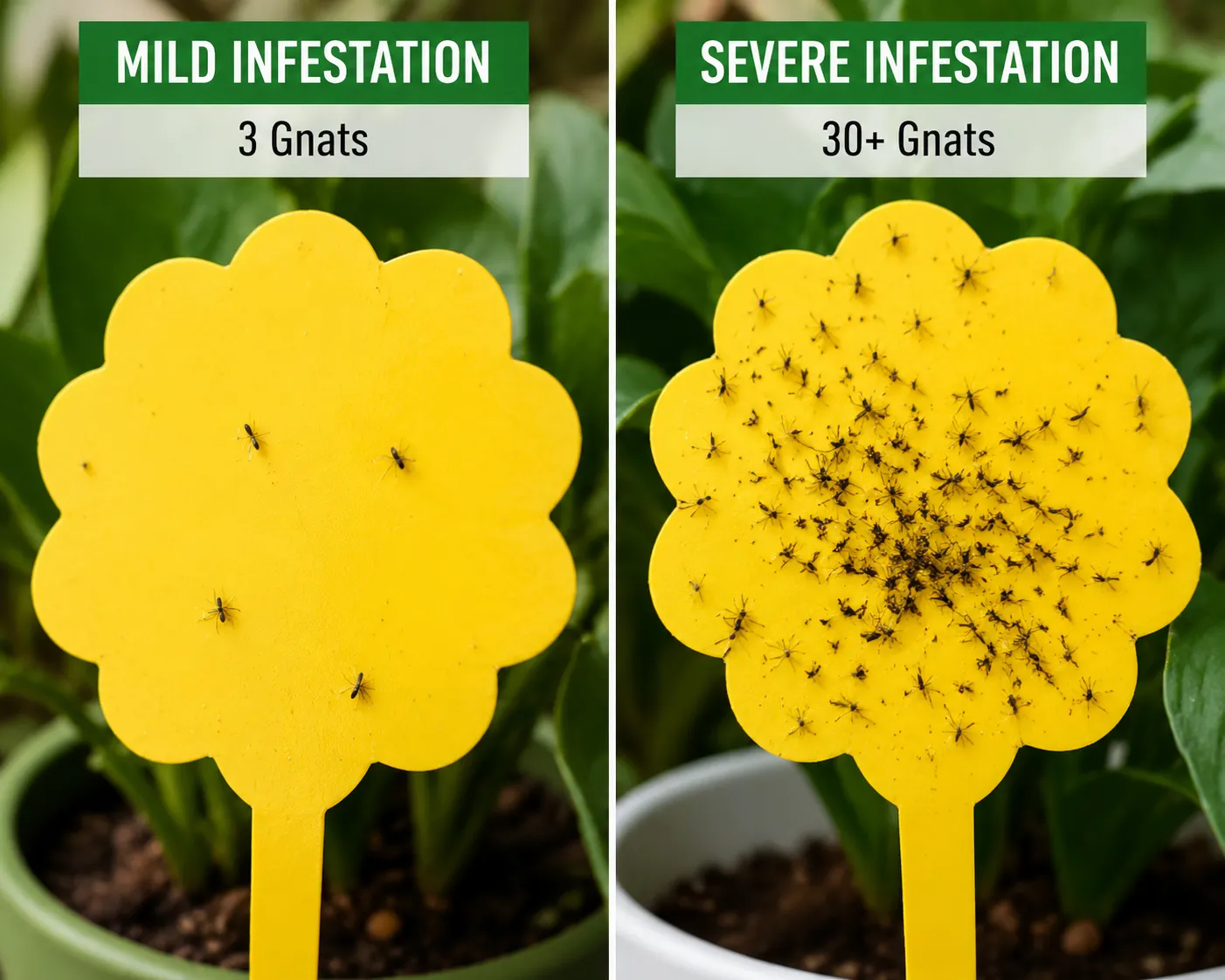
- Mild: 1–2 sticky traps with fewer than 10 gnats total per day
- Moderate: 3+ traps with 10–30 gnats per day; visible larvae in top 1 inch
- Severe: Traps max out at 30+ per day; larvae visible 2+ inches deep; multiple plants affected.
Household-type assessment:
- Standard household: All methods available; start with the fastest option for your severity level
- Pet owners, especially cats: Avoid neem oil entirely; all others safe
- Parents with young children: Avoid diatomaceous earth inhalation risk if powder is airborne; avoid hydrogen peroxide if unsupervised soil play is likely
- Renters: Prioritize non-damaging methods: traps, soil drying, Mosquito Bits; avoid hydrogen peroxide on floors due to stain risk
Why one method alone fails: Gnats have overlapping life stages. Sticky traps catch adults only. Mosquito Bits kill larvae but not flying adults. Soil drying stops reproduction but doesn’t kill existing larvae. Together, they break the entire cycle.
Method 1 Yellow Sticky Traps + Soil Drying Most Accessible
Yellow sticky traps capture flying adults; drying soil 1 inch below the surface stops larvae reproduction. This combo eliminates gnats in 2–3 weeks for mild infestations; it’s the most beginner-friendly approach. Place 2–3 traps per plant, check every 2 days, and water only when the top 1 inch feels dry. Replace traps when saturated.
Why yellow, not other colors: Gnats are attracted to yellow wavelengths. White and blue traps catch fewer adults. It’s not a myth; it’s documented gnat behavior across multiple studies.
How to position and check traps:
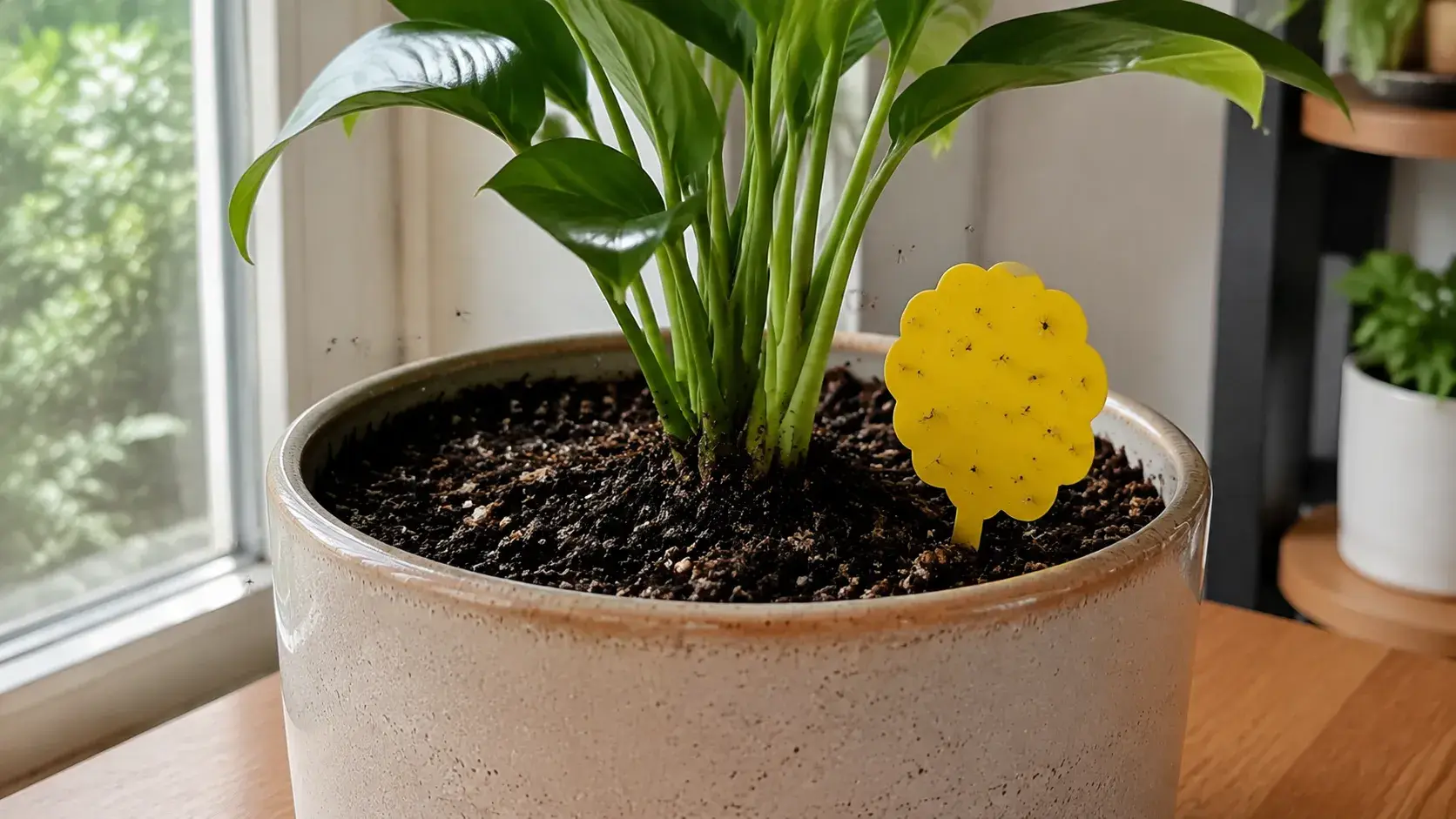
- Insert sticky traps horizontally into soil, or place them flat at soil level with one edge just touching the soil surface.
- This positioning captures both soil-dwelling larvae trying to pupate at the surface AND flying adults mid-flight.
- Check every 2 days; record gnat count trending downward = on track; plateauing or rising = escalate to Mosquito Bits.
The trap-stopping mistake: Most beginners quit using traps after 1 week because “they’re working”; they see fewer gnats and assume they’re done. You must continue traps for 3–4 weeks even if gnat count drops to 1–2 per day. Remaining pupae in soil emerge later; if you stop early, they restart the cycle. This is the #1 reason gnat treatment “fails”: the infestation wasn’t solved; it just looked solved temporarily.
How to dry soil the right way, not killing your plant:
- Let the top 1 inch dry between waterings; use your finger to test
- For tropical plants Pothos, Philodendron, Calathea: This is still too dry. Use Mosquito Bits + traps instead; keep soil consistently moist but well-draining.
- For succulents and snake plants: This is perfect. Combine with sand top-dress for extra prevention.
Numbered execution steps:
- Buy 5–6 yellow sticky traps; 3-pack recommended; buy 2 packs.
- Insert into soil at soil level in each infested plant pot, or place flat on soil surface.
- Water plant only when the top 1 inch of soil feels dry to your finger, not soggy, not bone-dry.
- Check traps every 2 days; note gnat count to track a downward trend.
- Replace traps when saturated or weekly, whichever comes first.
- Continue full protocol for a minimum of 3–4 weeks, even if no gnats appear for several days.
Method 2 Mosquito Bits & BTI Science-Backed, Most Effective
Mosquito Bits BTI Bacillus thuringiensis israelensis are bacteria that kill gnat larvae without harming plants, pets, or people. Sprinkle dry bits on wet soil, or brew “mozzie tea” by steeping bits for 24 hours, then watering into the soil. Kills larvae in 24–48 hours; use weekly for 4 weeks to prevent pupa emergence.
VERIFY: Confirm BTI kill time is 24–48 hours at room temperature 65–75°F
What is BTI and why it’s different: Not a poison; a bacterium that gnat larvae eat, causing fatal damage to their digestive system. Harmless to mammals, birds, beneficial insects, and soil microbes. This is why it’s pet-safe and child-safe.
Mosquito Bits vs. Mosquito Dunks:
- Bits: Granular, easier to measure/apply, better for large pots, faster acting when brewed into tea
- Dunks: Solid pellets, slower to dissolve, better for water-based treatment of large quantities
- Recommendation for most indoor plant collections: Mosquito Bits
How to use Mosquito Bits dry application:
- Water plant until soil is evenly moist.
- Sprinkle 1 teaspoon of Mosquito Bits directly onto soil surface per 6-inch pot, proportional for larger pots.
- Lightly work bits into the top 1/2 inch of soil with your finger or a small stick; this ensures contact with moist soil where larvae feed.
- Water lightly so bits are incorporated into moist soil; bits require moisture to activate and become available to larvae.
- Repeat every 7 days for 4 weeks; targets overlapping generations and pupae emergence.
How to make “Mozzie Tea” brewed application:
- Fill a spray bottle or container with 1 cup of water.
- Add 1 tablespoon Mosquito Bits.
- Let it steep 24 hours at room temperature; bacteria activate and disperse into water.
- Stir well; spray or pour into soil, soaking to a 2-inch depth.
- Use this “tea” to water the plant weekly for 4 weeks.
- Store extra tea in the refrigerator for up to 1 week.
Safety and compatibility:
- With fertilizer: Yes, safe to mix
- With hydrogen peroxide: NO; wait at least 48–72 hours between treatments. Hydrogen peroxide kills BTI bacteria. Use one method, wait several days, then switch to the other. Do not combine.
- With neem oil: No; use one or the other, not together.
- For pets and children: BTI is non-toxic; no special precautions needed.
Method 3 Hydrogen Peroxide Soil Drench Rapid Larva Kill
3% household hydrogen peroxide pharmacy-grade kills gnat larvae through oxidative damage, destroying their soft bodies. Mix 1 part peroxide with 4 parts water, drench soil to a 2-inch depth, and allow to air-dry. Effective against larvae on contact. Use as a boost method in moderate/severe cases, or alone for rapid response.
VERIFY: Confirm 3% H₂O₂ is standard concentration; confirm 24-hour larva kill timeline; confirm phytotoxicity risk at 1:4 dilution
Why it works and why it’s not a silver bullet: Hydrogen peroxide kills larvae through oxidation; the fizzing you see is H₂O₂ decomposing into water and oxygen gas, releasing oxygen radicals that destroy soft-bodied larvae. However, it also kills beneficial soil microbes through this same oxidative process, so it should not be used repeatedly. Peroxide decomposes quickly into water and oxygen within 24–48 hours, so repeated use is not needed. It won’t kill adults or pupae, and it is not suitable for use immediately before or after BTI; wait at least 48–72 hours between the two treatments, as peroxide will kill the BTI bacteria.
How to apply detailed steps:
- Mix 1 cup 3% hydrogen peroxide with 4 cups water in a watering can.
- Water each infested plant slowly, saturating soil to a 2-inch depth.
- Allow excess to drain completely; do this in a sink or bathtub for indoor plants; avoid carpet staining.
- Let the pot drain for 10 minutes, then resume normal location.
- Repeat every 3–5 days for 2 weeks PLUS sticky traps simultaneously; you need two kill mechanisms.
Safety cautions:
- For pets/children: Harmless if consumed in small amounts; 3% is low-concentration, but tastes bad and causes mild irritation. Not recommended for homes where kids/pets directly mouth soil.
- For plant roots: Safe if used as directed, diluted 1:4; overdoing concentration can damage root cells. Stick to 3% pharmacy solution; never use 10%+ concentrations on soil.
When to combine H₂O₂ with Mosquito Bits vs. alone:
- Alone: Severe infestations, rapid response needed, soil drying possible
- Combined: Do not use hydrogen peroxide and Mosquito Bits together or within 48–72 hours of each other. Hydrogen peroxide kills BTI bacteria. Use one method, wait 3+ days, then switch to the other if needed.
Advanced Methods & When to Use Them
Diatomaceous earth, neem oil, and commercial gnat barriers are effective but slower or riskier than core methods. Use these as secondary tools: DE for persistent cases (non-toxic, slow); neem for outdoors or severe infestations (avoid if you have cats); gnat barriers as preventive mesh layers. Combine with primary methods, not as a standalone.
Diatomaceous earth food-grade:
- How it works: Microscopic sharp edges cut gnat exoskeletons, causing dehydration.
- Application: Dust 1/4-inch layer on soil surface; reapply after watering.
- Pros: Non-toxic, reusable, inexpensive.
- Cons: Inhalation risk during application; needs frequent reapplication every 3–5 days; slow to kill 5–7 days.
- Best for: Outdoors or well-ventilated spaces; supplementary to Mosquito Bits.
Neem oil spray:
- How it works: Smothers and disrupts the insect nervous system.
- Pros: Organic; effective on adults and some larvae.
- Cons: Can stress plants if overused; unpleasant smell; caution recommended for cat owners; cats groom extensively; neem oil can cause mild irritation if ingested in small amounts; consult a vet if concerned.
- Application: Spray onto soil surface and lower stems weekly for 3 weeks. Avoid spraying directly on foliage that cats will groom.
- Best for: Pet-free households; outdoor plants; or as a supplementary method in homes with cats if used cautiously on soil only.
Fungus gnat barrier/sand top-dress:
- How it works: Physical barrier prevents adult gnats from laying eggs in soil.
- Material: 1-inch sand or perlite layer on top of soil.
- Pros: Preventive, non-toxic, low cost, remains effective indefinitely.
- Cons: Not curative; doesn’t kill existing larvae; aesthetic looks odd on foliage plants.
- Best for: Prevention after primary treatment; tropical plants that need humid soil.
Myth-busting quick takes: Cinnamon, apple cider vinegar, and camphor have some antimicrobial properties but aren’t effective enough for active gnats. They might help with prevention slightly, not treatment.
Preventing Gnats Before They Enter Your Home
Prevent gnats at the source: inspect nursery plants before buying. Check soil moisture: it should not be soggy; look for fungus gnats or larvae in the top 1 inch; and examine drainage holes for algae, a sign of constant wetness. Quarantine new plants in a separate room for 1–2 weeks before integrating into your main collection.
Nursery inspection checklist before you buy:
- Check soil is moist but not soggy; no algae or moss on surface.
- Look for adult gnats visible in or around the pot or yellow sticky traps already in nursery pots; a sign of their problem.
- Lift pot and check drainage: should not be wet on the bottom.
- Smell soil: should not smell sour or fermented, a sign of root rot + gnats.
- Gently part top 1 inch of soil; look for small white worms (larvae) or black specks (eggs).
- Ask nursery staff: “Have you had gnat problems with these plants recently?” Honest growers will tell you.
Quarantine protocol 1–2 weeks in a separate room:
- Place new plant in an isolated room (bathroom, office, spare room) away from other plants.
- Do not water for first 3–4 days; let soil dry out slightly. Gnats love freshly watered plants.
- Place one yellow sticky trap in or near the pot.
- Check the trap every 2 days for gnats.
- If any gnats appear, treat immediately with Mosquito Bits; apply both methods: traps + bits.
- After 2 weeks with no gnats on the trap AND no visible larvae in the soil, move the plant to the main collection.
Soil treatment option if you’re unsure about plant origin:
- Repot into fresh, sterile potting mix with perlite/drainage amendments. It can be overkill, but it eliminates all gnat risk upfront.
Long-Term Prevention: The Real Solution
Prevention is easier than treatment. Use well-draining soil mixes, add 30% perlite/bark, water only when the top 1 inch is dry, improve air circulation with a small fan, avoid leaving water trays under pots indefinitely, and monitor new plants. Combine these with a sandy top-dress on susceptible plants.
Soil composition: the drainage foundation:
- Use potting mixes with at least 30% drainage material perlite, bark, coconut coir.
- Avoid heavy, all-peat mixes that compact over time and retain water.
- Recommendation: If recovering from infestation, repot existing plants into a high-drainage mix.
Watering strategy: the 1-inch rule:
- Check soil with your finger before watering.
- Water only when the top 1 inch feels dry, not soggy below.
- For humidity-loving plants: use a moisture meter; ideal range: 40–60%, not a visual guess.
Air circulation: why a small fan matters:
- Gnats lay eggs in still, humid air.
- A small oscillating fan, even for 2 hours daily, disrupts egg-laying and reduces moisture.
- Secondary benefit: strengthens plant stems.
Avoid water trays or empty them daily:
- Water trays create standing water = gnat paradise.
- If using trays for humidity, empty them each evening.
- Alternative: mist plants instead of using trays.
Sandy top-dress one-time investment:
- Apply a 1-inch layer of coarse sand to the soil surface.
- Renew after watering shifts it.
- Cost: $5–10 per plant; lasts indefinitely if maintained.
Safety Considerations for Pets, Children & Plant Health
All primary methods traps, Mosquito Bits, soil drying are safe for pets and children when used as directed. Avoid neem oil entirely if you have cats; use hydrogen peroxide carefully, as it is an irritant; and prevent inhalation of diatomaceous earth by applying damp. Read product labels; when in doubt, choose the simplest method first.
Pet-safe methods for dogs, cats, birds:
- ✓Safe: Yellow sticky traps, Mosquito Bits BTI, soil drying, sand top-dress
- ⚠Caution: Hydrogen peroxide is low toxicity, but irritant if ingested; supervise application and allow to dry completely before pets access soil
- ✗Avoid: Neem oil; cats groom extensively and ingest residue; small amounts may cause mild irritation; use sparingly on lower stems/soil surface only, never on foliage; consult vet if cat ingests neem oil.
Child-safe methods for toddlers, crawlers:
- Safe: Yellow sticky traps placed out of reach, Mosquito Bits non-toxic, soil drying
- Caution: Hydrogen peroxide irritant if swallowed or in eyes; supervise
- Avoid: Diatomaceous earth if child likely to inhale fine powder; neem oil skin irritant.
Will treatment harm your plants?
- Soil drying: No harm if done correctly; mimics natural dry season.
- Sticky traps: No harm.
- Mosquito Bits: No harm; actually beneficial to soil microbes.
- Hydrogen peroxide: No harm if diluted 1:4; higher concentrations risk root burn.
- Diatomaceous earth: No harm, but can increase soil pH slightly over time.
- Neem oil: May stress plants if used too frequently or in heat; can clog leaf pores.
How Long Does Gnat Treatment Actually Take?
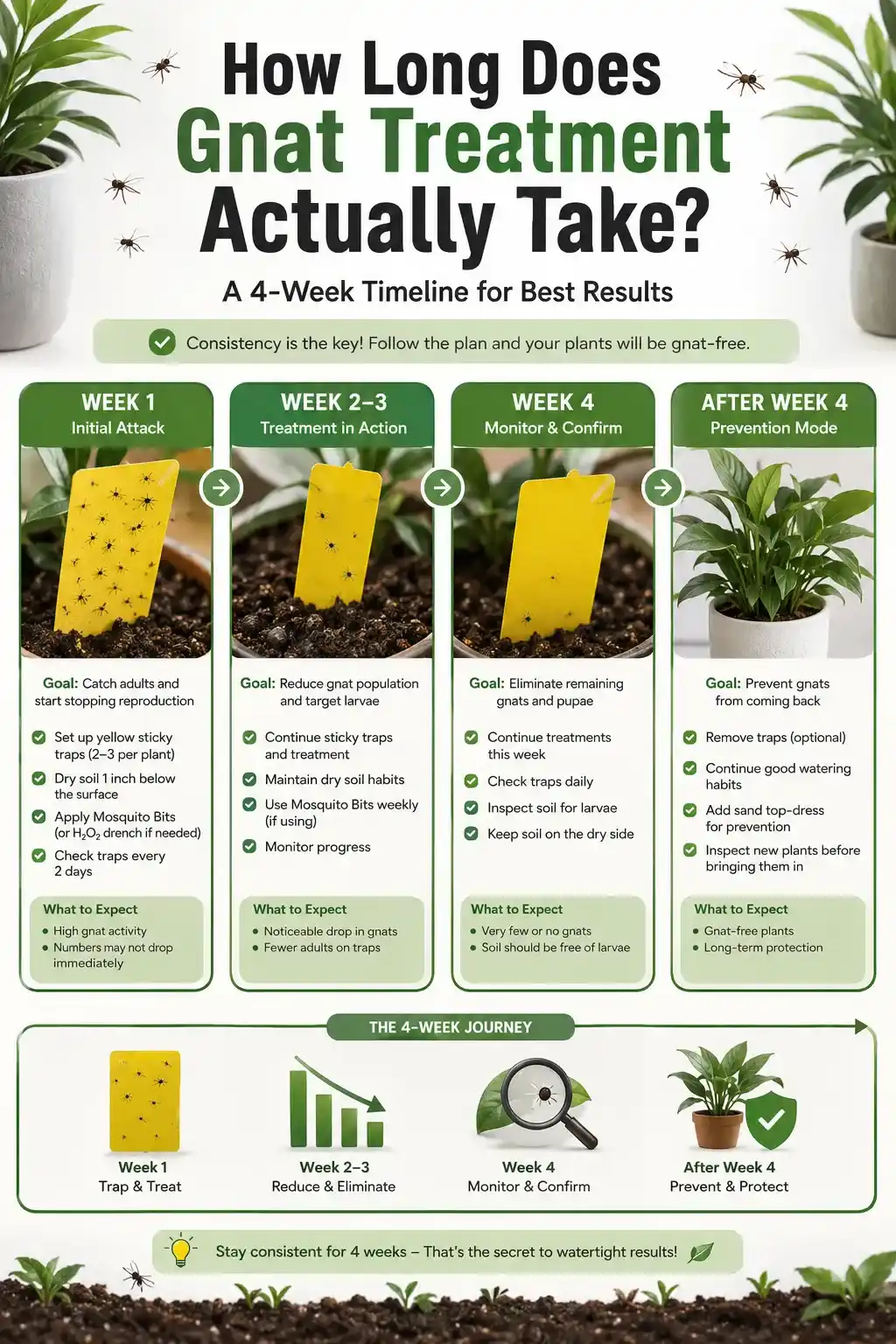
Timeline for how to get rid of gnats in indoor plants varies: mild infestations clear in 2–3 weeks; moderate in 3–4 weeks; severe in 4–6 weeks. Timeline depends on method and consistency. Sticky traps show results fastest: fewer adults in 3–5 days, but must continue 3–4 weeks total. Expect setbacks if you miss weekly treatments or if new adult gnats emerge from missed pupae.
Mild infestation 1–2 plants, few visible gnats:
- Week 1: Sticky traps + soil drying; gnat count drops to 1–2 per day
- Week 2–3: Continue protocol; traps show no gnats for 5+ consecutive days
- Week 4: Monitor with one trap; if clean, consider cleared
Moderate infestation multiple plants, 10–30 gnats/day:
- Week 1: Sticky traps + Mosquito Bits; gnat count noticeable but trending down
- Week 2–3: Continue; count drops to 1–3 per day
- Week 4: Monitor; if clean for 5+ days, reduce to prevention mode
- Week 5: May need one more Mosquito Bits round if any gnats reappear or missed pupae emergence
Severe infestation widespread, visible larvae, 30+ gnats/day:
- Week 1: Sticky traps + Mosquito Bits + hydrogen peroxide drench; rapid drop in visible gnats
- Week 2–3: Consolidate treatment; gnats nearly gone
- Week 4–5: Light monitoring; any adults = repeat H₂O₂ drench
- Week 6: Switch to prevention if clear
When to declare victory and not declare it too early:
- Clear no gnats on sticky traps for 10+ consecutive days PLUS no visible larvae in soil check.
- Do NOT stop treatment after 1 gnat-free week; dormant pupae may still emerge.
- Common mistake: stop after 2 weeks, see gnats reappear week 3–4 due to missed pupae.
Common Mistakes & Why Your Treatment Isn’t Working
Most treatment failures happen because of: 1 stopping too early (week 2–3 instead of week 4), 2 not drying soil enough (gnats still breed), 3 not using sticky traps to monitor progress, 4 treating one plant while ignoring others nearby, or 5 re-infecting yourself by bringing in a new infested plant.
|
Infestation Level |
Most Common Mistake |
Why It Fails |
Result |
How to Avoid It |
|
MILD |
Stopping treatment after Week 2 |
Pupae still dormant in soil; gnats re-emerge week 3–4 |
Feels like treatment failed; reader abandons method |
Commit to full 4 weeks minimum; use sticky traps to confirm gnats are truly gone not just fewer |
|
MILD |
Not using sticky traps to monitor |
Flying blind; can’t tell if treatment is working or if you need to escalate |
Wasted time; readers guess wrong on which method works |
Deploy 1–2 traps per plant; check every 2 days and record counts |
|
MODERATE |
Treating only one plant while others nearby have gnats |
Gnats fly between plants; re-infest the treated plant within days |
Feels like the treated plant “relapsed” |
Check all plants within 3 feet; treat the entire cluster simultaneously |
|
MODERATE |
Not combining methods |
Sticky traps catch adults only; soil stays moist so larvae still reproduce |
Method seems weak; reader escalates unnecessarily |
Use traps + soil drying OR traps + Mosquito Bits together from day 1 |
|
SEVERE |
Mixing hydrogen peroxide + Mosquito Bits |
H₂O₂ kills BTI bacteria; reader thinks BTI “doesn’t work” |
Wasted product; reader blames the method, not the chemical interaction |
If using H₂O₂, wait 48–72 hours before starting Mosquito Bits, or vice versa |
|
SEVERE |
Not drying soil enough while using traps alone |
Gnats still breed in soggy soil; method stalls at moderate effectiveness |
Treatment plateaus; reader thinks they’ve done all they can |
Check soil with finger daily; top 1 inch must feel dry between waterings |
|
ALL LEVELS |
Bringing new plants home during active infestation |
New plant may carry gnats; re-infects main collection |
Gnats spread to untreated plants; feels like treatment “failed” overall |
Quarantine all new plants for 2 weeks in separate room before integration |
|
ALL LEVELS |
Not checking soil for larvae, only counting adults on traps |
Larvae population persists unseen; gnats re-emerge after traps show decline |
Reader thinks gnats are gone, stops treatment, gnats reappear |
Inspect top 1 inch of soil weekly; if larvae are visible, continue full protocol 1–2 more weeks |