How to Water Indoor Plants While on Vacation
How to water indoor plants while on vacation depends less on a single clever hack and more on matching the setup to the plant, pot, room conditions, and trip length. For a few days, normal watering may be enough. For longer absences, choose a tested wick, bottle reservoir, watering globe, self-watering planter, or plant sitter that keeps moisture available without permanently soaking the roots.
The right setup for watering plants while on vacation supplies moisture at a pace the plant can use without keeping the root zone saturated.
The tricky part is choosing the right method. Should every pot get a reservoir? Can a plant really manage for 10 days? And is giving plants extra water before leaving actually safer?
Usually, no. The safest indoor plant vacation watering plan starts with the plant’s normal needs, then adds controlled moisture only where the absence requires it.
What should you do to your indoor plants before going on vacation?
Before leaving, water each plant normally until excess drains, check the soil and drainage, move plants away from unusually intense heat or direct sun, remove obvious dead material, and test any wick, bottle, globe, or self-watering setup before departure rather than improvising on travel day.
How early should you prepare your plants?
Start with the plants as they actually are, not as a vacation checklist says they should be.
Check the soil moisture of each pot and note which plants normally dry quickly. A large plant in a small pot may need a different plan from a smaller plant in a large container. Light, temperature, humidity, potting mix, pot size, plant size, and species can all change watering needs. University of Illinois Extension notes that these factors can all affect how quickly houseplants need water.
For longer trips, set up each intended watering device early enough to test it under normal room conditions. This matters because the same setup can behave differently depending on potting mix, pot size, light, temperature, humidity, and drainage. A system that looks sensible on the kitchen counter can behave differently once the wick is buried, the bottle is inverted, or several pots share one reservoir.
Should you move houseplants away from a sunny window?
Often, yes, especially during a warm-weather absence.
Moving plants away from a bright or hot window can help them dry out more slowly while you’re gone. The RHS recommends moving houseplants away from bright windows for summer absences and notes that a cooler position can help prevent plants from drying too quickly.
The goal isn’t to put plants in a dark corner. Use a cooler position that still provides suitable light for the plant. A drastic change can create its own stress, especially for plants already accustomed to bright conditions.
Should you water plants more than usual before leaving?
The assumption that plants should be soaked heavily before vacation is wrong.
A normal, thorough watering is sensible. Flooding the pot to “bank” extra moisture isn’t. Iowa State University Extension advises watering thoroughly when the plant needs it and allowing excess water to drain. It warns against letting plants sit in water because prolonged saturation can damage roots.
That distinction matters. A wet pot is not the same thing as a healthy moisture reserve.
The RHS makes a similar point in its holiday guidance by recommending moist but not waterlogged compost for winter absences and warning that holiday watering systems can fail through both under-watering and waterlogging.
Takeaway: Give your plants the water they normally need, then manage the environment and add controlled moisture only where the trip demands it.
Which vacation watering method is best for indoor plants?
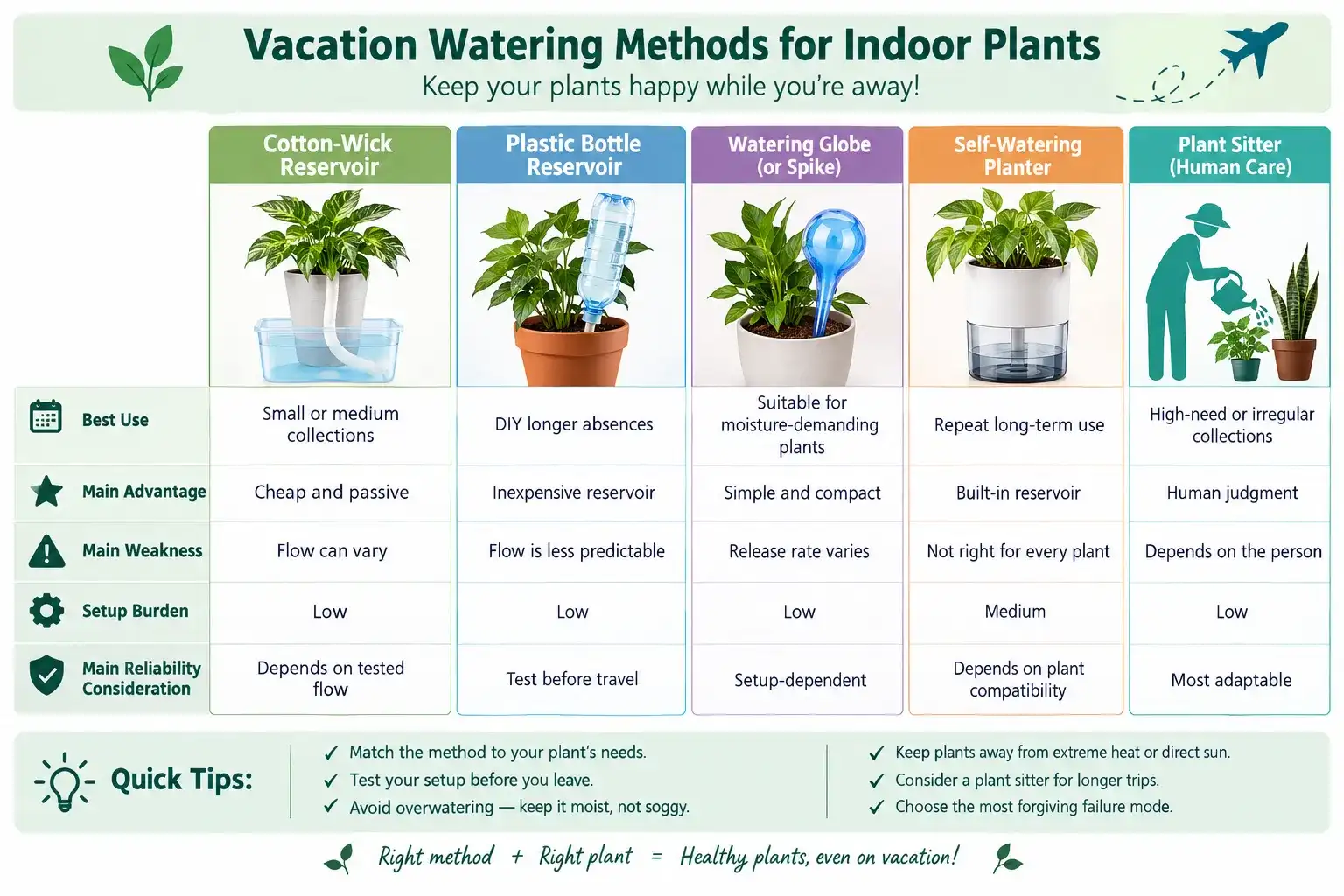
For a short trip, normal pre-watering may be enough for some plants; for longer trips, a tested wick, bottle reservoir, watering globe, or self-watering planter is more dependable. Choose based on the plant’s moisture needs, pot size, drainage, room conditions, and how long you will be away.
| Method | Best use | Main advantage | Main weakness | Setup burden | Main reliability consideration |
| Normal pre-watering | Short absences | No equipment | Limited duration | Very low | Plant-dependent |
| Cotton-wick reservoir | Small or medium collections | Cheap and passive | Flow can vary | Low | Depends on tested flow |
| Bottle plus wick or drip | DIY longer absences | Inexpensive reservoir | Flow is less predictable | Low | Test before travel |
| Watering globe or spike | Suitable moisture-demanding plants | Simple and compact | Release rate varies | Low | Setup-dependent |
| Self-watering planter | Repeat long-term use | Built-in reservoir | Not right for every plant | Medium | Depends on plant compatibility |
| Plant sitter | High-need or irregular collections | Human judgment | Depends on the person | Low | Most adaptable |
The table highlights the key distinction many vacation-watering lists miss: reliability isn’t the same as convenience.
A self watering indoor plant setup only makes sense when its moisture delivery matches the plant’s normal wet-dry cycle. A built-in reservoir can work well for a plant that tolerates consistent moisture, while it can be a poor fit for a plant that needs the potting mix to dry between waterings. The RHS makes this distinction explicitly, saying self-watering containers suit plants that need moisture year-round and do not mind staying moist.
The same principle applies to an automatic plant waterer. Automation only helps if the device delivers the right amount of water to the right plant.
Which method is best for a one-week vacation?
For a week, start with the simplest option that fits the plant.
Some established houseplants can manage a short absence with normal watering before departure. The RHS says most houseplants can tolerate a few days away, while absences longer than a week may require extra moisture measures.
For plants that dry quickly, a small passive system may be more sensible than relying on a large reservoir.
Which method is best for two weeks or longer?
For longer absences, prioritise controlled moisture and a known failure mode.
Plant owners managing mixed collections over multi-week absences typically group plants by watering demand and assign different systems rather than forcing every pot onto one vacation setup, because one moisture strategy rarely suits both drought-tolerant and moisture-demanding plants.
That is a much better operating rule than buying one device for every pot.
Do self-watering globes actually work?
Self-watering globes can work, but they aren’t universal insurance against dry soil.
Their performance depends on how quickly water leaves the reservoir, how the device sits in the potting mix, how thirsty the plant is, and how much moisture the container can hold. Treat a globe or spike as a delivery tool, not as a promise that a plant can safely go a fixed number of days without attention.
A simple test is far more valuable than a confident label. Set it up before you leave and watch whether the reservoir loses water while the soil responds sensibly.
Non-commodity insight: The best vacation watering system has the most forgiving failure mode, not necessarily the cheapest or most automated. You can adjust a system that delivers too little water during testing, but a setup that keeps a plant continuously saturated can create a different problem altogether.
Takeaway: Choose for predictability first, convenience second.
How to water indoor plants while on vacation for a week, two weeks, or a month?
The longer you are away, the less you should rely on a single pre-trip watering. A short absence may require only normal preparation for some plants. Longer absences often call for a tested reservoir method or human oversight, while month-long trips require especially careful matching of the system to the plant and room conditions.
For up to 7 days
Start with normal watering and environmental adjustments.
Move plants away from extreme heat or strong direct sun. Grouping can reduce exposure and make care easier. Avoid moving plants into a completely different growing environment right before you leave.
Some plants may need more than this, especially if they live in small pots, warm rooms, or bright locations.
For 8-14 days
This is the range where vacation plant watering becomes more about controlled delivery.
A wick, bottle reservoir, watering globe, or suitable self-watering planter can extend the moisture available to a plant, but only after you test it. A reservoir that empties too quickly doesn’t solve the problem. Neither does a system that keeps the pot saturated.
How Often to Water Indoor Plants
For 2-4 weeks
At this point, don’t build the entire plan around a clever hack.
Use a passive reservoir system that suits the plant, or arrange human oversight. The RHS recommends considering a trusted neighbour, friend, or relative for absences longer than a couple of weeks.
For valuable plants, adding a human check can reduce the chance that a failed passive system goes unnoticed. A reservoir can supply water while a person checks the collection for a blocked wick, an empty container, a tipped pot, or an unexpected environmental change.
For a month or longer
A month-long absence requires more planning.
The question isn’t simply, “How can I water plants on vacation for a month?” It’s, “What happens if the chosen system doesn’t behave as expected?”
For a long trip, a plant sitter becomes more useful because a person can respond to conditions a passive device cannot see. A sitter can notice dry soil, standing water, fallen foliage, a failed reservoir, or another problem and act on it.
Takeaway: As the trip gets longer, reliability and backup care matter more than cleverness.
What are the best DIY ways to water indoor plants while you are away?
The most practical DIY vacation systems use capillary or slow-delivery watering: a cotton wick from a water reservoir, a bottle-based wick or drip setup, or a correctly configured shallow-water arrangement for suitable pots. The important variable is controlled moisture delivery, not the container itself.
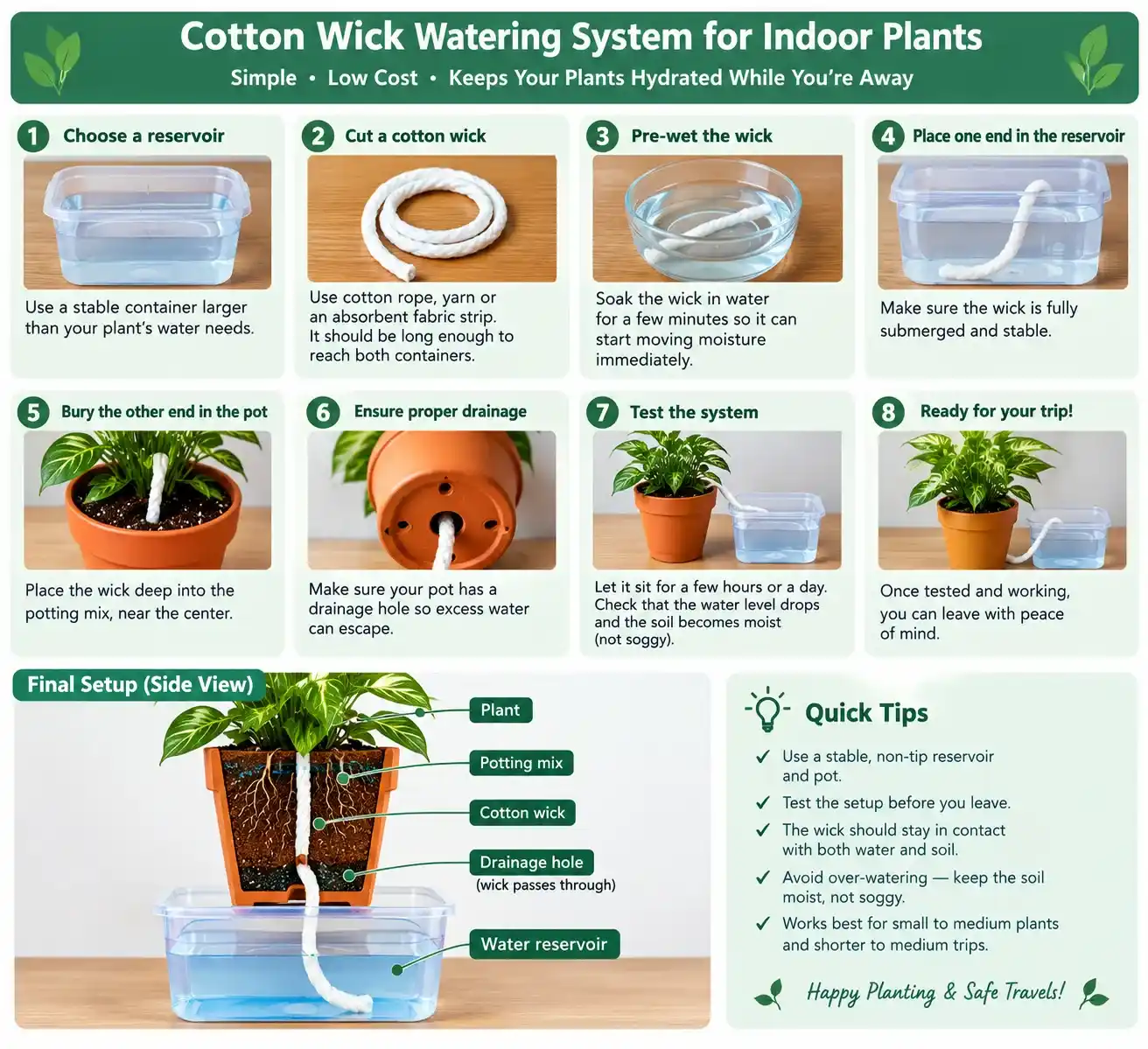
How do you make a simple cotton-wick watering system?
Wick watering works through capillary action. Water moves from a reservoir toward the drier potting medium through an absorbent material.
- Choose a stable water reservoir larger than the expected daily demand.
- Cut an absorbent cotton or fabric wick to reach both containers.
- Pre-wet the wick so water movement can start immediately.
- Place one end deep in the reservoir.
- Bury the other end securely in the potting mix.
- Position the reservoir and wick so neither tips, slips, nor loses contact during the test.
- Test the complete setup before leaving home.
A common mistake is testing the wick only for setup position. Test the water movement too. If the reservoir level never changes or the soil remains unchanged, the system isn’t ready for a suitcase and airport departure.
University of Georgia Extension describes the same basic principle for houseplants, using a raised water container and fabric cord to move water through capillary action.
Practitioner detail: A wick can touch the reservoir and still deliver poorly if its contact with the potting mix is weak or the wick isn’t transferring water effectively. Test the actual pot for moisture movement before relying on the system during travel.
Can you water plants with a plastic bottle while on vacation?
Yes, a plastic bottle can serve as a simple reservoir, but the bottle itself isn’t the clever part.
The challenge is controlling flow. A bottle that releases water too quickly becomes a flood. One that releases too slowly may barely help.
A homemade bottle system can therefore work best when the bottle is stable, the delivery path is predictable, and the setup has been tested with the actual plant.
For anyone comparing ways to water plants, the useful question isn’t “Does the bottle trick work?” It is “How does this particular setup behave for this particular pot?”
Can plants sit in a sink or bathtub while you are away?
A sink or bathtub can help with collections of suitable potted plants, particularly when paired with capillary matting.
The RHS recommends capillary matting for groups of smaller pots and describes placing plants on wet matting so they can draw up moisture. It notes that clay pots may need thorough watering first so they can begin drawing moisture effectively.
But don’t place every plant in standing water simply because the bathtub or sink is convenient. The RHS’s capillary-matting method uses wet matting that plants draw from, not prolonged submersion of every pot. Drainage still matters, and plants that dislike prolonged moisture aren’t good candidates for this setup.
Takeaway: DIY vacation systems work when they create predictable moisture movement. The container is secondary.
Which indoor plants need a different vacation-watering strategy?
Not every indoor plant should receive the same vacation treatment. Succulents and cacti generally have different moisture needs than ferns, herbs, and other moisture-demanding plants, while orchids and plants in small or porous pots may require special handling. Base the method on the plant’s normal care pattern.
What about succulents and cacti?
Succulents and cacti store water in fleshy leaves, stems, or other plant tissues, so they generally need a different vacation plan from plants that prefer evenly moist conditions.
The RHS specifically excludes cacti and succulents from its general holiday-watering recommendation because they can tolerate longer dry periods.
That doesn’t mean you should ignore them for months. It means a constant reservoir isn’t automatically an improvement.
What about ferns, herbs, peace lilies, calatheas and other thirsty plants?
Plants with higher moisture demands deserve more attention to consistency.
Light, temperature, humidity, pot size and potting mix can all change drying speed. That makes a controlled reservoir or human check more attractive for longer absences.
Don’t copy a cactus setup onto a fern just because both are in attractive pots. The watering strategy follows the plant.
What about orchids and plants that prefer drying between waterings?
Plants that need a drying period between waterings are a poor match for systems designed to keep the potting mix constantly moist.
That is the key distinction. A reservoir system can provide useful moisture without being appropriate for every root system. The plant’s normal wet-dry cycle still matters while the owner is away.
How do pot size and pot material change vacation watering?
Pot size and material can change how quickly a plant dries, so two identical plants may need different vacation setups.
Unglazed clay is porous and tends to dry faster than plastic. Illinois Extension specifically notes that plants in unglazed clay pots generally require more frequent watering than those in plastic pots.
A small pot generally contains less potting medium to hold moisture than a larger pot, while light, temperature and humidity can affect how quickly that moisture is lost. Think of the full setup as a system:
plant + pot + potting mix + light + temperature + drainage + absence length
That model is more useful than a universal watering calendar.
Takeaway: Vacation watering should fit the plant’s normal rhythm, not force every plant into the same reservoir setup.
What should you do when you get home from vacation?
When you return, check soil moisture, leaves, stems, drainage and any reservoir before watering again. Remove or disconnect temporary systems, check the plant’s condition before restoring its usual position and watering routine, and inspect for standing water, pest problems or signs of stress before resuming your usual care.
What should you check first?
Start with the pot, not the leaves.
Check soil moisture, then check the drainage hole and saucer. If a passive system is still connected, inspect the reservoir and wick before deciding what the plant needs next.
University of Iowa Extension advises checking actual soil moisture because wilting can sometimes signal overwatering as well as dryness.
Don’t automatically water just because you were away.
Should you water a plant immediately if it looks wilted?
Not necessarily.
Wilted foliage can come from dry soil, but it can have other causes. Check the potting mix first. If the soil is already wet, adding more water can make the situation worse.
If the potting mix has become extremely dry, water may run down the sides instead of soaking evenly. Iowa State University Extension recommends watering repeatedly until the root system is thoroughly wet and notes that very dry potting soil can resist re-wetting.
And once the plants are stable, restore their normal location and routine instead of keeping emergency measures in place indefinitely.
The next question is what changes when those vacations happen repeatedly, especially as seasons, room temperatures, and plant growth change.
What are the most common questions about watering indoor plants on vacation?
The right vacation-watering method depends mainly on how long you will be away, how quickly each plant normally dries, whether the pot drains freely, and whether you’ve tested the watering system. A reliable setup is matched, tested and adjusted rather than filled with more water.