
How to Increase Humidity for Indoor Plants: Simple Methods That Actually Help
A houseplant can look perfectly watered and still develop crispy brown leaf tips, curled foliage, or dry-looking edges. Low humidity may be part of the problem, especially when plants sit near heaters, air vents, or drafty doors.
If you’re wondering how to increase humidity for indoor plants without buying a pile of gadgets, start by measuring the humidity and identifying what is actually causing the problem.
So how do you fix it without buying a pile of gadgets?
The most reliable way to increase humidity for indoor plants is to use a plant humidifier for consistent control. Grouping plants, moving suitable plants to naturally humid rooms, and using enclosed spaces can help too. The right method depends on the plant, the room, and how dry the air actually is.
How Do You Know Your Indoor Plants Need More Humidity?
A plant may need more humidity when its environment stays dry and it develops symptoms such as crispy leaf edges or dry foliage. But these symptoms do not prove humidity is the cause. Check the room’s relative humidity and review watering, light, temperature, and fertilizer before changing your routine.
What humidity level is Too Low for houseplants?
Relative humidity, usually shortened to RH, describes how much water vapor is in the air compared with the amount the air could hold at that temperature.
Many common houseplants do well at moderate indoor humidity. University of New Hampshire Extension recommends roughly 40% to 60% relative humidity for many houseplants, while some tropical plants can benefit from higher levels. Cacti and succulents generally tolerate drier conditions.
That does not mean a plant sitting at 39% RH is suddenly in trouble. Plant response depends on species, temperature, airflow, root health, watering, and light.
What signs can point to dry air?
Low humidity can contribute to:
- Brown or crispy leaf tips
- Dry leaf margins
- Foliage that looks unusually dry
- Greater water loss from leaves
- Stress that becomes more noticeable around heat sources
Brown tips are tricky, though. Iowa State University Extension lists low humidity, inconsistent watering, fertilizer-related problems, water quality, temperature changes, and light conditions among possible causes of brown leaf tips and edges.
So don’t see one brown leaf and immediately buy a humidifier.
Why should you measure humidity instead of guessing?
A small digital hygrometer can tell you what the room is actually doing.
That’s useful because indoor humidity can vary significantly between rooms. A bathroom after a shower may have very different humidity conditions from a bedroom with a heater running nearby.
It also prevents another common mistake: adding moisture when the real problem is overwatering, poor drainage, or damaged roots.
What Humidity Level Should You Aim for With Indoor Plants?
There is no single ideal humidity level for every houseplant. Many common houseplants tolerate moderate indoor RH, while tropical species often benefit from higher humidity. The practical target should match the plant rather than forcing every houseplant into one number.
Think in relative humidity, not just “moist air”
Relative humidity changes with air temperature because the amount of water vapor needed to reach saturation changes as temperature changes.
This is why relative humidity is not the same thing as the total amount of moisture in the air. Absolute humidity and specific humidity describe moisture content in different ways, while dew point gives another way to think about how close air is to saturation.
You don’t need an ideal gas law lesson to care for a pothos.
For everyday plant care, RH is the useful number to watch.
The same amount of water vapor can produce different relative humidities at different temperatures. That is why a room can feel dry even when it still contains moisture. Higher humidity isn’t automatically better, either: very humid, stagnant conditions can create problems when airflow is poor.
What about tropical plants?
Humidity-loving plants can appreciate higher RH than many drought-adapted plants.
Orchids and other humidity-sensitive plants can benefit from higher relative humidity, but humidity should be considered alongside air movement. High humidity without enough circulation can create other problems.
That gives you an important lesson: high humidity is not automatically better.
A humid, stagnant corner can be a worse setup than a slightly drier room with gentle air circulation.
How high is too high?
The goal is not to chase 80% RH simply because a plant is tropical.
Humidity conditions should fit the plant and the whole environment. If a room becomes persistently humid, condensation and poor airflow can become concerns. The plant needs suitable light, temperature, moisture, and air movement as part of the same system.
Takeaway: Aim for a stable, plant-appropriate humidity level rather than the highest number a hygrometer can display.
|
Method |
Primary effect |
Best for |
Cost |
Main limitation |
|---|---|---|---|---|
|
Humidifier |
Raises room humidity |
Dry rooms and multiple plants |
$$ |
Requires equipment and monitoring |
|
Grouping plants |
Creates a local microclimate |
Several plants together |
Free |
Effect is limited to the immediate area |
|
Humid room |
Uses existing environmental humidity |
Suitable plants in bathrooms or kitchens |
Free |
Light and temperature may not be suitable |
|
Terrarium or cloche |
Creates enclosed high humidity |
Small, humidity-loving plants |
$$ |
Not practical for large plants |
|
Pebble tray |
Provides a small local moisture source |
Individual plants |
$ |
Limited effect on surrounding humidity |
|
Misting |
Temporarily wets foliage |
Limited supplemental use |
$ |
Not reliable for sustained humidity control |
The right method depends on whether you need to raise humidity throughout a room or only create a more humid environment around one plant.
Best Ways for How to Increase Humidity for Indoor Plants?
The best method depends on whether you need to change the humidity of an entire room or create a more humid environment around a few plants.
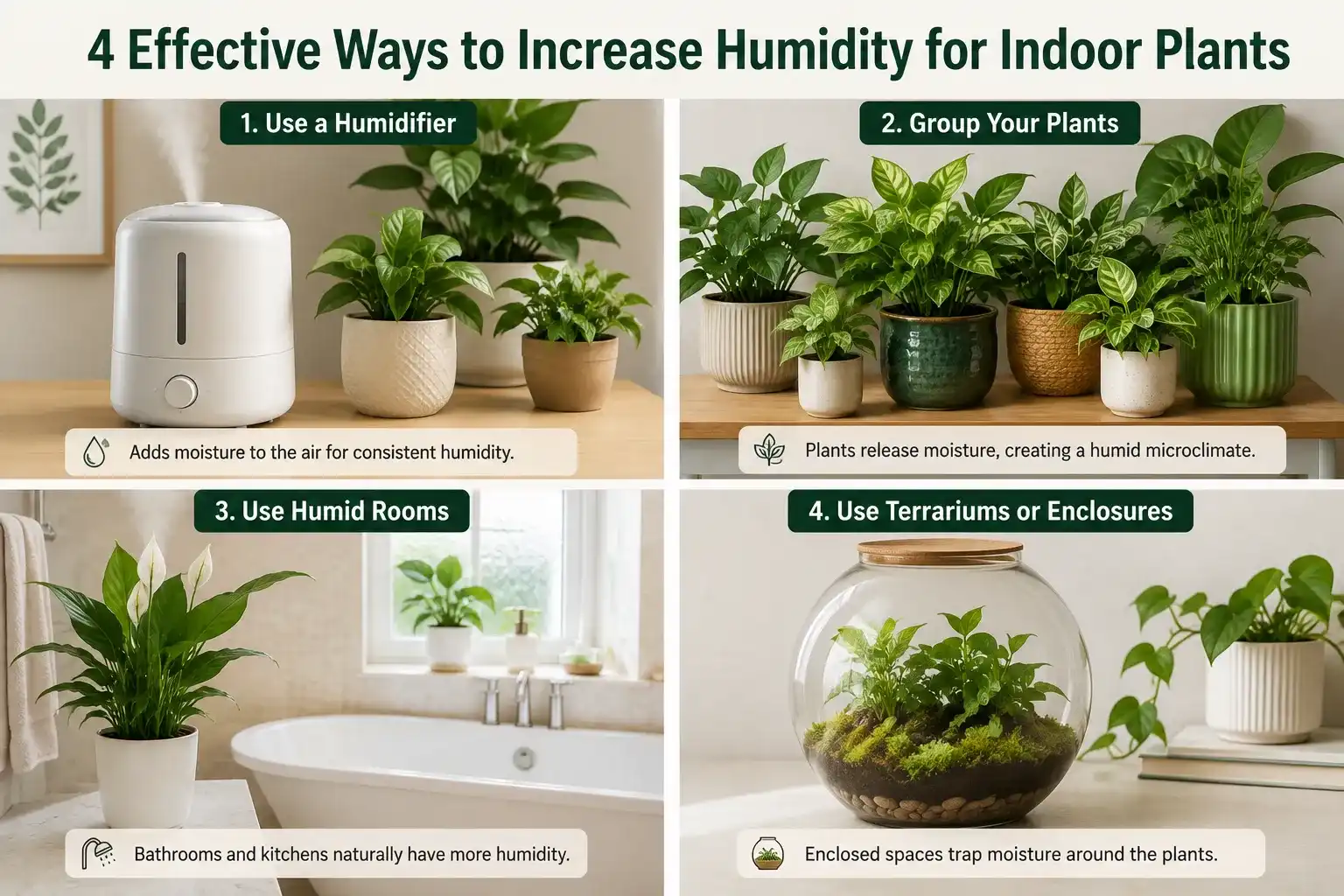
Use a humidifier for consistent humidity
A plant humidifier makes the most sense when several plants share a dry room or when measured RH stays below the level your plants handle well.
That makes a humidifier particularly useful when several plants share the same dry room.
University of New Hampshire Extension recommends using a portable humidifier for more consistent control and pairing it with a digital thermometer and hygrometer so the change in RH can be monitored.
Don’t point a powerful stream of moisture directly at foliage and assume more is better. The goal is stable humidity, not constantly wet leaves.
Group your plants together
Grouping plants is one of the simplest ways to create local humidity.
Plants release water through transpiration, and moisture can evaporate from potting media. When several plants are placed close together, that moisture can remain concentrated around the foliage instead of immediately spreading through a large room.
This works best when the group is reasonably compact and there is not strong air movement constantly stripping moisture away.
Move suitable plants to humid rooms
Bathrooms and kitchens can naturally have more moisture than other rooms.
That makes them useful locations for humidity-loving plants, provided the lighting and temperature are appropriate. A dark bathroom is not a good plant location simply because it is humid.
Use terrariums, cloches, or other enclosed spaces
An enclosure can hold water vapor around a plant far more effectively than an open room.
Enclosed spaces such as terrariums and cloches can maintain a more humid environment around suitable small plants. The tradeoff is that enclosed spaces need monitoring so excess moisture and poor airflow don’t create problems.
The practical distinction most guides miss
A grouped collection can create a useful local microclimate without noticeably changing the RH on the other side of the room. A humidifier, by contrast, can affect the broader room environment.
That distinction matters more than most lists of “humidity hacks” admit.
Takeaway: Choose the smallest intervention that can actually solve the humidity problem.
Do Pebble Trays, Bowls of Water, and Misting Actually Increase Humidity?
Pebble trays, bowls of water, and misting can put moisture into the air, but their effect is very different from a room humidifier. Misting fades quickly, while trays may provide a small local benefit. They should not be treated as equal solutions for persistent whole-room dry air.
Do pebble trays work?
Yes, but expectations matter.
A pebble tray consists of a shallow tray containing water and pebbles that raise the pot above the water line. Evaporation adds moisture near the plant.
The University of New Hampshire says pebble trays can provide a small humidity benefit, especially when used around several plants and in areas with low air circulation.
Iowa State gives similar guidance but emphasizes keeping the bottom of the pot above the water. Otherwise the roots remain in wet conditions and the plant can develop root problems.
Does a bowl of water increase humidity for plants?
Water evaporates, so a bowl can contribute some water vapor to surrounding air.
But a bowl is not automatically an effective room humidifier. The amount of evaporation depends on factors such as water surface area, air movement, temperature, and the size of the room.
The bigger the space, the harder it is for a small exposed water surface to create a meaningful change in overall RH.
Does misting houseplants help?
This is one of the most repeated pieces of indoor plant advice, and it is one of the easiest to misunderstand.
Penn State Extension explains that after misting, the temporary rise in humidity lasts only until the water evaporates, which can happen within minutes. Iowa State similarly says misting is not an effective way to raise relative humidity unless it is repeated several times a day.
Misting can have other uses for particular plants or for cleaning foliage. But it shouldn’t be sold as a reliable solution for a dry room.
When can these methods still make sense?
They can make sense as supplementary measures.
A pebble tray beneath a humidity-loving plant, a compact plant grouping, or an occasional misting routine may fit into a broader care strategy.
The mistake is expecting one small tray or spray bottle to transform a dry bedroom.
The humidity myth worth dropping
The assumption that a pebble tray is basically a natural humidifier is wrong.
A tray can create evaporation. That does not mean it will meaningfully humidify an entire room.
Penn State’s explanation is blunt: moisture from a wet pebble tray diffuses into the room, producing almost no overall change in room relative humidity.
That’s the useful distinction: moisture added is not the same as meaningful humidity control.
Takeaway: Use small DIY methods for local support, not as a substitute for measured, consistent humidity control.
Where Should You Place Indoor Plants to Keep Them More Humid?
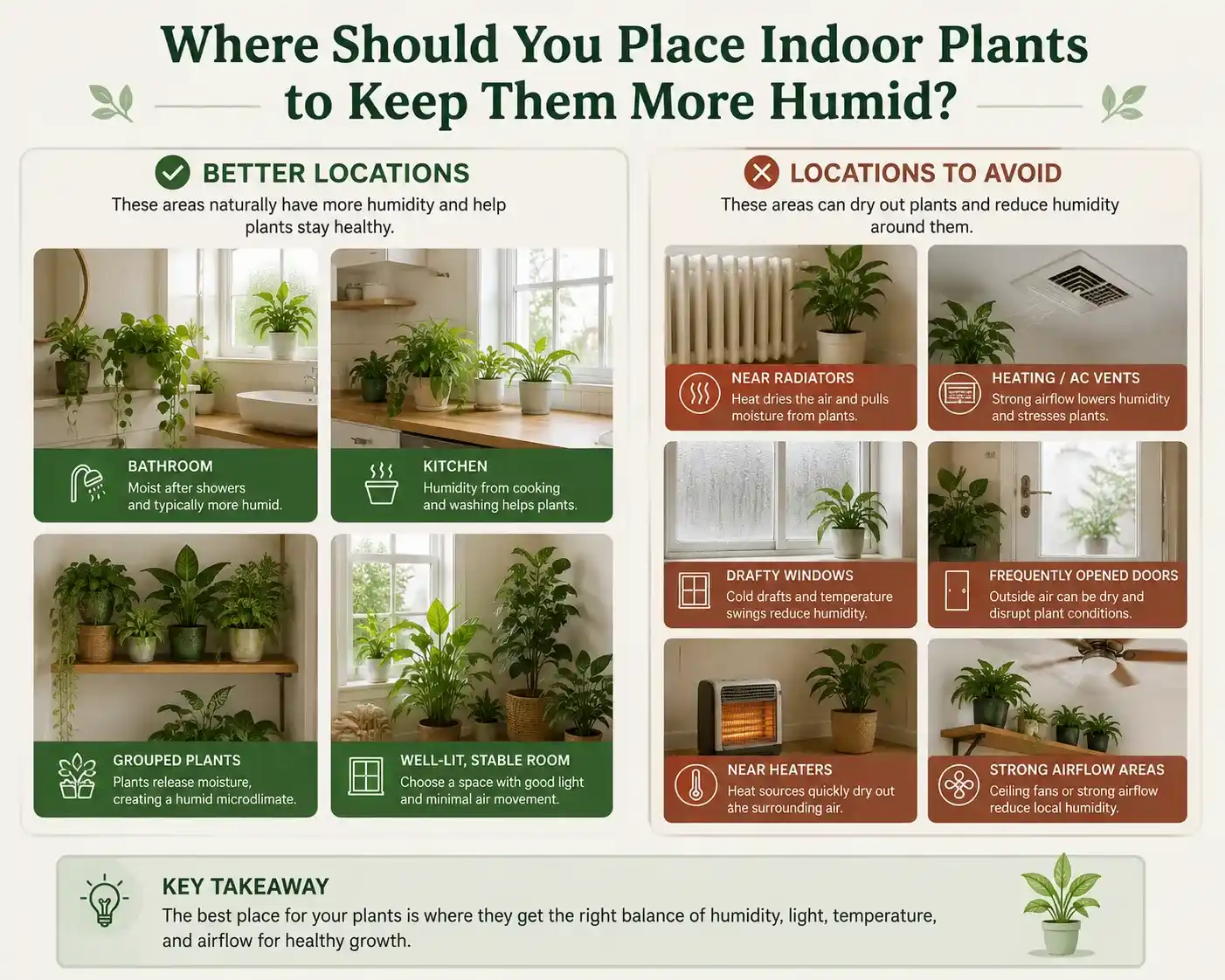
Placement can improve humidity without adding equipment. Group suitable plants together, use naturally more humid rooms when lighting permits, and keep plants away from heaters, heat vents, and strong drafts. The best location balances humidity with light, temperature, and airflow.
Better locations
A practical humidity-friendly location might be:
- A bathroom with adequate natural or supplemental light
- A kitchen away from direct heat
- A grouped plant shelf
- A room without strong HVAC airflow
- An area where several plants can share a local microclimate
The objective isn’t simply to find “the most humid room.” It is to find the best overall plant environment.
Locations to avoid
Keep humidity-sensitive plants away from:
- Radiators
- Heating vents
- Strong air-conditioning outlets
- Frequently opened exterior doors
- Drafty windows
- Areas with large temperature swings
University extension guidance specifically recommends moving plants away from heat vents, radiators, and drafty doors or windows when dry conditions are a problem.
Why light still matters
Putting a plant in a humid bathroom can sound like an easy win until the plant spends every day in inadequate light.
Humidity is only one part of the environment.
A plant that needs bright indirect light should not be pushed into a dark location solely to increase moisture. A better approach is often to improve humidity where the plant already has enough light.
A useful pattern for plant collections
People sometimes hope that adding more houseplants will solve a dry-air problem. Plants do release moisture through transpiration, but they should not be treated as a reliable substitute for humidity-control equipment.
Takeaway: The best humid location is one where the plant gets the right light and temperature too.
How Do You Increase Humidity Without a Humidifier?
You can increase humidity without a humidifier by grouping plants, moving suitable plants to naturally humid rooms, using enclosed growing spaces, and reducing exposure to drying airflow. These methods work best when combined and monitored rather than treated as one magic DIY fix.
Best no-humidifier approach for one plant
Start with placement.
Move the plant away from direct heat and strong airflow. If a suitable bathroom or kitchen receives enough light, that may be a better location.
For small humidity-loving plants, an appropriate enclosure can provide a much stronger humidity effect than leaving the plant exposed in a dry room.
Best approach for several plants
Grouping is the easiest place to start.
Bring compatible plants together and avoid positioning the group directly beside a heating vent or fan.
This approach costs nothing and can create a useful local humidity zone.
How to increase humidity for indoor plants DIY
A practical DIY approach starts with changing the plant’s surroundings rather than simply adding water nearby.
- Measure the room’s current relative humidity.
- Move plants away from heat and drying drafts.
- Group compatible plants together.
- Use a suitable naturally humid room when lighting allows.
- Enclose small humidity-loving plants when appropriate.
- Recheck the humidity after making environmental changes.
- Escalate to a humidifier if the room remains persistently dry.
A common mistake is skipping measurement and making several changes at once. That makes it impossible to tell which change actually helped.
When no-humidifier methods are unlikely to be enough
A larger dry room can overwhelm small local methods.
If the hygrometer continues showing low humidity after grouping and placement changes, a humidifier is usually the more practical next step.
That’s not a failure of DIY care. It is simply a scale problem.
[IMAGE SUGGESTION: Five-step visual showing measure, move, group, monitor, and humidify]
Takeaway: DIY humidity works best when it changes the plant’s environment rather than simply adding a little water nearby.
Final Takeaway
Increasing humidity for indoor plants is less about finding a magic humidity hack and more about matching the solution to the plant and the room. Measure the relative humidity first, correct obvious sources of dry airflow, and use grouping or naturally humid spaces when they are enough. If the room remains consistently dry, a humidifier provides more reliable control.
Most importantly, don’t chase the highest humidity reading. Healthy plants need the right combination of humidity, light, temperature, watering, and airflow.