
How Often to Water Indoor Plants Stop Guessing, Start Reading Your Plant
You’ve brought home a beautiful monstera from the garden center. The tag says water once weekly, but after five days the soil is soggy, and the leaves are yellowing. Meanwhile, your friend’s pothos has been thriving on the same watering day for three years. Why did the same schedule kill one plant and sustain another?
Is a watering schedule your enemy or your friend? What if the real secret isn’t how often, but knowing what to look for?
If you’ve overwatered a plant before, or watched one slowly dry out despite good intentions, you’re not careless; you’re missing a framework. This guide gives you that framework, and a way to discover your own watering frequency by the end of 30 days.
Here’s the direct answer: How often to water indoor plants depends on multiple factors: plant species, pot size and material, soil moisture levels, light exposure, humidity, temperature, and season. Rather than following a rigid schedule, the most reliable method is checking your soil 1–2 inches below the surface using
the finger test. If it feels dry to the touch, water thoroughly until it drains from the pot. Most popular indoor plants need water every 7–14 days during the growing season (spring/summer) and every 14–21 days during dormancy (fall/winter), though drought-tolerant plants like succulents need significantly less. Environmental factors and individual plant needs create wide variation from these ranges. This guide walks you through how to read your plant’s environment, discover your own rhythm, and stop guessing.
The Once Weekly Rule Is Killing Your PlantsHere’s Why
Myth vs. Reality:
|
Myth |
Reality |
|---|---|
|
Water once per week. |
Schedules ignore soil, environment, and pot type. |
|
Follow the tag. |
Tags assume greenhouse conditions, not your home. |
|
Droopy leaves = thirsty. |
Droopy leaves signal stressoften overwatering. |
|
More water = healthier. |
Overwatering is the #1 killer of houseplants. |
|
One schedule fits all. |
Your south window dries soil faster than your north corner. |
So how often to water indoor plants? The schedule myth came from garden soil, which drains differently than indoor potting mix. It persists because it’s simple to repeat, but simplicity doesn’t match reality.
What actually matters: Three things control watering needs: 1 how fast your soil dries, 2 your apartment’s climate, and 3 the plant type. A schedule ignores all three.
Instead of watering on Thursday, use this: check soil every 3–4 days. When the top 1.5 inches feel dry, water thoroughly until drainage appears. Repeat. This takes 30 seconds per plant and adapts automatically to seasons, weather, and room differences.
Key insight: Schedules are brittle. Observation is flexible. Readers stop feeling guilty about forgetting a day and start feeling empowered by learning to observe.
Your Apartment Has Climate Zones That Affect Watering
Your apartment isn’t one climate. It’s a collection of microclimates. The bathroom is humid. The south-facing window is bright and dries soil quickly. The north corner is cool and moist. A schedule that works in one zone fails in another.
Zone 1: Bathroom High Humidity, Slow Drying
- Shower steam raises humidity noticeably above other rooms.
- Soil stays moist considerably longer than in other areas.
- Best plants: Ferns, Calathea, Pothos
- Watering adjustment: Every 8–12 days instead of 7–10
- Common mistake: Assuming moist soil means it’s thriving; overwatering anyway
Zone 2: South-Facing Window Bright, Fast Drying
- Direct sun heats soil and accelerates evaporation.
- Dries noticeably faster than room average
- Best plants: Succulents, Snake Plant, Monstera
- Watering adjustment: Every 5–7 days or less for succulents
- Common mistake: Placing humidity-lovers here; they scorch and dry out
Zone 3: North Corner Low Light, Slow Drying
- No direct sun; coolest room area
- Soil dries considerably slower than sunny spots.
- Best plants: ZZ Plant, Snake Plant, Pothos, low-light tolerant varieties
- Watering adjustment: Every 12–14 days
- Common mistake: Thinking low light means the plant is suffering; overwatering to compensate
Zone 4: Kitchen/Near Heat Medium Light, Erratic
- Cooking heats air intermittently; drying is unpredictable.
- Check every 3–4 days; water when top inch is dry.
- Best plants: Herbs Basil, Mint, Monstera, Pothos
- Common mistake: Watering Monday, not checking Wednesday when cooking has dried soil fast
Finding your zones: Identify each room where you keep plants. Note the light: bright, medium, low, and any heat sources vent, radiator, window. Track one plant there for 2 weeks using the monitoring log. By week 2, you’ll know the zone’s drying speed.
Key insight: Environmental factors explain why plant types and schedules differ. Move a struggling plant to the right zone, and it often recovers without watering changes.
Seasonal Watering Shifts Are Real and Substantial
Your plants don’t have the same watering needs year-round. In spring and summer, they grow fast and need more water. Understanding how often to water indoor plants during each season is crucial because in fall and winter, growth slows, and water needs drop. This isn’t minor; it’s dramatic.
Growing Season Spring/Summer:
- Longer days = more light; warmer temps = faster growth
- Roots absorb water faster; leaves transpire more moisture.
- Soil dries considerably faster than in winter.
- Watering frequency: Every 7–10 days for most tropicals
- Why it matters: Beginners on a once weekly schedule forget to water earlier in spring; root stress follows
Dormant Season Fall/Winter:
- Shorter days = less light; cooler temps = slower metabolism
- Plant growth slows or stops; roots absorb water slowly.
- Soil dries considerably slower than in summer.
- Watering frequency: Every 14–21 days for most plants, sometimes longer for drought-tolerant types
- Why it matters: Beginners on a once-weekly schedule overwater dormant plants; root rot develops
The Heating Trap: In winter, your heating system creates a paradox: indoor air is warm like summer, but humidity drops and plant metabolism is slow like winter. Result: soil dries faster, but roots can’t use the water. Solution: Check soil more often in winter, but water less frequently than you’d think.
Seasonal Example Monstera:
- Summer July: Dry by day 5–6
- Winter January: Still moist at day 14
- Same plant, same pot, different seasons = different watering frequencies. Schedules can’t adapt. Soil checks can.
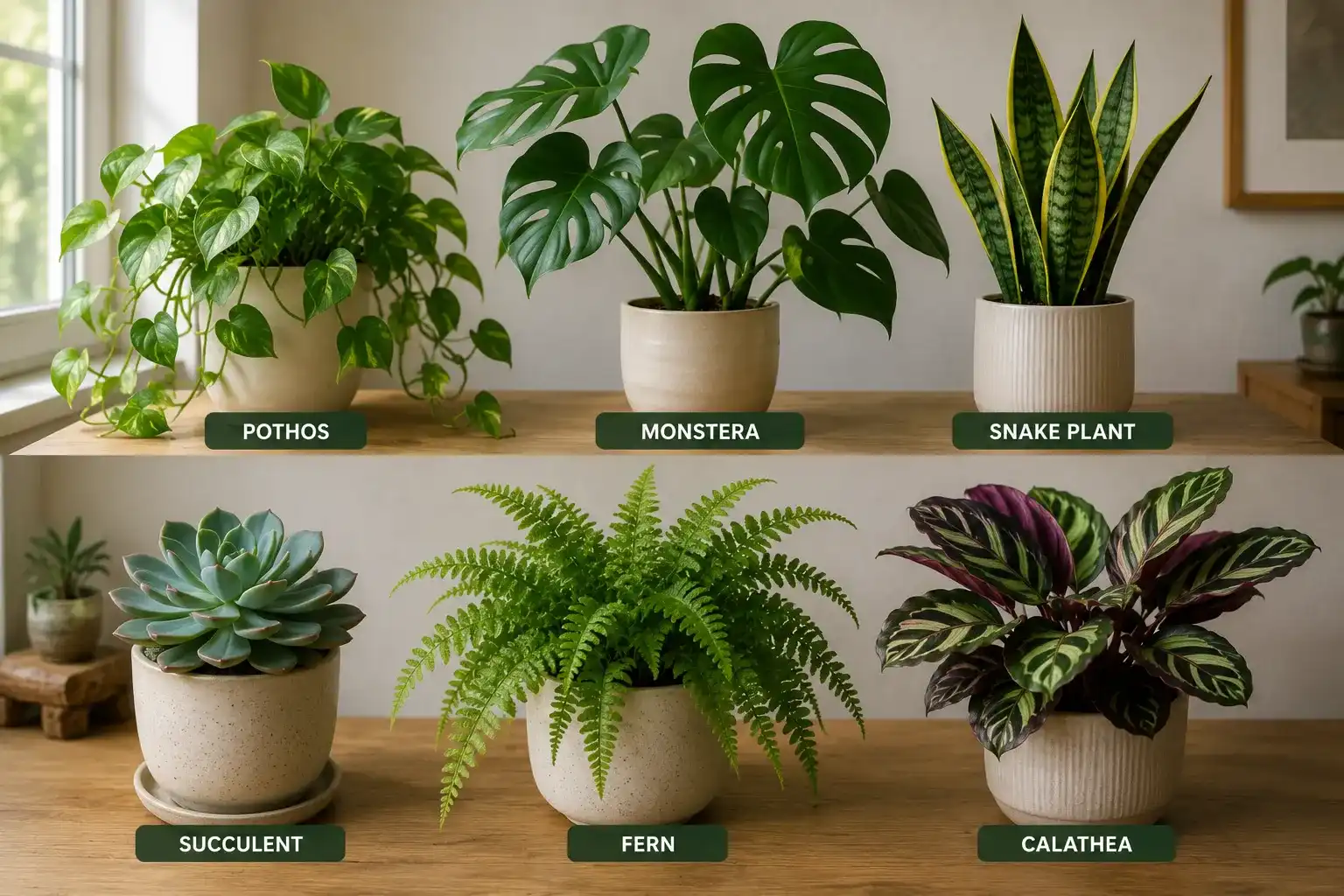
Plant-Specific Watering Popular Houseplants Reference
|
Plant |
Typical Frequency |
Drying Preference |
Key Note |
|---|---|---|---|
|
Pothos |
Every 7–10 days |
Soil dries halfway |
Forgiving; adapts to most conditions |
|
Monstera |
Every 7–10 days |
Dries mostly, not bone-dry |
Larger plants in bigger pots dry slower |
|
Snake Plant |
Every 14–21 days summer; extend to 4–8 weeks winter dormancy |
Bone-dry preferred |
Underwater rather than over; extremely rot-prone |
|
Succulent Echeveria, Jade |
Every 14–21+ days |
Bone-dry required |
Winter = 50% less frequency; nearly dormant |
|
Calathea |
Every 5–7 days |
Consistently moist, never soggy |
Humidity-sensitive; prefers bathroom zone; brown tips if water quality is poor |
|
Boston Fern |
Every 5–7 days winter; 2–4 days summer |
Consistently moist |
Needs frequent watering in warm seasons; high humidity essential |
|
ZZ Plant |
Every 14–21 days |
Dries fully between water |
Neglect-tolerant; nearly unkillable |
|
Basil Herb |
Every 3–5 days |
Moist but drains well |
Fast-growing; water more than foliage plants |
Understanding how often to water indoor plants depends on plant type.
Key patterns:
- Succulents & Cacti: Underwater everything else. Bone-dry soil between waterings is non-negotiable.
- Tropical Foliage Pothos, Monstera: Prefer slightly moist soil- the Goldilocks zone.
- Ferns & Humidity-Lovers: Consistent moisture is key, but they also hate sitting in water: a narrow band. Bathroom zones are their home.
- Herbs & Greens: These grow fast and need water more often than decorative plants. Expect 3–5-day watering.
Practitioner detail: Larger Monsteras in bigger pots dry slower than smaller plants in small pots, even though they’re the same species. Track pot size + plant size together, not just plant type.
Three Ways to Know When Your Plant Needs Water
Forget the schedule. Here are three methods that work.
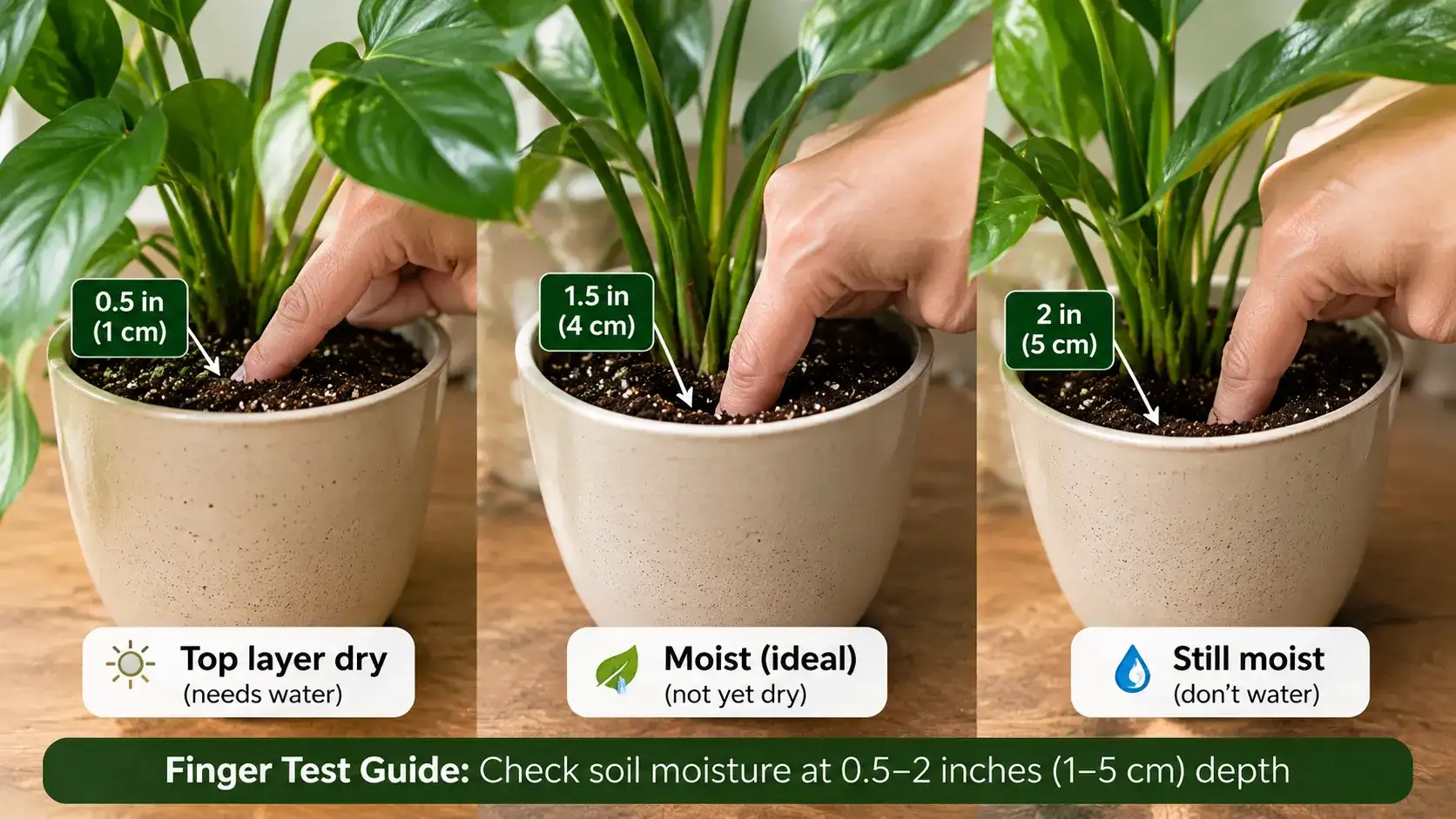
Method 1: The Finger Test Best Option
- Push your finger 1.5–2 inches into the soil; it should reach the root zone, not just the surface.
- Note how it feels: wet = don’t water; moist = wait 1–2 days; dry = water now.
- Water thoroughly until drainage appears. Empty the saucer after 30 minutes.
Why it works: It reads the actual root zone. Beginners who test only the top 0.5 inch see a dry surface and overwatered soil below. Always test at 1.5–2 inches. This detail fixes most watering mistakes.
Method 2: The Weight Test
- Lift the pot after watering when fully saturated. Feel its weight.
- Every 2–3 days, lift it again.
- When it’s noticeably lighter- maybe 30–40% lighter- soil is nearly dry. Water then.
Why it works: Water is heavy. After a few cycles, your hands calibrate to the difference. Less precise than the finger test but works for people who prefer it.
Method 3: Moisture Meter
- Analog $5–15: Lasts forever; less precise
- Digital $15–40: More precise; needs batteries.
Honest take: Meters build confidence but aren’t more accurate than the finger test used correctly. Only buy if you’ve tried the finger test for 4+ weeks and still doubted yourself.
Which to use? Start with the finger test. Everyone has fingers; zero cost. Best accuracy. After 2–3 weeks, you’ll trust your hands. Add the weight test if you doubt yourself. Buy a meter only if you like data and have 20+ plants.
Five Common Watering Mistakes And How to Stop Them
When learning how often to water indoor plants, beginners make the same five mistakes over and over
Mistake #1: Watering on Schedule Instead of Reading Soil
- You water on the same day every week, regardless of soil moisture.
- Result: Soil often feels moist when you water; you add saturation
- Fix: Throw away the schedule. Use the finger test every 3–4 days instead.
Mistake #2: Assuming Droopy Leaves Mean Thirsty
- Plant droops; you panic and water
- If the plant was already overwatered, drooping continues because roots are rotting.
- You water again; plant dies faster.
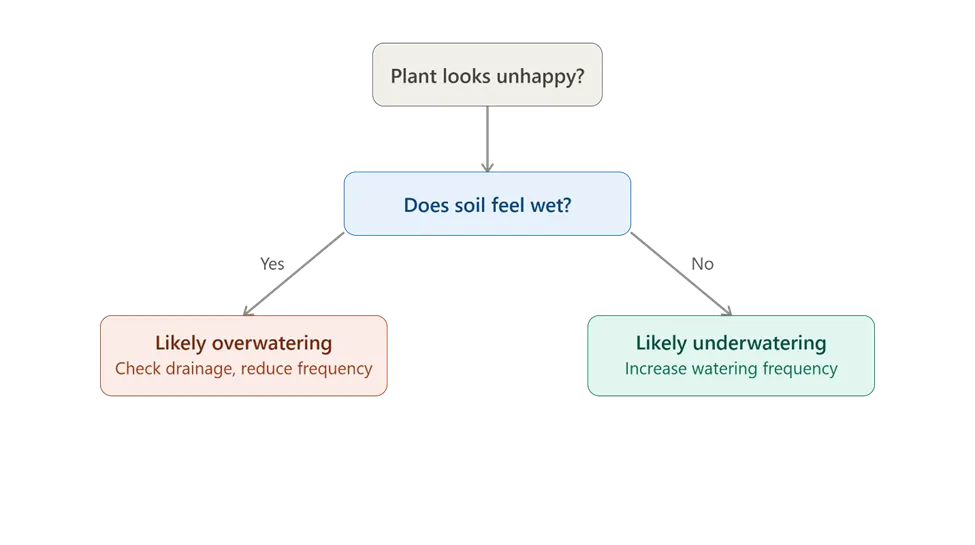
- Fix: Always check soil before watering. Droopy + wet soil = stop watering. Droopy + dry soil = water now
Mistake #3: Splashing Water on Leaves
- Wet leaves encourage fungal growth; leaves don’t absorb water anyway.
- Fix: Water at soil level only. Let water drain from the pot.
Mistake #4: A Little Bit of Watering Daily
- Soil never fully dries; it stays at 60–70% moisture where roots struggle to absorb efficiently.
- Result: Root rot within 2–3 weeks from constant dampness
- Fix: Water thoroughly until drainage appears, then don’t water again until soil is nearly dry.
Mistake #5: Ignoring Drainage Holes
- Plant is in a decorative pot with no drainage hole.
- Water sits; roots drown within 7 days.
- Fix: Use a plastic nursery pot inside the decorative pot, or drill a hole, or repot into a draining container. Non-negotiable.
Troubleshooting flowchart:
How to Recover From Overwatering Full Timeline
Overwatering is reversible if caught early. Here’s what root rot looks like at each stage and what to do.
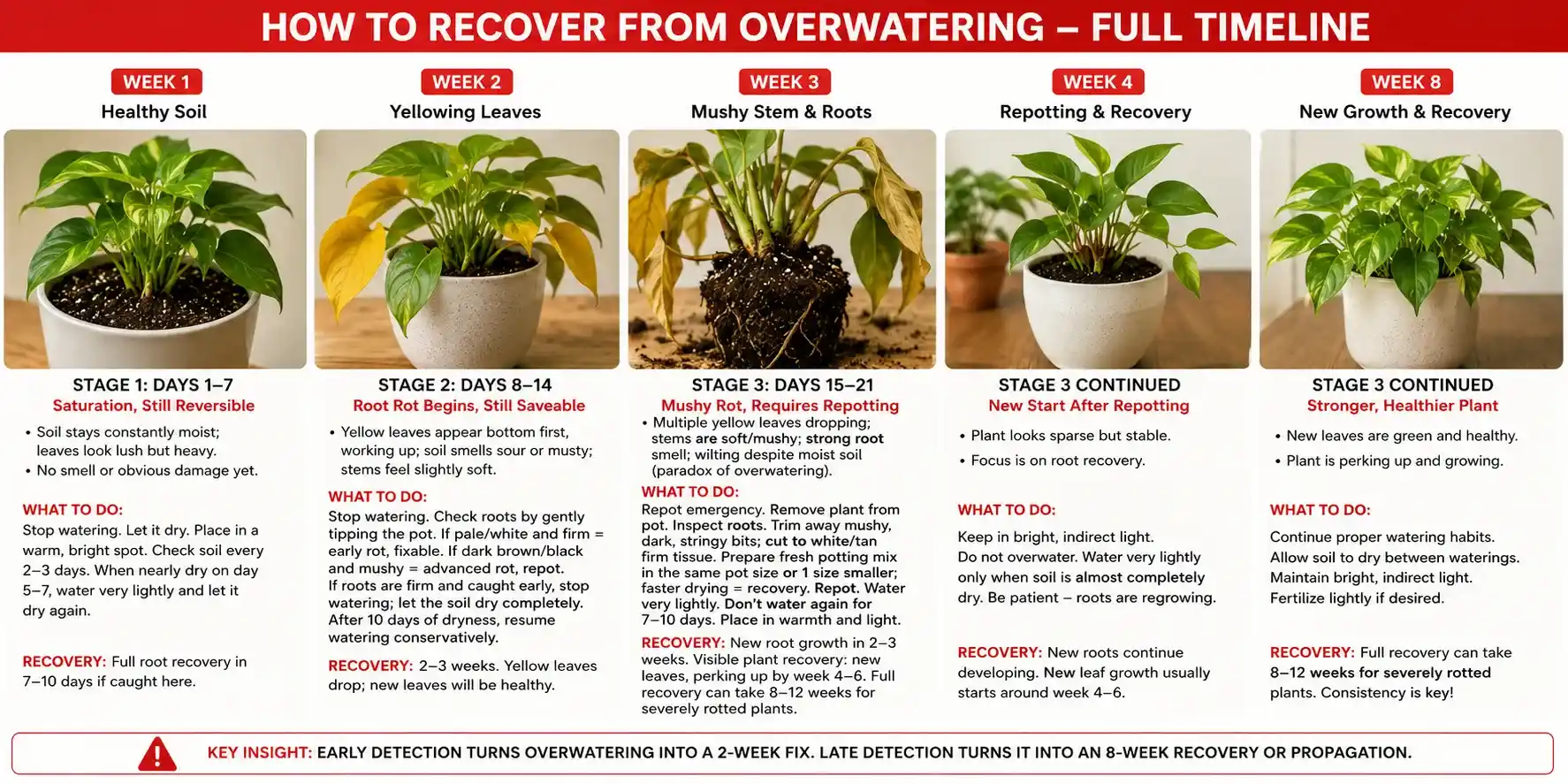
Stage 1: Days 1–7 Saturation, Still Reversible
- Soil stays constantly moist; leaves look lush but heavy.
- No smell or obvious damage yet
- What’s happening: Roots are struggling to breathe; bacteria are just starting to colonize
- What to do: Stop watering. Let it dry. Place in a warm, bright spot. Check soil every 2–3 days. When nearly dry on day 5–7, water very lightly and let it dry again.
- Recovery: Full root recovery in 7–10 days if caught here
Stage 2: Days 8–14 Root Rot Begins, Still Saveable
- Yellow leaves appear bottom first, working up; soil smells sour or musty; stems feel slightly soft.
- What’s happening: Bacteria have established; root cell walls are breaking down.
- What to do: Stop watering. Check roots by gently tipping the pot. If pale/white and firm = early rot, fixable. If dark brown/black and mushy = advanced rot, repot. If roots are firm and caught early, stop watering; let the soil dry completely. After 10 days of dryness, resume watering conservatively.
- Recovery: 2–3 weeks. Yellow leaves drop; new leaves will be healthy.
Stage 3: Days 15–21 Mushy Rot, Requires Repotting
- Multiple yellow leaves dropping; stems are soft/mushy; strong root smell; wilting despite moist soil paradox of overwatering.
- What to do: Repot emergency. Remove plant from pot. Inspect roots. Trim away mushy, dark, stringy bits; cut to white/tan firm tissue. Prepare fresh potting mix in the same pot size or 1 size smaller; faster drying = recovery. Repot. Water very lightly. Don’t water again for 7–10 days. Place in warmth and light.
- Recovery: New root growth in 2–3 weeks. Visible plant recovery: new leaves, perking up by week 4–6. Full recovery can take 8–12 weeks for severely rotted plants
Stage 4: Days 22+ Severe Rot, Last Resort
- Most leaves yellow and dropping; base of stems mushy/hollow; entire root system dark and non-functional
- If the stem is still green inside, cut a small notch to check: Propagate healthy stem sections in water or soil. Cut 4–6 inch sections. Remove lower leaves. Place in water or moist soil. In 2–4 weeks, roots develop.
- If the stem is dark/mushy throughout: The plant is likely gone. Learn from it and move forward.
Key insight: Early detection turns overwatering into a 2-week fix. Late detection turns it into an 8-week recovery or propagation.
The 30-Day Watering Journal: Discover Your Plant’s Rhythm
The fastest way to learn how often to water indoor plants is to log it. You’ll discover your plant’s rhythm in 30 days.
Why logging works: When you write down when you water and what the soil felt like, patterns emerge you’d miss otherwise. After 4 weeks, you know your plant’s exact drying speed.
How to use the log:
Weeks 1–2 Baseline: Don’t water yet. Just observe soil daily. Note if it feels: 1 bone-dry, 5 moist, 10 soggy. By day 7, you’ll see the baseline drying pattern.
Weeks 3–8 Active Tracking: Water when soil hits 3–4 on the 0–10 scale. Record date, amount rough: 1 cup, 2 cups, and days since last watering.
Pattern Emerges: By week 4, you know your plant’s exact needs. This Monstera needs water every 7 days. That Fern needs water every 5 days, not from a schedule- from observation.
Example Monstera, South-Facing Window:
- Week 1–2: Baseline shows soil dries wet → moist → barely moist → dry over 7 days
- Week 3: First watering day 7; soil now 10/10
- Week 4–8: Consistent pattern every 7 days; soil reaches the 3–4 zone where watering is needed
- Month 2: Late winter light is lower; drying slows; shift to every 8 days
Common discoveries: This plant needs a water-every-7-days pattern. Drying is faster on sunny days, slower on cloudy days; environment matters. I’ve been watering too often; the log revealed a frequency of 4 days, while actual drying showed 7–10. Winter needs less water; the seasonal shift is real and visible.
Optional Tools What Actually Helps
You don’t need special tools. The finger test and a watering can work for 95% of plant owners. But if you want to optimize:
Moisture Meters
- Analog $5–15: Lasts forever; less precise
- Digital $15–40: More precise; needs batteries.
- Honest take: Build confidence but aren’t more accurate than the finger test used correctly. Only buy if you’ve tried the finger test for 2+ weeks and still doubted yourself.
Self-Watering Pots
- Works for succulents and drought-tolerant plants
- Fails for humidity-lovers because water wicks continuously, oversaturating
- Useful if you travel monthly; not recommended for delicate plants
Automated Drip Systems
- Works if climate is consistent and timing is tested first
- Fails if humidity or light varies; zones differ; one zone dries faster than another.
- Use only if you’ve logged watering patterns first and know exact intervals.
Humidifiers
- Helps if your Ferns or Calatheas have brown leaf tips despite correct watering
- For one or two plants, grouping plants is enough.
- For a 20+ plant collection, a small humidifier can help humidity-lovers thrive.
Watering Cans: The One Essential Tool
- Long, narrow spout so you water soil, not leaves.
- Comfortable handle
- Size: 1–2 liters, manageable
- Budget option: Simple plastic can, $5–10
Honest take: Tools help confidence, not outcomes. Consistency beats gadgets.
Three Simple Experiments to Understand Your Space
Reading about watering is one thing. Running an experiment and seeing patterns yourself is another.
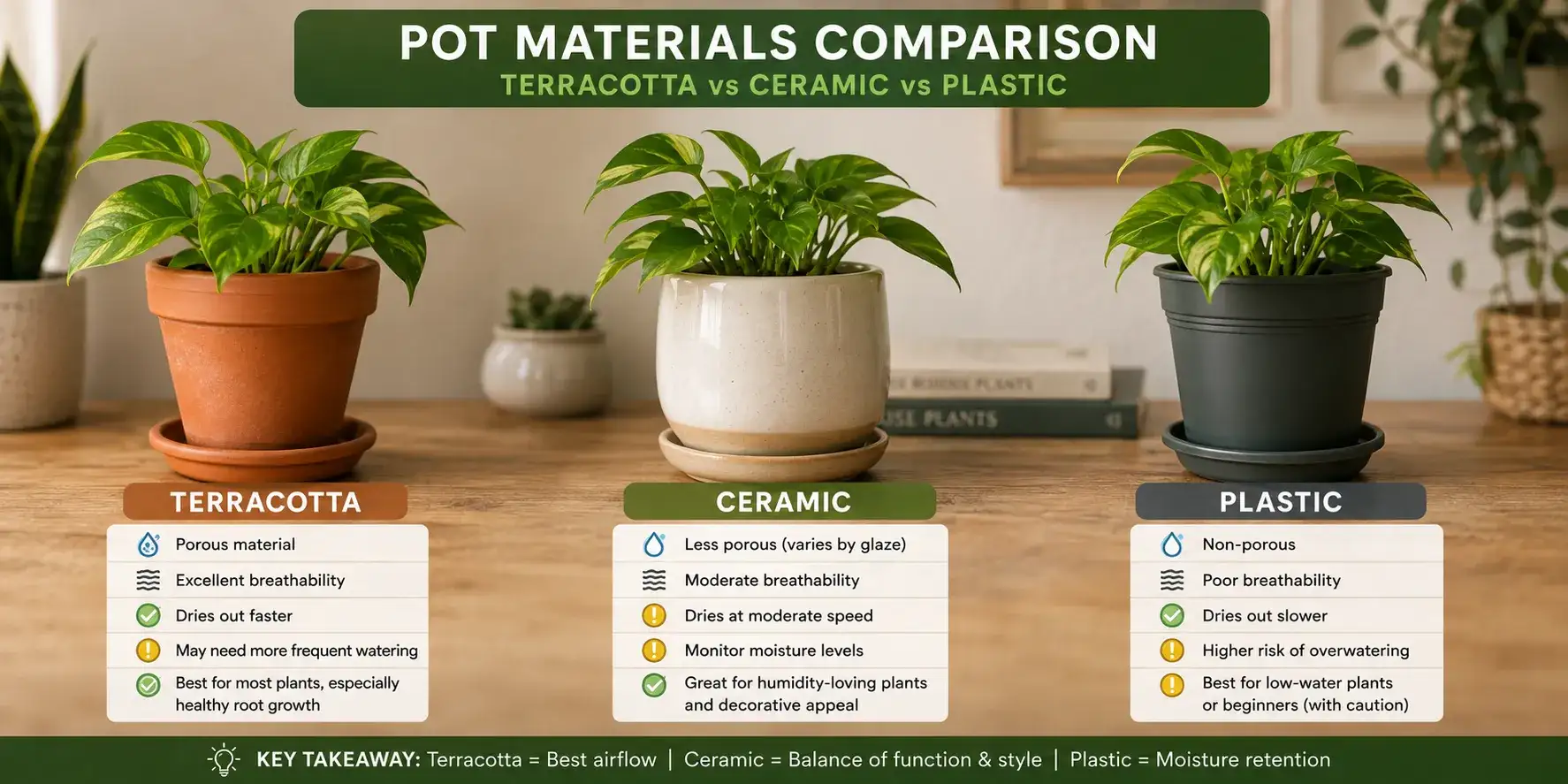
Experiment #1: Pot Type Drying Speed 2 Weeks
- Take three identical plants or propagate cuttings.
- Pot one each in: plastic, ceramic, terracotta
- Use the same potting mix for all three.
- Place all in the same location; water all identically on day 1
- Track every 3 days: check soil moisture on a 1–10 scale and note the date.
- Result: Terracotta dries fastest, ceramic medium, plastic slowest
- Application: If your plant struggles with overwatering, move it from plastic to terracotta or ceramic. Faster drying = fix
Experiment #2: Environmental Factor Test 4 Weeks
- Take one plant or propagate four cuttings.
- Place in 4 locations: south window, north corner, bathroom, near AC/heating vent
- Same pot, soil, initial watering for all four
- Track weekly: soil moisture, room temperature, leaf color
- Result: South dries fastest; north slowest; bathroom medium; vent erratic
- Application: If a plant struggles, check which zone it’s in. Move to the right zone for that plant type, and it often recovers without watering changes.
Experiment #3: Overwatering Simulation 3 Weeks, Optional
- Pick a hardy plant you don’t mind stressing or propagate an extra.
- Deliberately overwater: water daily for 7–10 days.
- Track daily: soil appearance, leaf color, smell
- Watch yellowing start days 5–7, mushy roots visible days 10–12, recovery visible week 3–4
- Application: Seeing root rot in person makes recovery timelines feel real, not theoretical
Frequently Asked Questions
Your 30-Day Reset Scaling to Your Whole Collection
By now you know how often to water indoor plants based on observation, not guessing. Pick one plant and run the 30-day experiment. By the end, you’ll have a personalized watering frequency with zero guessing.
The 4-Week Plan:
- Week 1: Observe only; no watering. Record soil feel daily on a 1–10 scale. See baseline drying pattern.
- Weeks 2–3: Water when soil hits 3–4. Record date, amount, days between waters. Pattern starts emerging.
- Week 4: Rhythm confirmed. By now you know the exact days between waterings, likely 6–10 for most plants. Feels automatic.
- Result: You know your plant’s needs from observation, not guessing.
Scaling to Your Collection:
- Group plants by zone: south window together, bathroom together, etc.
- Use the same rhythm for plant type in the same zone; all tropicals in the south window need similar frequency.
- Adjust by season: increase frequency in summer, decrease in winter.
- Always finger-test before watering; the rhythm is baseline, the test confirms timing each week.
The moment you’ve succeeded: You’ll stop thinking about schedules. You’ll walk by a plant, touch soil out of habit, see it’s dry, and water it. No calendar. No stress. Just knowing.
Closing Statement
You came looking for a watering schedule. You’re leaving with something better: a framework.
Schedules are brittle; they break under humidity swings, heating seasons, light changes, pot size variations. A framework understanding how pots work, how environments differ, how to read soil, and how to adjust for seasons is flexible. It survives change.
Over the next 30 days, keep the log. Run experiments; notice which zones dry fastest. Watch your plants respond to the finger test. After a month, the mystery evaporates. You won’t need this guide anymore. You’ll be the guide.