
How To Get Rid Of Spider Mites On Indoor Plants
You bought a stunning monstera last month, and now tiny yellow speckles are creeping across three leaves. You’re wondering: Did I bring pests into my home? Is this fixable?
If you’re searching for how to get rid of spider mites on indoor plants, you’re in the right place. The short answer: you likely have spider mites. They’re recoverable if caught within 2–3 weeks, and you probably already have the tools to fight them.
But here’s the honest part: most people don’t catch them until they’ve spread to half the plant. This guide covers how to identify them fast, treat them with methods that actually work, and prevent them from coming back.
Identify Spider Mites And Confirm It’S Not Something Else
Spider mites are tiny arachnids related to spiders and ticks, not insects that feed on plant cell contents by piercing leaf surfaces. Common indoor species are the Two-Spotted Spider Mite and Red Spider Mite, both nearly invisible to the naked eye. The telltale sign isn’t the mite itself; it’s the fine webbing on leaf undersides and yellow stippling tiny dots on upper leaves that spread rapidly across foliage.
What They Actually Look Like
At less than 1mm, spider mites are nearly impossible to spot without magnification. Under a hand lens or macro phone lens, you’ll see six legged larvae or eight-legged adults, usually pale yellow, red, or translucent. The color varies by species: Two-Spotted mites have a dark spot on each side of their body, hence the name; Red Spider Mites are brick-red. Movement is slow and deliberate on their gossamer webbing.
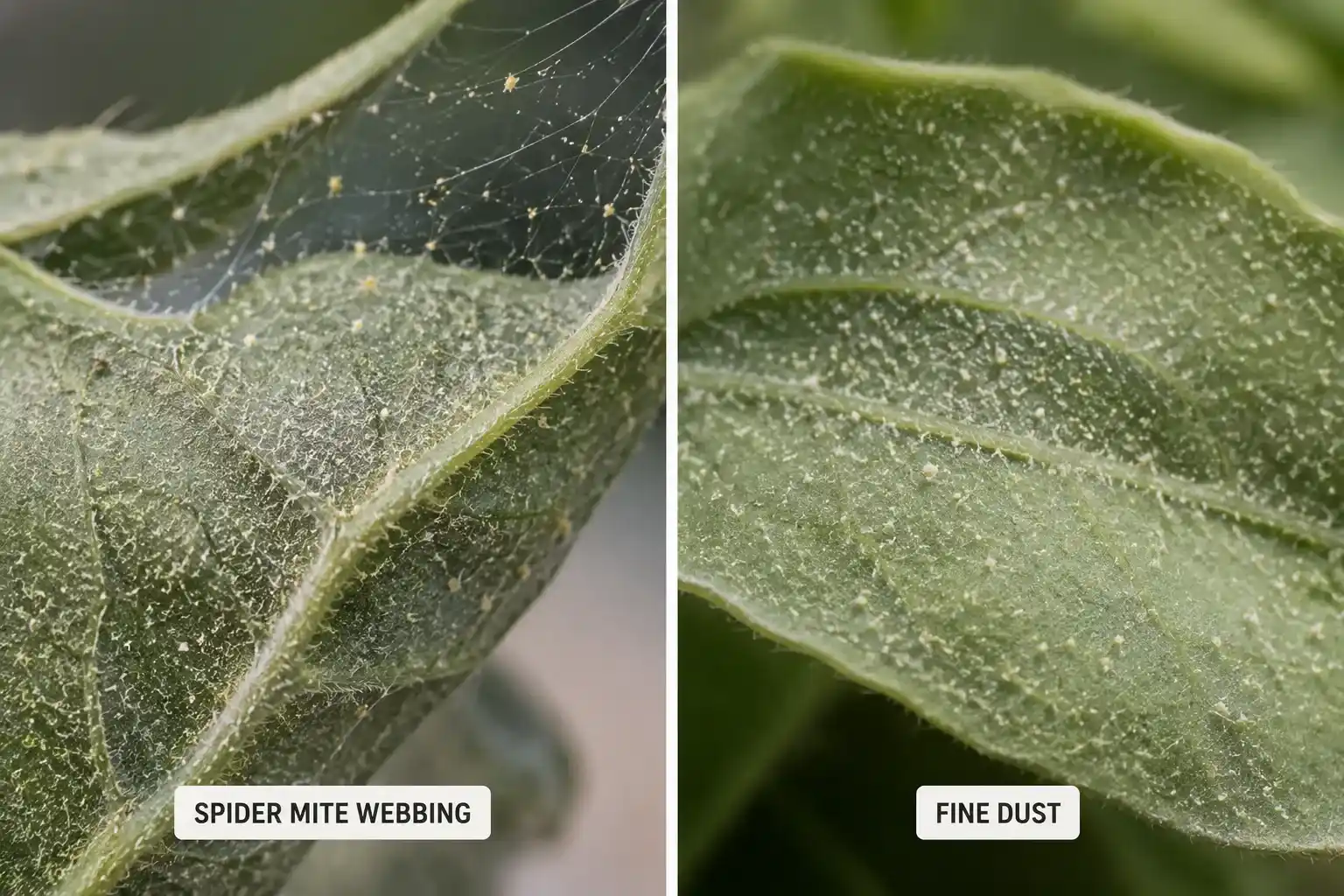
The webbing is the giveaway. It’s not dust; dust scatters when tapped; spider mite webbing is continuous, silky sheets covering leaf undersides and sometimes connecting leaf to leaf. This isn’t just protective shelter; it’s a highway for mites to travel and lay eggs on.
Early Warning Signs Check These First
- Fine, barely-visible webbing on leaf undersides is the #1 early marker
- Yellow or brown speckles on upper leaf surfaces, feeding punctures
- Stippled yellowing spreading across leaves in a pattern, not solid discoloration
- Leaves that feel slightly sticky or gritty to the touch
- New growth appearing curled or distorted.
If 3+ of these are present, move to the white paper test immediately.
The White Paper Test: The 30-Second Diagnosis
This is the practitioner’s trick that separates confirmation from guessing. Place a white sheet of paper under a suspected leaf and tap it gently. Live spider mites will fall onto the paper and crawl. Dead mites or shed skin will stay still. This one detail matters: most articles mention this test by name but never explain what you’re actually looking for. The crawling mites are your proof of active infestation. If you only see stationary debris, you’re seeing residual webbing and old skins; the infestation may have already peaked or partially resolved.
Mistaken Identity What It’s NOT
|
Symptom |
Spider Mites |
Fungus Gnats |
Thrips |
Nutrient Deficiency |
|---|---|---|---|---|
|
Webbing on undersides |
Fine, continuous sheets |
None |
None |
None |
|
Visible pest on leaves |
Nearly invisible; magnification needed |
No; gnats live in soil |
Tiny, elongated, visible without magnification |
N/A |
|
Droppings |
Dust-like frass under webbing |
Tiny dark spots in soil |
Black specks on leaves/flowers |
None |
|
Damage pattern |
Stippling + webbing |
Yellowing from soil upward |
Silvery streaks + dark spots |
Interveinal between veins |
|
Where it starts |
Leaf undersides sheltered |
Soil surface |
Upper leaves exposed |
Older leaves first |
The key differentiator: spider mites leave webbing. Nothing else does. If you see webbing, it’s spider mites.
Why Your Home Is A Spider Mite Resort Entry & Environmental Triggers
Spider mites enter your home in three ways: hitching on a new plant you bring home (most common, roughly 60% of cases), riding in on outdoor air during warm months if a window is near infected plants, or dormant in soil (rare). But entry alone doesn’t cause an explosion. The real trigger is your indoor environment.
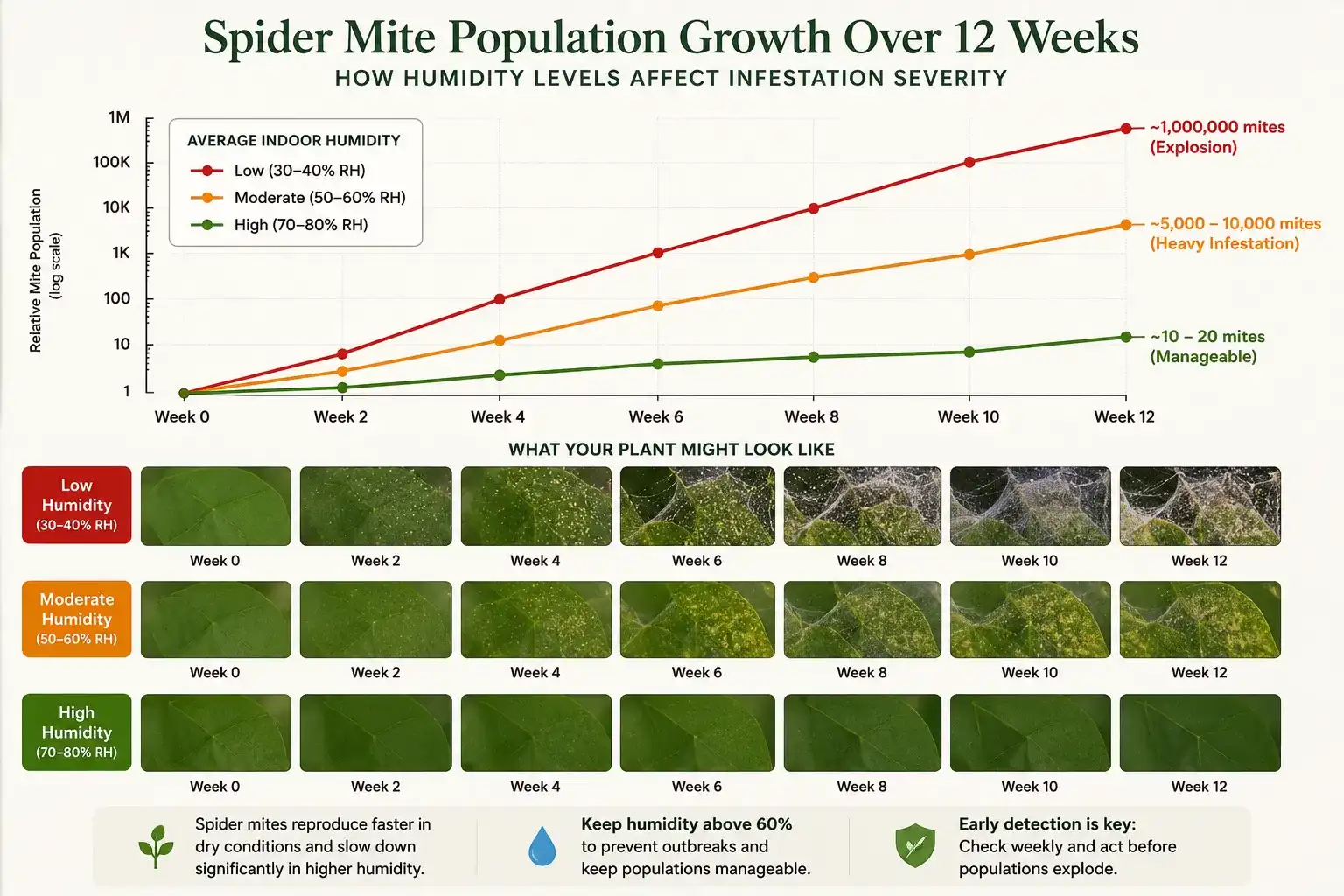
Spider mites thrive when humidity drops below 50%, and your home is climate-controlled. This is the pattern: beginner plant owners in homes with central heating typically see spider mite infestations peak in winter, December–February, because indoor humidity plummets to 30–40%, triggering a breeding surge and stressing plants simultaneously. This happens because mites reproduce faster in dry air at 70–75°F and 30% humidity; they complete a full generation in 7 days. At the same temperature but 60% humidity, the cycle stretches to 14 days. Half as fast. And stressed plants underwatered, in low light, have weakened defense systems, making them three times more vulnerable to mite feeding damage.
Where Mites Hide on Arrival
The new plant you bought last week didn’t look infected in the store. It probably wasn’t humid there. But once it’s in your dry living room, dormant mites on the plant activate and start feeding. Or a single mite from an adjacent plant in the nursery made the journey to yours in soil or on a leaf by the time you notice webbing; that one mite may have become hundreds.
Why Winter Is Peak Season, And Spring Is Your Second Chance
Indoor heating in winter creates the perfect storm:
- Humidity drops from ambient 50–60% down to 30–35%; the furnace circulates dry air continuously.
- Plants stressed by lower light and shorter days have reduced transpiration and weaker defenses.
- Mites breed fastest in warm, dry conditions; your heated home is ideal.
Spring brings relief; outdoor humidity rises, you may open windows, and natural light improves plant vigor. But if you didn’t catch and treat the infestation in winter, dormant eggs laid in February hatch in spring when conditions are still dry before humidity truly stabilizes.
Damage Assessment What You’Re Actually Dealing With
Not all spider mite infestations are equally urgent. Understanding how bad this actually is changes your treatment approach.
Light infestation: webbing on 1–2 leaves, new growth clear, less than 10% of plant affected: recovers fully in 3–4 weeks with consistent water spray or insecticidal soap. Expect 0- 5% permanent leaf loss. Start treatment now; strong recovery is likely.
Moderate infestation: 30% of plant affected, visible webbing on multiple leaves, some leaf drop: takes 6–8 weeks to recover. Prepare for 15–30% permanent leaf loss during recovery; heavily damaged leaves will drop, and new leaves will regrow. This is normal and part of the recovery process.
Severe infestation: 40–80% of foliage affected, heavy webbing visible on stems, significant leaf drop, stunted new growth: recovery takes 8–12 weeks. Expect 30–50% permanent leaf loss. The plant may not survive, or may regrow very slowly and misshapen. Salvage attempt only if the plant has sentimental value.
Critical infestation: 80%+ defoliation, nearly bare branches, heavy webbing everywhere: the plant is unlikely to recover. Success rate is under 30%. Unless the plant is rare or irreplaceable, discard it to prevent spread.
The Honest Truth About Heavy Infestation: Here’s What Everyone Gets Wrong
Most online guides tell you “all spider mite infestations are fixable.” That’s misleading. Here’s the reality: heavily infested plants with 80%+ defoliation can technically recover, but recovery takes 10–16 weeks, permanent branch death is almost certain, you’ll likely need to prune dead wood afterward, and your time/effort may exceed the plant’s replacement cost. For rare or sentimental plants, salvage them. For common, cheap plants like pothos and begonias, it’s faster to replace.
Use the 2-week rule: if you see no visible improvement after 2 weeks of consistent daily treatment, discard and move on.
Your Treatment Options Natural, Chemical, Biological
The fastest way to get rid of spider mites on indoor plants depends on severity. Are you treating an infestation less than 2 weeks old (light), or longer (moderate-to-heavy)?
- Light: start with water spray or insecticidal soap
- Moderate: use neem oil or soap; prepare for 3–4 weeks of treatment.
- Heavy: consider chemical miticide or discard the plant
Natural Methods Start Here
Water Spray: The Free First Line of Defense
How it works: high-pressure water from a kitchen sink spray or garden hose dislodges mites and webbing; repeated applications reduce the population by 60–70% per spray. For light infestations caught within 1–2 weeks, 4–5 water spray treatments resolve it completely.
- Frequency: every 3 days; spray undersides thoroughly for 30 seconds per leaf
- Setup: isolate the plant over a sink or bathtub; let dry before moving back to a shelf
- Eco-impact: zero chemicals; safe for pets, kids, and aquariums
- Limitation: doesn’t kill eggs; requires consistent commitment for 2–3 weeks
- Best for: renters, pet owners, early detection, first-line response
Insecticidal Soap Fast Knockdown Without Residual Toxicity
How it works disrupts the mite’s cell membranes on contact; kills live mites, larvae, nymphs, adults within 24 hours. Critical: does NOT kill eggs. Requires 2–3 applications 5–7 days apart to catch newly hatched cohorts.
- Effectiveness: 80–85% on live mites if applied thoroughly to undersides
- Frequency: every 5–7 days; minimum 3 applications
- Setup: mix per label; spray leaf undersides thoroughly until dripping
- Eco-impact: biodegradable; safe for most plants; always test on one leaf first; safe for pets/kids once dry.
- Common brands: Look for products labeled ‘insecticidal soap’ or ‘potassium fatty acid salts’ on the label.
- Pro tip: spray in the evening. Mites are more active at night and less protected by leaf surface wax, making them more vulnerable to the soap’s cell-membrane disruption.
- Caution: does not prevent re-eggs; easy to miss undersides
Best for: moderate infestations, fast results needed, organic/eco-conscious gardeners
Neem Oil Slow But Disrupts the Entire Lifecycle
How it works: azadirachtin, the active ingredient, disrupts mite hormones and feeding behavior; kills all life stages including eggs, but takes 7–10 days to show full effect. This makes it the most thorough natural option.
- Effectiveness: 85–90% over 3 weeks; slower than soap but more complete
- Frequency: every 7–10 days; 2–3 applications typical
- Setup: mix per label; spray leaf undersides + tops; do NOT spray in direct sunlight; risk of leaf burn
- Eco-impact: OMRI-certified organic; safe for pets/kids; low persistence in soil
- Caution: can burn soft-leaf plants calathea, African violets; test on one leaf first; do not use on severely stressed plants; temperature-dependent; works best 65–85°F
- Limitation: slow action 7+ days before you see improvement; not for urgent situations
When to use: moderate-to-heavy infestations, prevention-focused strategy, patience available
How Neem Oil Compares to Insecticidal Soap
|
Factor |
Insecticidal Soap |
Neem Oil |
|---|---|---|
|
Speed |
24–48 hours kills live mites |
7–10 days full lifecycle coverage |
|
What it kills |
Live mites only; NOT eggs |
All stages including eggs |
|
Number of applications |
3–4 every 5–7 days for 2–3 weeks |
2–3 every 7–10 days |
|
Cost |
$8–15/bottle |
$12–20/bottle |
|
Plant safety |
Safe for most; test on soft-leaf plants |
Test on soft-leaf plants; risk of burn |
|
Best use case |
Quick knockdown of visible mites |
Complete lifecycle disruption |
|
Limitation |
Doesn’t kill eggs |
Slower to show results |
Use soap for urgency use neem for prevention.
Horticultural Oil Suffocation Strategy
How it works: suffocates mites and eggs on contact by coating the cuticle; mechanical kill rather than poison.
- Effectiveness: 75–80% if applied thoroughly; lingers 5–7 days longer than soap.
- Frequency: every 7–10 days; 2–3 applications
- Setup: apply on cool morning/evening; avoid heat and direct sun during application
- Eco-impact: non-toxic to mammals; low persistence; safe for pets/kids
- Difference from neem: purely mechanical suffocation vs. neem’s hormonal disruption
- Limitation: oily residue; plants look shiny for 1–2 weeks; can clog leaf pores if overused
Best for: moderate infestations, preference for mechanical action over chemistry
Biological Control Predatory Mites
Phytoseiulus persimilis: Let Predators Do the Work
How it works: release predatory mites into infested plants. Each predatory mite eats 5–10 spider mites per day.
- Effectiveness: 90%+ if conditions are right; slower initial results 5–7 days before mite population noticeably drops, but very thorough long-term
- Timeline: predatory mites need 2–3 weeks to establish; requires patience but highly effective
- Setup: order online; release per instructions; maintain humidity above 60% and temperature 65–80°F for mite survival
- Eco-impact: zero chemicals; 100% organic; self-sustaining if conditions are right
- Success rate: 80% if humidity is maintained; drops to 30% if humidity falls below 50%
- Limitation: mail-order only; requires patience; temperature and humidity sensitive
Critical caveat: predatory mites require sustained humidity above 55% to survive. If your home is naturally dry or you can’t maintain a humidifier, this method will fail. This is the biggest reason people abandon it.
Best for: patient timeline, willing to commit to humidity long-term, multiple plants at risk
Chemical Escalation When Natural Methods Fail
When to escalate: after 2+ weeks of natural methods with less than 50% improvement, OR if the infestation covers 40%+ of the plant and you need urgent rescue, OR if you cannot raise humidity above 50% and natural methods aren’t working.
CRITICAL DISCLAIMER
Always verify that the product label specifically states: 1) approval for indoor ornamental plants, 2) spider mites are listed as the target pest, and 3) it is legal in your region. Product availability, active ingredients, and restrictions vary significantly by country and region. Consult your local agricultural extension office if unsure whether a product is approved for your plants or location. Different countries approve different miticides, and indoor ornamental plants have specific label restrictions.
Pyrethroid Pesticides Fast Knockdown, High Toxicity
How it works: Synthetic copies of pyrethrin from chrysanthemum flowers; attacks the mite’s nervous system; kills mites in 24–48 hours.
- Effectiveness: 95%+ on live mites; does NOT kill eggs; requires 2–3 applications 5–7 days apart.
- Safety: moderate-to-high toxicity; wear gloves; spray outdoors or in well-ventilated area; keep pets/kids away 4+ hours
- Brands: availability varies by region; check current product availability before purchasing
- Limitation: high resistance potential; should not be primary method
- Rotation strategy: use once if natural methods fail; alternate with neem/soap for follow-up applications
Best for: emergency rescue only; use once, then rotate
Abamectin Avermectin-Class Miticide Moderate Toxicity
How it works: derivative of soil organism Streptomyces avermitilis; disrupts nervous system slightly differently than pyrethroids; kills live mites in 48–72 hours plus partial ovicide kills some eggs.
- Effectiveness: 90%+ on live mites + partial egg kill; fewer applications needed 2 instead of 3
- Safety: low-to-moderate toxicity; safer than pyrethroids; pet/kid restrictions 2–4 hours post-spray
- Rotation strategy: can use as second chemical option, different mode of action from pyrethroid
- Availability: varies by region; check local agricultural extension.
Best for: second-line chemical if pyrethroid fails; lower toxicity preference
Why Resistance Is Real And How to Stop It
Here’s what most beginners get wrong: if neem oil worked on your spider mites last year, don’t use it again this year. Mites don’t have memory, but their populations do. Over 3–4 weeks, repeated exposure to the same active ingredient selects for mites with mutations that survive it. By week 5, that chemical becomes 50% less effective. By month 3, it’s nearly worthless.
To prevent resistance, rotate between different modes of action:
- Rotation A all natural: Water spray → Insecticidal soap → Neem oil → Repeat soap avoid the same chemical twice in a row.
- Rotation B chemical escalation: Pyrethroid application 1 → Neem oil application 2 → Abamectin application 3, if needed
- Rotation C mixed strategy: Soap natural → Pyrethroid chemical → Predatory mites biological
Golden rule: never use the same active ingredient for two consecutive treatments, even if it’s a different brand name.
Integrated Pest Management The Proven Playbook
IPM is a 5-tier system that stacks defenses. Most people skip the first three tiers and jump straight to spraying, which is why they fail. Here’s the complete approach:
Tier 1: Prevent Infestation Before It Starts. Foundational
Do these every week, year-round:
- Maintain humidity above 50%, ideally 55–60% via humidifier, pebble tray, or grouping plants. This alone eliminates 80% of potential infestations.
- Quarantine new plants for 2 weeks before integrating them into your collection. White paper test on Day 3, Day 7, Day 10, and Day 14
- Wipe leaves monthly with a soft cloth + lukewarm water. Dust shields mites from detection and acts as a food source; removing it improves plant photosynthesis as a bonus.
- Water consistently; never let soil dry completely. Watering stress triggers plant vulnerability.
- Use a small fan on low to maintain gentle air circulation. Mites disperse more in still air.
- Keep plants away from heat vents where temperature spikes above 80°F; mite reproduction accelerates in heat.
- Sterilize pots before reuse: boil or use a 1:10 bleach solution. Mites can hide in soil and pot debris.
Output: these 7 practices prevent 80% of infestations before they start.
Tier 2: Detect Early Weekly Monitoring
- White paper test weekly on any plant that’s been indoors 2+ weeks or lives in a dry room. Takes 2 minutes per plant
- Visual inspection: look at undersides of leaves on 3–5 oldest leaves; mites colonize there first
- Keep a simple log: date, plant name, “clear” or “webbing observed”. Patterns emerge fast
- Action threshold: if webbing is observed on ANY leaf, move to Tier 3 immediately
Tier 3: Respond To Early Infestation Less Than 10% Coverage
- Isolate the plant immediately; move to a separate room/shelf away from other plants. Mites can spread 6+ feet per week through air movement.
- Start a water spray every 3 days for 2 weeks, or use insecticidal soap every 5–7 days. Assess progress after the 3rd application using the white paper test.
- Monitor for spread to other plants in the same room; if any show webbing, isolate them too.
- Escalate if needed after 2 weeks of 6 water spray applications; if webbing is still visible, move to Tier 4
Expected outcome: 70% of early infestations resolve here without chemical escalation.
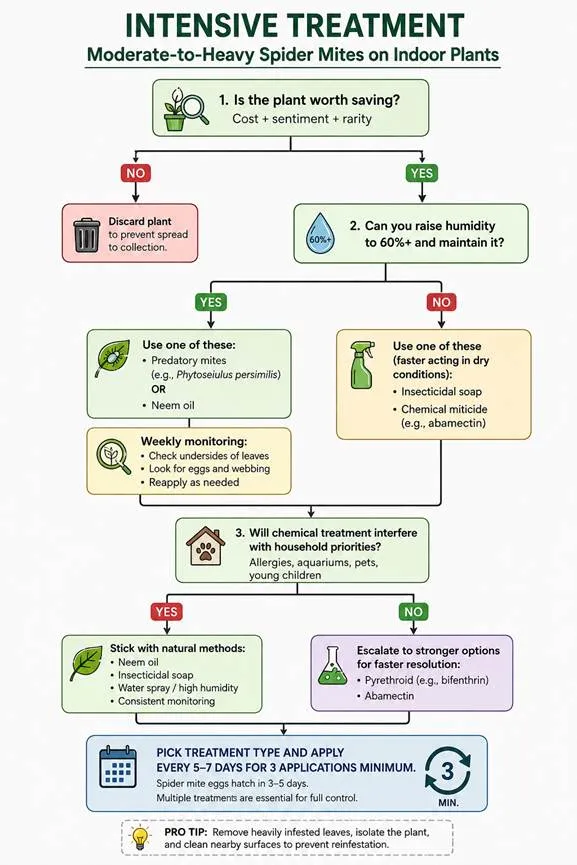
TIER 4: Escalate To Intensive Treatment Moderate-To-Heavy
Decision tree:
Tier 5: Long-Term Monitoring Post-Treatment
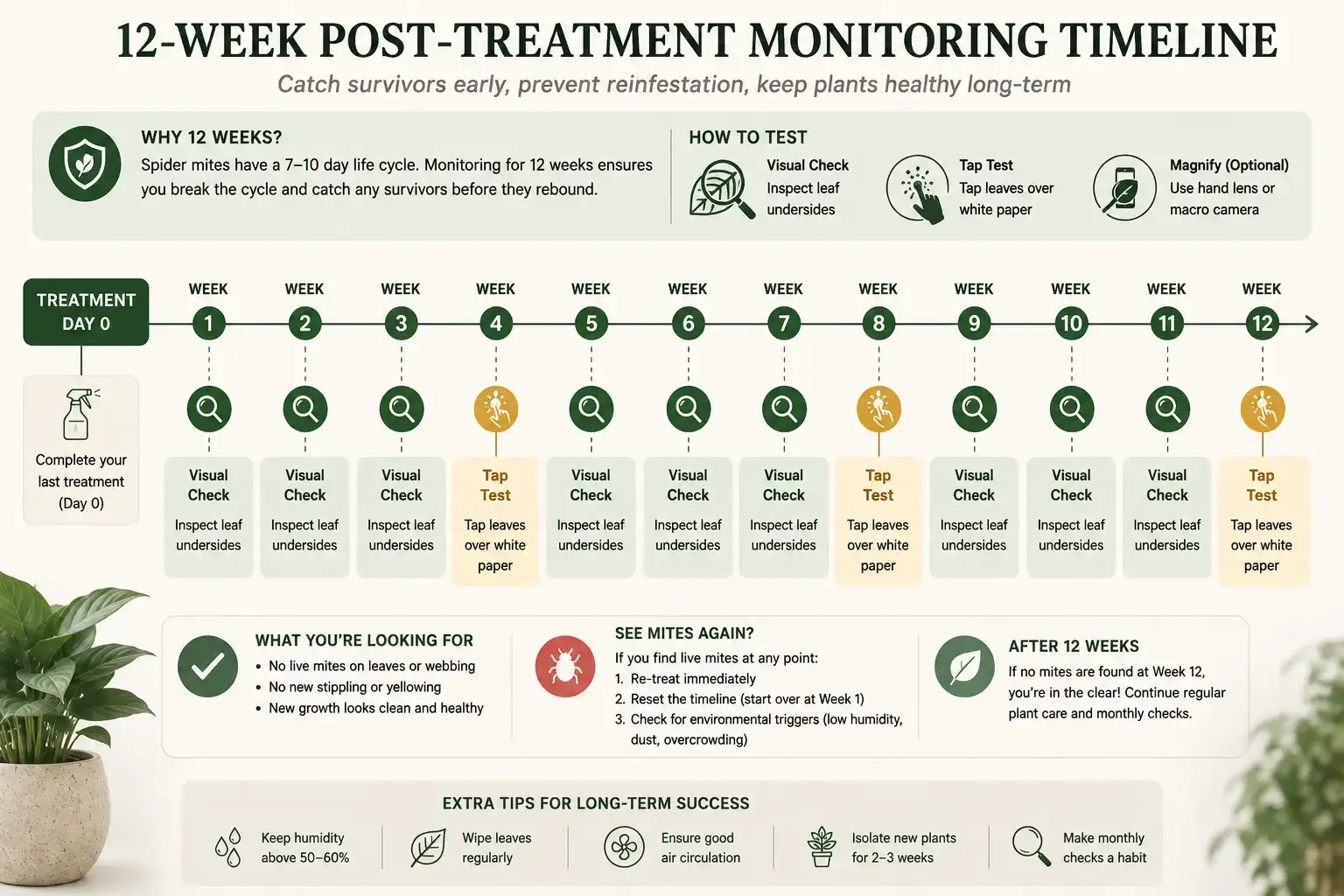
Re-infestation is common in the first 6 months. Here’s the follow-up schedule:
- Weeks 1–4 active treatment: white paper test EVERY 3 days
- Weeks 5–12 recovery phase: white paper test weekly
- Weeks 13–26 post-treatment: white paper test every 2 weeks
- Month 6+ back to normal: white paper test monthly as baseline
If ANY webbing reappears after treatment ends, restart Tier 3 immediately. Re-infestation at this stage is often harder to kill, possibly due to resistance developing from the previous treatment.
Plants At Risk & Strategic Grouping
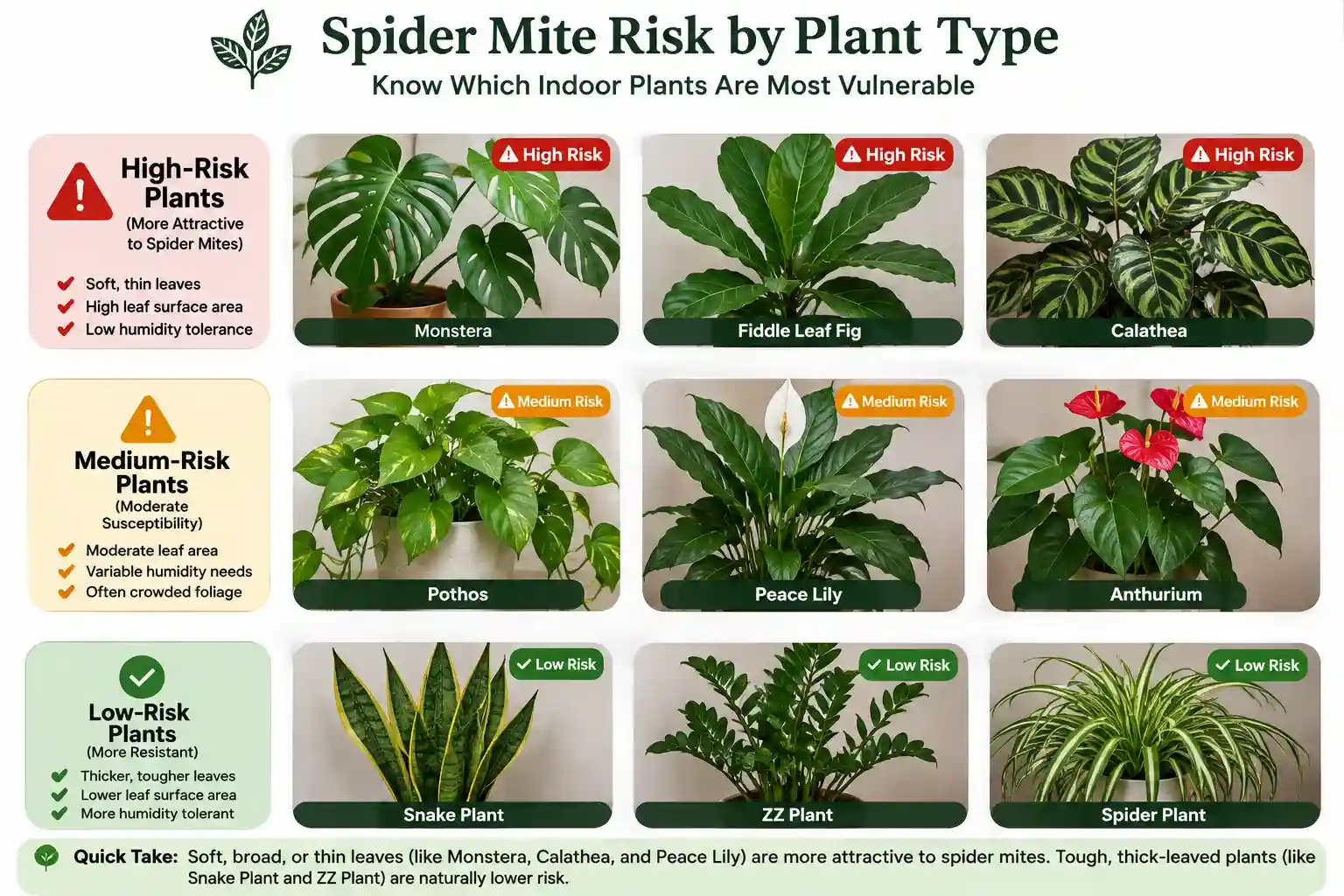
Not all houseplants are equally vulnerable. Understanding which of your plants are high-risk simplifies prevention.
High-Risk Plants Monitor Weekly
Calathea, Monstera deliciosa, Ficus all varieties, Roses ornamental indoors, Carnations, Impatiens, Begonias tuberous, wax, Ivy, Passion flower
Why: thin or tender leaves lack the waxy protective cuticle that deters spider mites. Feeding damage is visible within days.
Medium-Risk Plants Monitor Bi-Weekly
Pothos, Philodendron, Anthuriums, Orchids, African violets, Hibiscus, Tomato plants indoors
Low-Risk Plants Monitor Monthly
Snake plant Sansevieria, succulents (jade, Echeveria, aloe), ZZ plant, Dracaena, mature Rubber plant
Why: waxy or desiccant leaves, tough leaf structure, low nutritional appeal to mites.
Strategic Grouping for Prevention
Group your plants by risk level and place high-risk plants in a shared humid zone:
- Zone 1 High-risk grouping: Calathea, Ficus, Monstera, Roses on a pebble tray with a humidifier 1–2 feet away. Humidity maintained at 55–65%
- Zone 2 Medium-risk grouping: Pothos, Philodendron, Begonias with secondary humidity, occasional misting, or shared pebble tray
- Zone 3 Low-risk/hardy: Succulents, Snake plant, ZZ plant in standard care; minimal monitoring needed
This strategy simplifies prevention and containment; if infestation strikes, it’s likely contained to one zone.
Troubleshooting & Edge Cases
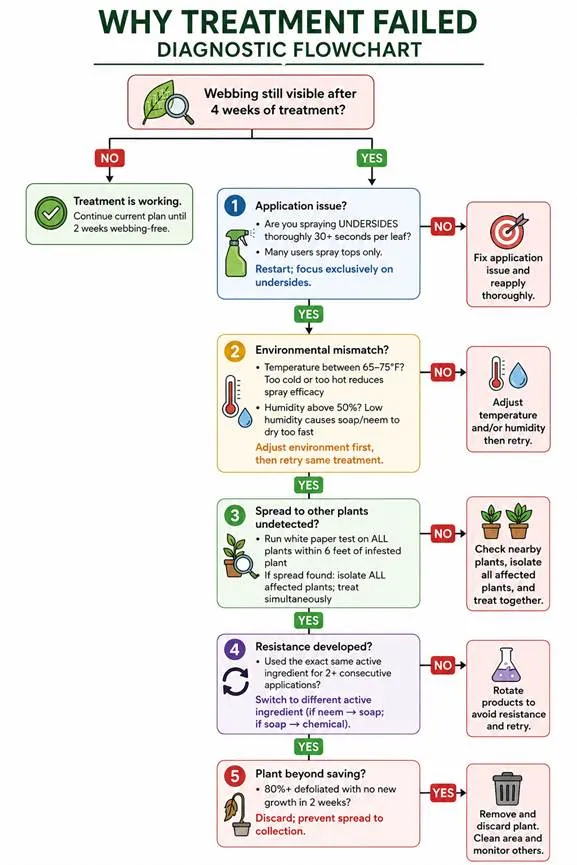
Why Treatment Failed Diagnostic Flowchart
Renter-Friendly No Landlord Conflicts
Avoid spray treatments that leave residue or affect walls/ceilings. Instead:
- Neem oil wipes: apply neem oil with a cloth to individual leaves; no spray; no landlord issues
- Nylon netting isolation: drape food-grade netting over plant for 2–3 weeks; traps mites inside; prevents spread to other plants
- Bottom-watering + closed bathroom: place plant in bathtub with a water tray below the pot; close the door. Creates humidity without floor/wall dampness
- Non-oily insecticidal soap: use water-based soap, not oil; leaves no residue; fully rinsable
If landlord conversation becomes necessary: “Spider mites are a common issue in apartments. I’m treating them with water and non-toxic soap, confined to a bathtub. No permanent changes to the unit.”
Pet-Safe Protocol Dogs, Cats, Aquariums
Avoid pyrethroids entirely; toxic to cats; used in flea collars but hazardous for indoor plants in living spaces. Safe options:
- Water spray: zero toxicity; rinse and dry thoroughly
- Insecticidal soap: rinse plant thoroughly after 4+ hours; zero residue = zero pet risk
- Neem oil: rinse thoroughly; citrus-scented, zero toxicity if fully dried; cats dislike the smell anyway
- Predatory mites: 100% safe; no toxins; no rinsing needed
Application protocol for pet homes
- Move plant to isolated room, bathroom, garage, or basement.
- Apply spray treatment
- Close door; keep pets out for 4+ hours minimum
- Rinse leaves thoroughly with cool water to remove residue + ensure safety.
- Let dry completely before moving back to main living area.
Frequently Asked Questions
DISCLAIMER
Chemical Treatment Disclaimer
Always read and follow the product label before applying any pesticide or miticide. The label must explicitly state: 1) approval for indoor ornamental houseplants, 2) spider mites as the target pest, and 3) legality in your region. Product availability, active ingredients, and restrictions vary significantly by country. Consult your local agricultural extension office if unsure.