
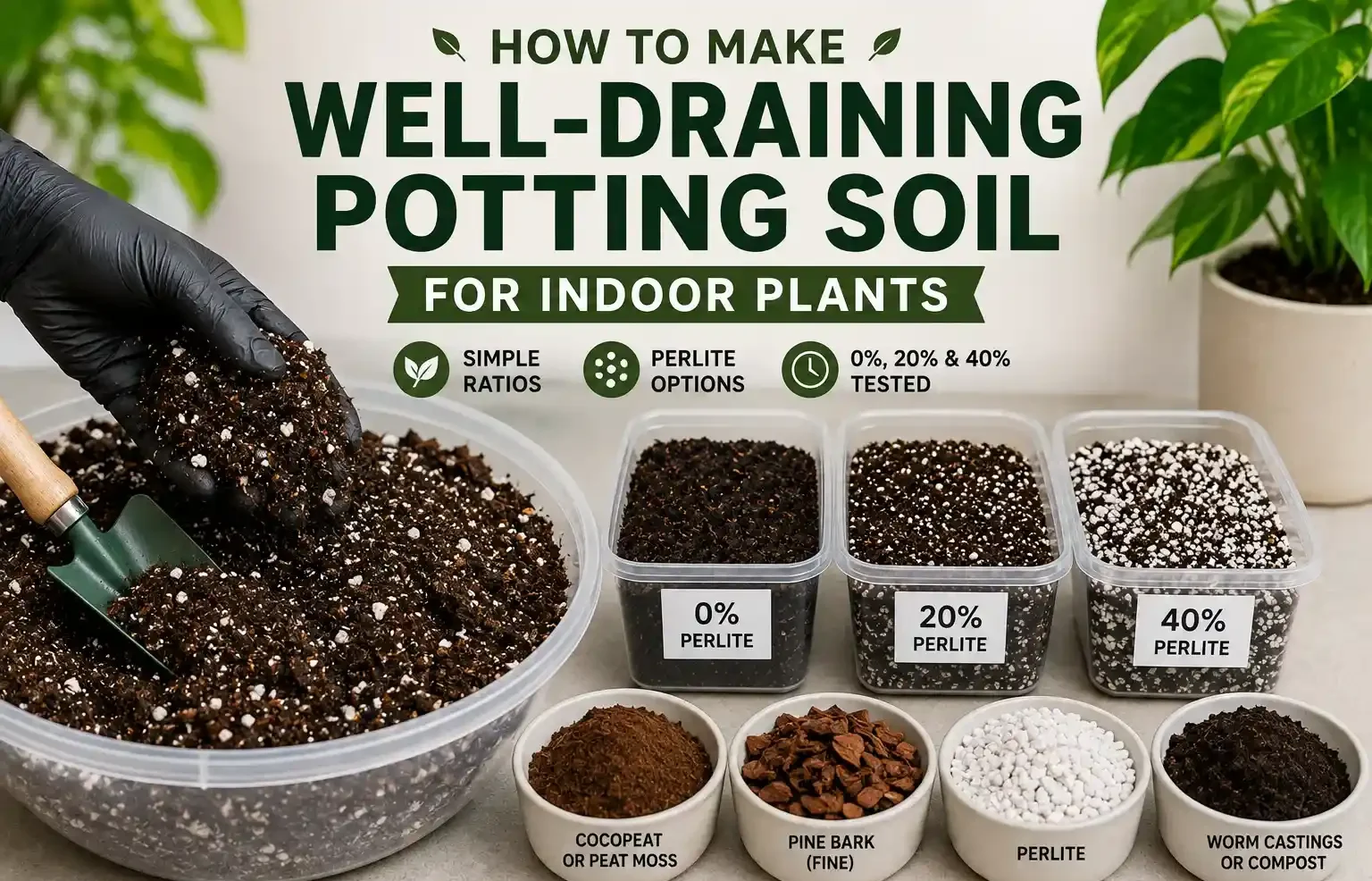
Well-Draining Potting Soil for Indoor Plants: How to Make It
A new houseplant can sit in wet soil for days even when its owner waters carefully. The frustrating part is that the bag may say “potting mix,” yet the root zone can still stay soggy.
So what actually makes well draining potting soil for indoor plants work? And how much perlite is enough?
For most indoor plants, the answer is a mix that balances moisture retention with air space. A moisture-holding base such as potting mix or coir provides water, while perlite, pumice, or bark opens the structure. The right well-draining soil mix ratio depends on the plant, pot, room conditions, and how quickly the mix dries.
And more perlite isn’t automatically better.
What makes potting soil well draining for indoor plants?
Well-draining potting soil does not simply let water escape as fast as possible. It balances water retention, air space, particle size, and structure so roots receive moisture without remaining saturated. Indoor plants need that balance because a container has far less root-zone volume than garden soil.
Drainage, aeration, and moisture retention are related, but they aren’t the same thing.
Drainage describes how excess water leaves the container. Aeration describes how much air remains in the spaces between particles. Moisture retention describes how much usable water the mix keeps after excess water has drained.
A good indoor potting mix needs all three.
Think of the mix like a kitchen sponge with larger air pockets built into it. A sponge that never holds water is useless. A sponge that stays completely saturated is just as problematic for many plants.
That distinction matters because “fast draining” and “well draining” don’t mean exactly the same thing. A mix can shed water quickly but still fail to provide enough moisture between waterings. On the other hand, a fine, compact mix can hold water for too long.
Container size adds another layer. The University of Illinois Extension advises against putting a small plant into an oversized pot because the soil can remain wet too long. It recommends choosing a container roughly 1 to 2 inches larger in diameter when moving a plant up a pot size.
The drainage hole matters, too. A container with proper drainage allows excess water to escape rather than leaving the root zone sitting in water.
For a site publishing many plant-care articles, the reusable explanation should stay centralized rather than copied into every plant guide.
Indoor Plant Soil & Drainage Fundamentals
Takeaway: Good drainage means controlled dry-down with enough moisture left for the plant, not water disappearing as quickly as possible.
Which ingredients should you use to make well-draining potting soil?
A simple indoor mix needs a dependable base plus a coarse, porous amendment that creates air space. Common choices include commercial potting mix or coir as the base, with perlite, pumice, or coarse bark contributing structure. Compost can add organic matter, but too much can make a mix hold more water.
Start with a moisture-holding base
A quality commercial potting mix is the easiest starting point for most beginners. These products may contain peat moss, coir, bark, perlite, vermiculite, fertilizer, or combinations of them.
The advantage is consistency.
For a potting soil mix for indoor plants, starting with a known commercial base also makes experimentation easier. If every batch starts with wildly different ingredients, comparing drainage becomes almost impossible.
Coir is useful for gardeners who want a homemade potting soil without peat moss. It can serve as the moisture-holding component while perlite or another coarse amendment creates additional pore space.
Peat moss remains common in potting media, but it isn’t mandatory for every homemade recipe.
Add an aeration amendment
Perlite is lightweight and commonly used to improve drainage and aeration. Penn State Extension lists perlite among common ingredients in soilless mixes and identifies it as a material that contributes to drainage and aeration.
Pumice provides a similar structural role, while coarse bark creates larger spaces in a chunky soil mix.
The key isn’t to collect every amendment on the garden-center shelf. It’s to know what each ingredient is doing.
What about compost, vermiculite, charcoal, and fertilizer?
Compost can contribute organic matter and nutrients, but it shouldn’t automatically be treated as a drainage ingredient. Vermiculite generally holds more water than perlite, making it better suited to situations where moisture retention matters.
Penn State Extension notes that potting media can combine peat moss, vermiculite or perlite, and compost or organic fertilizers to provide water-holding capacity, nutrients, and aeration.
Charcoal is often added to specialty mixes, but it isn’t a required ingredient for ordinary houseplant drainage.
Fertilizer is a separate question. A mix can drain perfectly while still lacking enough nutrients.
Can garden soil be used indoors?
Garden soil is usually a poor default for indoor containers. University of Illinois Extension recommends soilless media for houseplants and warns that garden soil can bring disease and insect organisms into containers while failing to provide adequate drainage on its own.
That matters for people searching for the best soil for indoor plants no bugs. No potting mix can promise that a plant will never develop pests, but using a clean, purpose-made potting medium avoids deliberately bringing garden soil and its associated organisms indoors.
0%, 20%, or 40% perlite?
| Perlite ratio | What to measure | Role in the protocol | What it tells you |
| 0% | Drainage start, moisture retention, dry-down | Baseline | How does the base medium behave? |
| 20% | Drainage, air space, dry-down | Moderate aeration | Does added porosity improve the watering window? |
| 40% | Dry-down, moisture retention, surface moisture | High aeration point | Does extra porosity improve drainage without drying too quickly? |
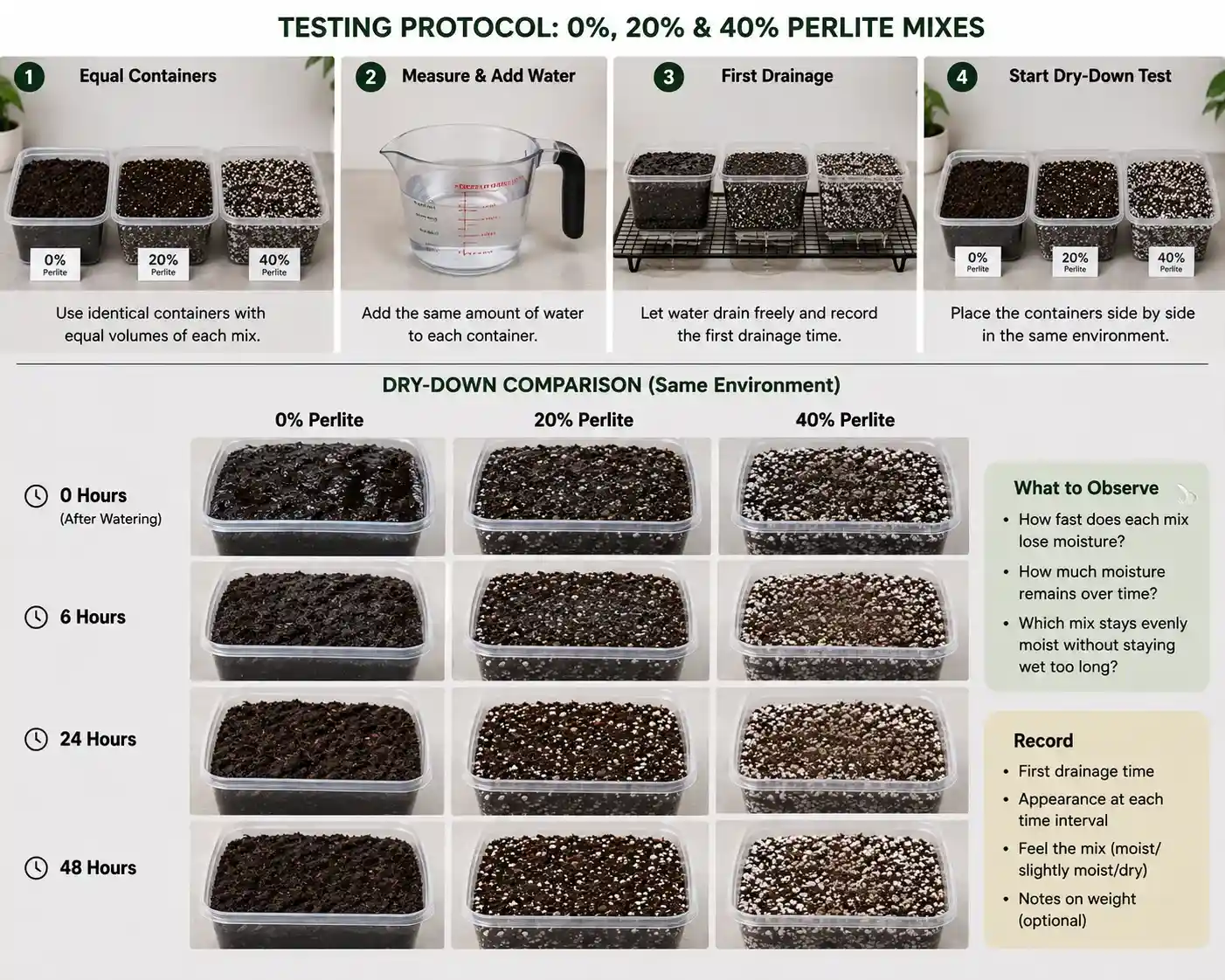
[TESTING PROTOCOL] This comparison is designed to be paired with your own controlled home measurements. Use identical containers, equal mix volumes, equal water inputs, and a same observation period. Do not estimate results observe and record what actually happens. The value is in the controlled comparison, not in impressively precise numbers.
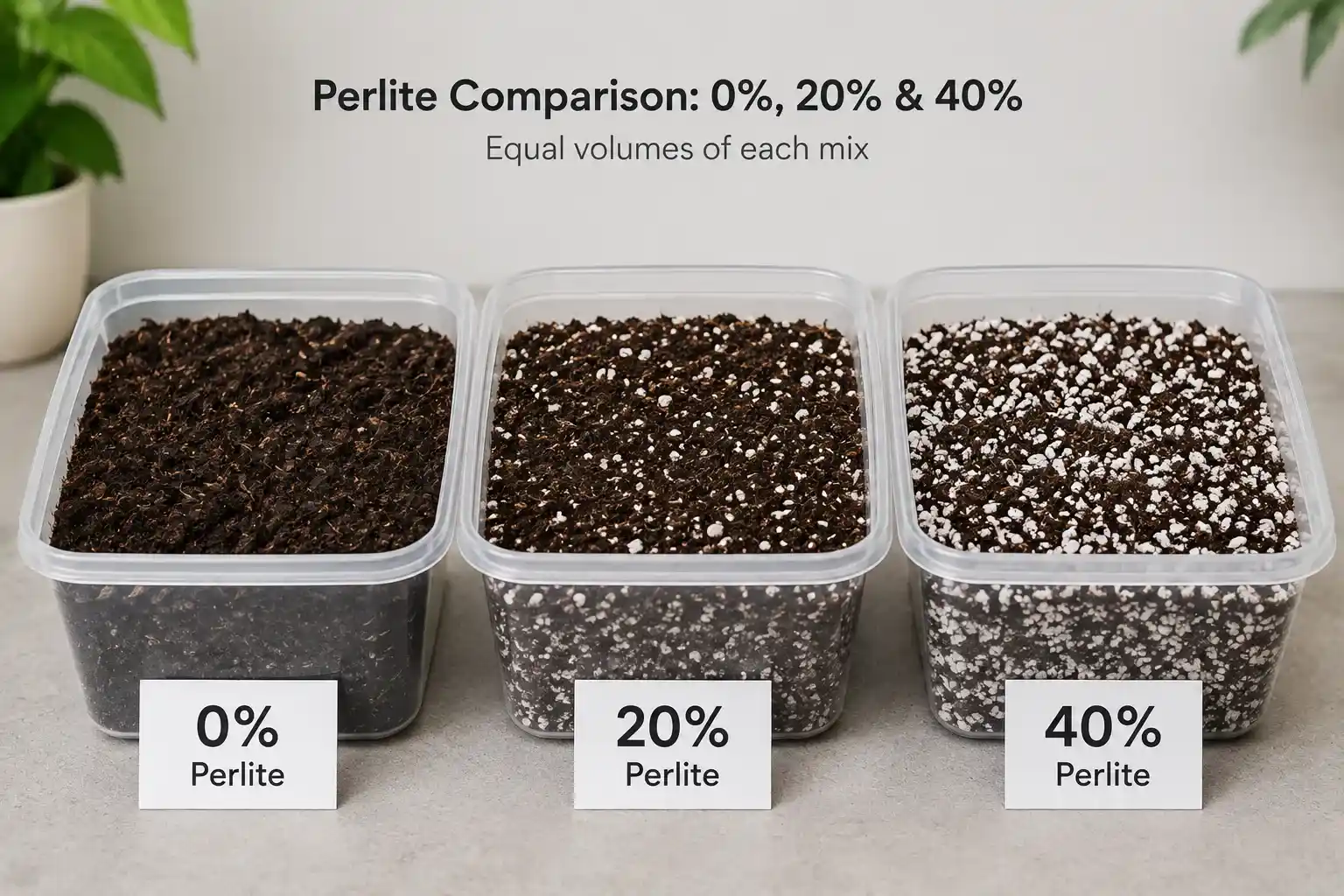
[IMAGE SUGGESTION: Three identical containers labeled 0%, 20%, and 40% perlite, photographed side by side with equal volumes of each mix, ready for the test]
How much perlite should you add, 0%, 20%, or 40%?
There is no universal perlite percentage for every indoor plant. A 0% mix represents the baseline, 20% creates a moderate structural change, and 40% produces a much airier blend. Use these three ratios as controlled comparison points in a simple home protocol, then choose based on how the mix actually behaves with your plant, your pot, and your room conditions.
0% perlite: Establishing your baseline
The 0% ratio establishes the baseline because it gives the other mixes a baseline to be compared against.
This doesn’t mean 0% is automatically bad. Some commercial potting mixes already contain substantial aeration material. Adding more amendments to an already airy product can change its behavior in ways that aren’t obvious from the ingredient list alone.
That is why the starting mix should be identified before comparing ratios.
20% perlite: Testing moderate aeration
The 20% ratio provides a moderate aeration point for gardeners who want more air space without turning the mix into an extremely coarse medium.
The important part is not the number itself. The useful question is whether the resulting mix gives the plant a manageable dry-down window in your specific environment.
That makes a 20% ratio a starting hypothesis to test, not a rule carved in stone.
40% perlite: Testing maximum aeration
The 40% ratio creates a much more amendment-heavy mix and serves as the high-aeration point in the protocol. That may make sense for plants and growing conditions that benefit from a faster dry-down, but it isn’t automatically an upgrade for an ordinary foliage plant.
This is the point where the popular advice gets sloppy.
The assumption that more perlite is always safer is wrong. Extra air space can change how much water the mix holds between watering events. If a plant already lives in a warm, bright setting and uses water quickly, that may be useful. In a cool, low-light room, the same change can produce a very different watering pattern.
The final verdict should come from the plant and the environment, not from the biggest number in a recipe.
How should you run the perlite ratio protocol at home?
A useful home comparison changes only one variable at a time. Keep the container, pot volume, drainage-hole setup, starting mix, and water input consistent across all three ratios.
- Measure identical volumes of the base mix and perlite.
- Combine each ratio until the amendments are evenly distributed.
- Fill identical containers to the same level.
- Add the same measured amount of water to each container.
- Record when drainage begins and how the water behaves.
- Observe the mixes under the same room conditions.
- Track how quickly each mix becomes noticeably drier.
- Compare the results before choosing a preferred ratio.
A common mistake is changing the pot size between tests. That makes the comparison less useful because container geometry can change how long the mix stays wet.
Another mistake is comparing a very fine commercial mix against a coarse commercial mix and blaming the difference entirely on perlite. The starting texture matters.
[TESTING NOTE] Particle size can matter as much as the ingredient name. Fine particles can settle into the larger spaces created by coarse amendments, so a mix that contains plenty of perlite can still behave more densely than expected if the base material contains a lot of fine material. Watch for this during your side-by-side comparison.
[HOME TEST TEMPLATE]
Use this template to run and record your own 0%, 20%, and 40% comparison:
- Starting potting mix and ingredient list
- Container dimensions and material
- Drainage-hole dimensions or configuration
- Dry mix volume used in each pot
- Water volume applied (identical for all three)
- Time until first drainage appears
- How water behaves on the surface (pooling, absorbing immediately, running through)
- Dry-down observations at consistent intervals (e.g., 24h, 48h, 72h)
- Weight change if you have a kitchen scale
- Photos of each mix at the same stage and time
Do not turn the test into a fake precision exercise. The value comes from controlled comparison same container, same volume, same water, same room not from manufacturing impressive numbers.
Takeaway: The best perlite ratio is the one you verify yourself: the mix that creates a useful dry-down window for your specific plant, pot, and room.
How should you adjust the mix for different indoor plants?
Indoor plants differ in how much moisture and air their roots need, so the same mix should not be treated as universal. Start with the base recipe, then move toward a lighter or more moisture-retentive structure according to plant type, pot size, room conditions, and how quickly the mix dries.
Tropical foliage and common houseplants
Most common foliage plants need a mix that holds some moisture while leaving enough air space around the roots.
A moderate-aeration indoor potting mix is often easier to manage than an extremely coarse blend because it gives beginners a little more room between watering sessions.
The exact recipe still depends on the starting product and the room.
Succulents and cacti
Succulents and cacti generally need a faster-drying root environment than many tropical foliage plants.
That makes a coarser mix worth considering. Perlite, pumice, and coarse mineral or bark components can change the structure substantially.
But even here, “add as much perlite as possible” is weak advice. The pot, light level, temperature, and watering habits still matter.
Cuttings and propagation
Propagation is a different job.
A cutting often benefits from a medium that stays evenly moist without becoming saturated. Penn State Extension identifies perlite as providing drainage and aeration and notes that bark provides strong drainage and aeration, while propagation media should remain moist rather than saturated.
That means a mature-plant recipe shouldn’t automatically become the propagation recipe.
Low-light or slow-drying rooms
Users in low-light indoor rooms typically choose a moderate-aeration mix rather than maximum drainage to get a manageable dry-down window, because the plant may use water more slowly and the root zone can stay moist longer.
The key is to watch the whole system.
Penn State notes that different container materials affect water behavior, with terracotta tending to pull water away from the mix while plastic containers generally retain moisture more readily.
The same potting soil mix ratio for indoor plants can therefore behave differently in 2 rooms.
What about outdoor container plants?
A well draining potting soil for outdoor plants still needs structure and air space, but outdoor conditions can differ sharply from indoor conditions.
Sun exposure, rainfall, wind, temperature, and container size can speed up drying. A formula that seems unnecessarily porous indoors may make more sense outside.
So don’t copy an outdoor recipe into a dim apartment and expect identical results.
How do you make and use the potting-soil mix correctly?
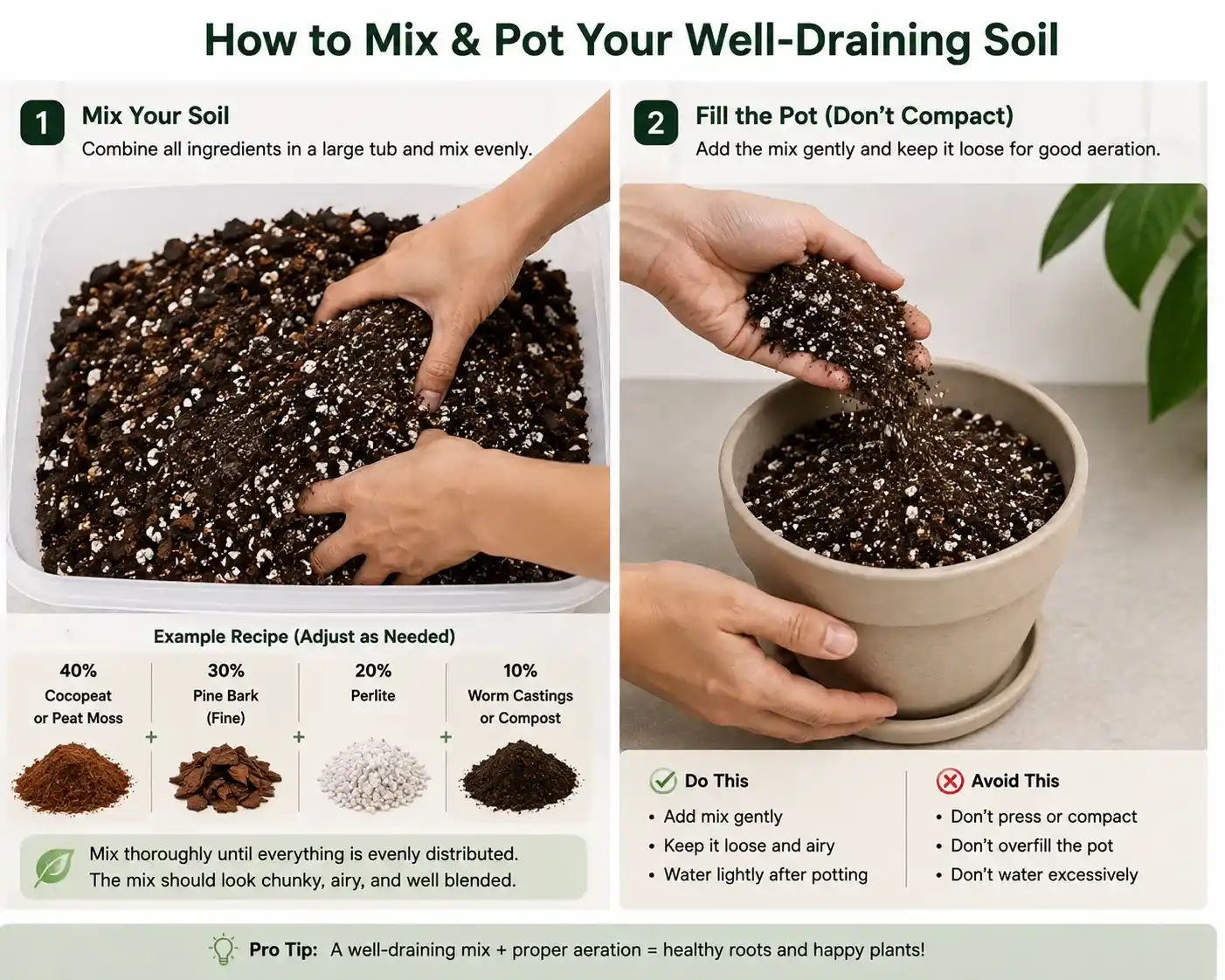
Measure the ingredients by volume, mix them thoroughly, and keep the blend uniform before potting. Use a container with a functional drainage hole, avoid compressing the mix around the roots, and water according to the plant’s drying needs rather than following a fixed calendar.
Make the mix
- Measure the base mix according to the chosen recipe.
- Measure the perlite, pumice, or bark amendment.
- Combine the ingredients in a clean container.
- Mix until the coarse amendment is distributed evenly.
- Moisten the medium before repotting when appropriate.
- Fill the container without packing the mix tightly.
- Water thoroughly after planting and allow excess water to drain.
- Observe the dry-down before watering again.
A common mistake is compressing the mix because it looks loose. The goal is good contact around the roots, not a densely packed block.
Penn State Extension recommends moistening potting mix before repotting so it can absorb water evenly.
How should leftover homemade mix be stored?
Store unused material in a clean, labeled container where it stays dry and protected from contamination.
For a diy potting soil batch, label the date and ratio. That simple habit prevents a common problem later: opening an unlabeled container and having no idea whether it contains a 20% or 40% amendment ratio.
For long-term storage, follow the handling instructions for any packaged ingredients used.
What makes a mix too dense?
A dense mix often reveals itself through slow drying, poor water movement, clumping, or a noticeably heavy texture.
The subtle issue is consistency. If the bottom half of a pot contains finer material than the top, the root zone may behave differently from what the recipe suggests.
That is why a good potting soil recipe needs even mixing, not just correct ingredient names.
What should you do if your plant still stays wet or dries too quickly?
If a plant stays wet for too long, inspect the pot, drainage hole, container size, and mix before simply adding more perlite. If it dries unusually fast, reduce the emphasis on coarse amendments and review watering, light, temperature, and pot size. Diagnose the system before changing the recipe.
If the mix is the problem
Look for excessive fine material, compaction, poor structure, or a base mix that simply holds more water than expected.
This is where a small change can beat a complete rebuild. If the base is otherwise suitable, adjusting the aeration component may solve the problem.
If the container is the problem
A blocked drainage hole can undermine even a good mix.
An oversized pot leaves more wet mix around a relatively small root system. Illinois Extension warns against over-potting for exactly this reason. (See the pot-size guidance in the section above.)
A decorative cachepot is another common trap. Penn State Extension explains that these outer containers often lack drainage holes and are better used as covers for an inner planting pot rather than as the direct growing container.
If the environment is the problem
A recipe cannot compensate for every growing condition.
Low light can change how quickly a plant uses water. Container material can affect moisture. Room temperature and airflow can change evaporation.
Teams and users managing plants in slower-drying indoor conditions typically get better results by adjusting the entire watering setup rather than endlessly increasing the amendment ratio. The mechanism is simple: changing the soil doesn’t change how much water the plant actually uses.
When should the mix be replaced?
Replace the mix when its structure has degraded badly, when contamination is suspected, or when the existing texture is fundamentally wrong for the plant.
Don’t automatically throw it away because water sits on top for a few seconds. Diagnose first.
And don’t create a gravel layer at the bottom of a pot as a quick drainage fix. Illinois Extension also notes that a gravel layer does not improve drainage and can make the situation worse by changing where the saturated zone sits.
Open-ended close: That leaves one practical question: which common shortcuts actually help beginners, and which ones create more problems?
What are the most common questions about homemade well-draining soil?
The best homemade mix depends on what you are growing and how quickly the pot dries. Most beginners need a simple, repeatable base recipe plus one aeration amendment, then a small adjustment based on plant type and environment. The questions below address the most common edge cases.
What is the best fast-draining soil for indoor plants?
The best fast-draining soil for indoor plants depends on the plant and growing conditions. A mix that dries quickly enough for a succulent can dry too fast for a tropical foliage plant. Judge the mix by its dry-down behavior, not by the presence of one ingredient.
How can I get good drainage for indoor plants?
Getting good drainage for indoor plants requires more than changing the soil. Use a container with a functioning drainage hole, avoid oversized pots, choose a suitable mix, and adjust watering to the plant’s drying rate. The University of Illinois Extension recommends well-drained growing media for houseplants.
What can I mix in soil to make it well draining?
You can mix perlite, pumice, or coarse bark into a suitable potting base to increase air space. The right choice depends on the existing mix. If it already contains plenty of coarse material, adding more may be unnecessary and can make the medium dry faster than intended.
Can you use garden soil for indoor plants?
Garden soil is generally not the best choice for indoor containers. It can be heavy, drain poorly, and introduce unwanted organisms into the growing environment. Penn State Extension recommends a good-quality soilless potting mix instead of garden soil for houseplants.
A homemade mix is useful when the gardener wants control over texture and ingredients. A commercial product is useful when consistency matters more.
For most beginners, the best indoor potting mix is the one whose behavior is predictable.
That is a better goal than chasing a perfect recipe.