
Pothos Plant Care: A Practical Guide to Healthy Growth and Lasting Variegation
A pothos can stay alive in surprisingly poor conditions. That is part of its charm, but it can hide what the plant actually needs. A vine may keep growing while its leaves become smaller, its stems stretch, or its variegation fades.
Good pothos plant care comes down to a few things: bright indirect light, well-draining soil, watering based on how quickly the pot dries, and enough room for the roots to function. For variegated cultivars, light becomes even more important because low light can reduce the desirable leaf color and patterning.
The trick is not to follow a rigid calendar. It is to read the plant and the environment together.
What conditions does a pothos need to grow well?
Pothos grows best in moderate to bright indirect light, a well-aerated potting mix, and soil that is allowed to dry between waterings. It tolerates a wide range of indoor conditions, including lower light, but growth and foliage quality can suffer when light stays too weak. Avoid harsh direct sun and chronically wet soil.
What does “bright, indirect light” actually mean indoors?
Bright indirect light means the plant receives plenty of ambient daylight without sitting in intense, unobstructed sun for long periods. Near a bright window with filtered light is usually a better target than putting pothos directly against hot glass.
For a practical explanation of window direction, light intensity, and placement, use this article’s dedicated resource:
The important distinction is simple. Low light may keep a pothos alive. Better light usually gives it a better-looking plant.
What makes pothos different from a truly low-light plant?
Pothos is adaptable, not light-independent.
Penn State notes that pothos can survive in low-light conditions for a long time, but eventually the plant can lose desirable foliage qualities such as brightness or variegation. Wisconsin Extension makes the same broader point, noting that low light can lead to loss of variegation.
That matters because “tolerates low light” is often interpreted as “prefers low light.” Those are very different claims.
What are the five care variables that matter most?
Think of pothos indoor plant care as five connected variables:
- Light controls the quality and density of growth.
- Watering controls root-zone moisture.
- Soil and drainage determine how long that moisture remains available.
- Temperature and humidity affect the plant’s growing environment.
- Pruning and training determine the shape of the plant.
Change one, and the others can behave differently. A pothos in a dim room may use water much more slowly than the same plant sitting beside a bright window.
Takeaway: The best pothos setup is not a perfect formula. It is a balanced environment that lets the pot dry at a sensible pace while the plant gets enough usable light.
How much light does pothos need to keep its variegation?
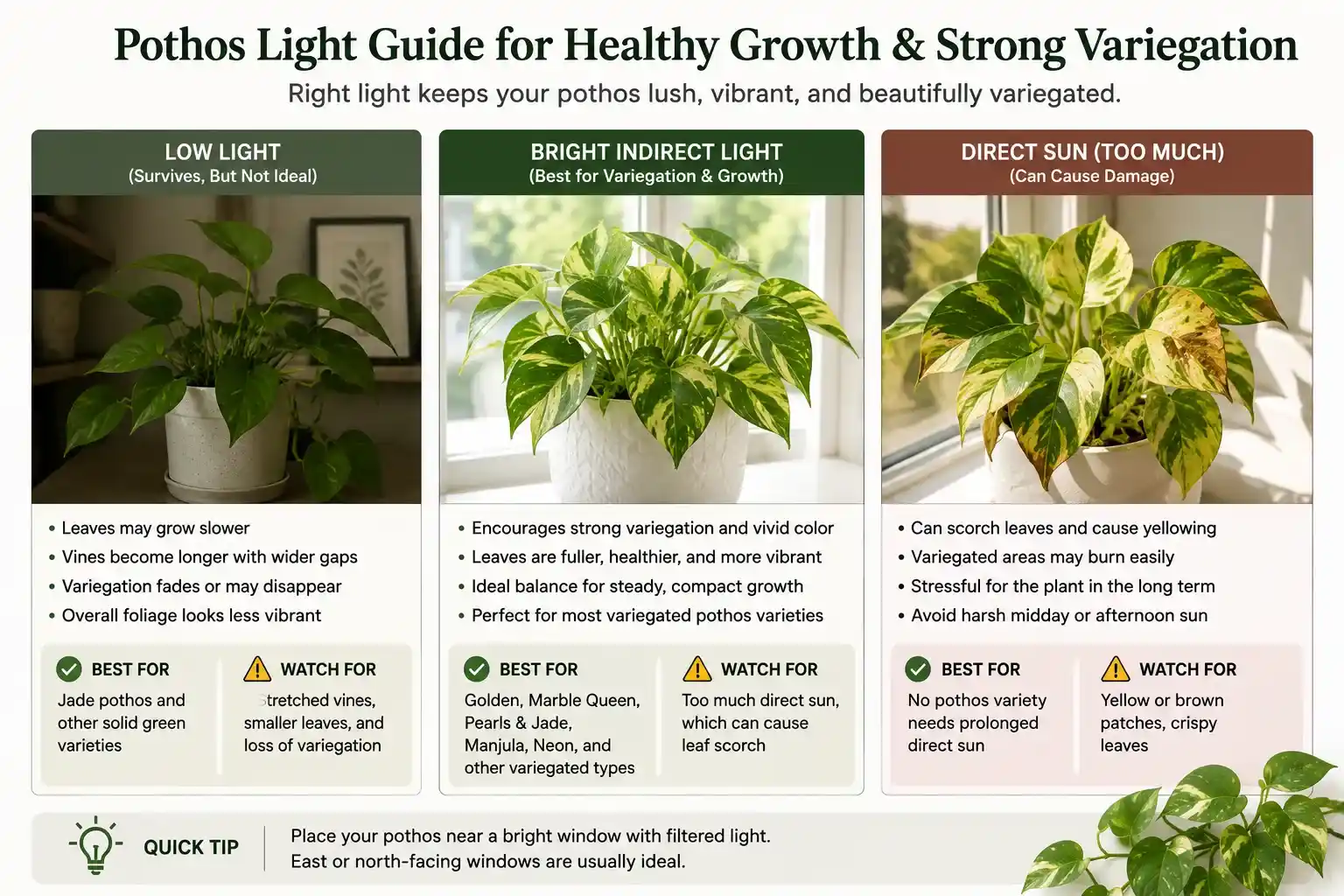
Pothos generally performs best in medium to bright indirect light. Solid-green cultivars are more forgiving in dim rooms, while highly variegated types usually benefit from stronger usable light to maintain their pattern. Bright does not mean harsh direct sun. The goal is enough light without leaf damage.
How does low light change pothos foliage?
Low light affects more than growth speed.
A pothos may start producing longer gaps between leaves, weaker-looking vines, or less striking coloration. With variegated plants, the visible pattern can become less pronounced. Clemson’s January 2026 pothos guidance specifically lists bright, indirect light as the preferred condition while noting that pothos tolerates low light.
The plant does not necessarily collapse when light drops. It simply starts spending its limited resources differently.
That is why a plant can look “fine” while still performing below its potential.
Why does variegation make light more important?
Variegated leaves contain areas with less green tissue than fully green leaves. That makes light management more important when the goal is to maintain strong foliage quality.
For practical purposes, the important thing is what happens to the new growth.
Old leaves show you the conditions they experienced earlier. New leaves tell you more about the conditions the plant is receiving now.
That makes new growth one of the best signals to watch when adjusting placement.
What should you do when new pothos leaves become greener?
Start with light, not fertilizer.
Move the plant gradually toward a brighter indirect-light location and watch subsequent new leaves. Avoid responding by putting it into intense direct sun. That can create a different problem without solving the underlying placement issue.
The assumption that more sun automatically means better color is wrong. Pothos needs usable light, not maximum light. Penn State specifically recommends moderate to bright light while warning against direct sun, and Clemson likewise recommends bright indirect light.
A brighter room with filtered or indirect light is usually a much better solution than a harsher window.
Which light conditions preserve color without causing scorch?
Aim for a stable spot where the plant receives strong ambient daylight but avoids prolonged, intense direct rays.
Signs that the plant needs more light can include:
- New growth becoming less patterned
- Longer, more widely spaced vines
- Reduced foliage density
- Less intense color in cultivars selected for bright foliage
Signs that the plant may be receiving too much direct sun can include yellowing or scorched-looking foliage. Penn State specifically notes yellowing associated with direct sun.
Pothos light and variegation comparison
| Pothos type | Lower-light flexibility | Variegation or color priority | Practical placement |
| Jade | High | Solid dark green | Good option for a dimmer room |
| Golden | Moderate | Yellow-green pattern | Bright indirect light helps maintain stronger color |
| Neon | Moderate | Bright chartreuse foliage | Medium to bright indirect light |
| Marble Queen | Lower | Strong white-and-green variegation | Favor brighter indirect light |
| Pearls and Jade | Lower to moderate | White and silvery variegation | Give it a bright indirect position |
| Manjula and other heavily variegated types | Lower to moderate | High | Prioritize stable, usable light |
Cultivar behavior varies, so these are placement guidelines rather than rigid rules. Wisconsin Extension, for example, identifies Jade as a lower-light option and notes that low light can reduce variegation in pothos.
How often should you water pothos?
Water pothos when the soil has dried rather than following a fixed weekly schedule. The exact interval depends on pot size, soil, light, temperature, and room conditions. Water thoroughly, allow excess water to drain, and avoid keeping the root zone constantly wet. Pothos generally handles slight dryness better than prolonged overwatering.
How do you know when pothos actually needs water?
Check the soil rather than the calendar.
A plant in bright light may dry relatively quickly. A plant in a cooler, darker room may stay moist much longer.
This is why “water every Sunday” is such a poor universal rule.
Feel the potting mix and look at the plant together. The surface should no longer be wet before the next thorough watering. Penn State similarly advises watering pothos when the soil is dry.
What does overwatering look like?
Overwatering is less about giving a plant too much water in one event and more about keeping the roots wet too often.
Warning signs can include yellowing foliage, persistently damp soil, poor growth, and root damage. Clemson identifies root rot as a major pothos problem associated with excess water. Wisconsin Extension likewise connects root rots with overwatering.
When the soil stays wet for too long, adding more water obviously does not solve the problem.
What does underwatering look like?
A thirsty pothos may droop temporarily. Leaves can lose firmness, and the soil will be noticeably dry.
The useful distinction is what happens after watering. A plant that perks up after its moisture level is restored is telling you something very different from a plant sitting in wet soil while continuing to decline.
Should watering change in winter?
Usually, yes, because the plant’s environment changes.
Lower light, cooler rooms, and reduced growth can slow drying. That means the same watering routine used during a brighter growing period may leave the pot wet for too long.
Pattern claim: Users growing pothos in darker or cooler rooms typically need to water less often because the pot dries more slowly. That is a consequence of the growing environment, not a special “winter watering rule.”
The practical habit is simple: check the soil first.
What soil, pot, humidity, and temperature are best for pothos?
Pothos does well in an airy, well-drained potting mix and a container with drainage holes. It prefers warm, stable indoor conditions and can tolerate a range of household environments. Good drainage matters more than building an elaborate humidity routine around the plant.
What soil mix prevents pothos from staying wet too long?
Use a quality houseplant mix that holds enough moisture for the roots but does not collapse into a dense, airless mass.
The exact recipe matters less than the result.
The root zone should have access to both moisture and air. If a mix remains saturated for long periods, changing the watering schedule may not be enough. The soil itself may be the bottleneck.
Common ingredients such as orchid bark can help create a looser mix when used appropriately, but there is no magic pothos soil recipe that every home needs.
Does pothos really need high humidity?
Pothos appreciates humidity, but that does not mean every home needs a misting routine.
Clemson lists a preferred humidity range in its 2026 guidance, while Penn State describes pothos as a plant that handles ordinary indoor conditions well.
The stronger priority is root health.
Don’t center your pothos care routine on misting. Raising humidity may help in very dry conditions, but it cannot compensate for poor light, waterlogged soil, or bad drainage.
That’s the contrarian point many generic plant-care articles miss. The plant’s root zone is usually a much more consequential place to focus attention than the surface of its leaves.
What temperature keeps pothos comfortable?
Pothos prefers warm indoor conditions and should be protected from cold drafts and abrupt temperature changes. Clemson’s January 2026 guidance gives separate day and night temperature ranges, while Penn State places pothos comfortably within ordinary room temperatures.
For most homes, consistency matters more than chasing a perfect number.
Keep the plant away from a consistently cold window, strong heating airflow, or an AC vent blasting directly onto the foliage.
When is it time to repot pothos?
Look for signs that the current container is no longer working well for the root system.
Roots emerging from drainage holes, a severely crowded root ball, or a plant that rapidly dries out despite appropriate watering can all justify closer inspection.
Penn State recommends annual repotting into a slightly larger container and cautions against overwatering immediately after repotting.
A larger pot is not automatically better. Too much unused wet soil can create a slower-drying root environment.
How do you make a pothos bushier, fuller, or able to climb?
To make pothos bushier, prune long stems instead of allowing every vine to extend indefinitely. Cuttings can be rooted and replanted to add density, while a support can train vines upward rather than letting them trail. Good light still matters because pruning cannot replace weak growing conditions.
How do you make pothos bushier?
Pruning changes the shape of the plant. It does not magically create new foliage from a weak environment.
For a fuller-looking plant:
- Identify long or bare sections that need shortening.
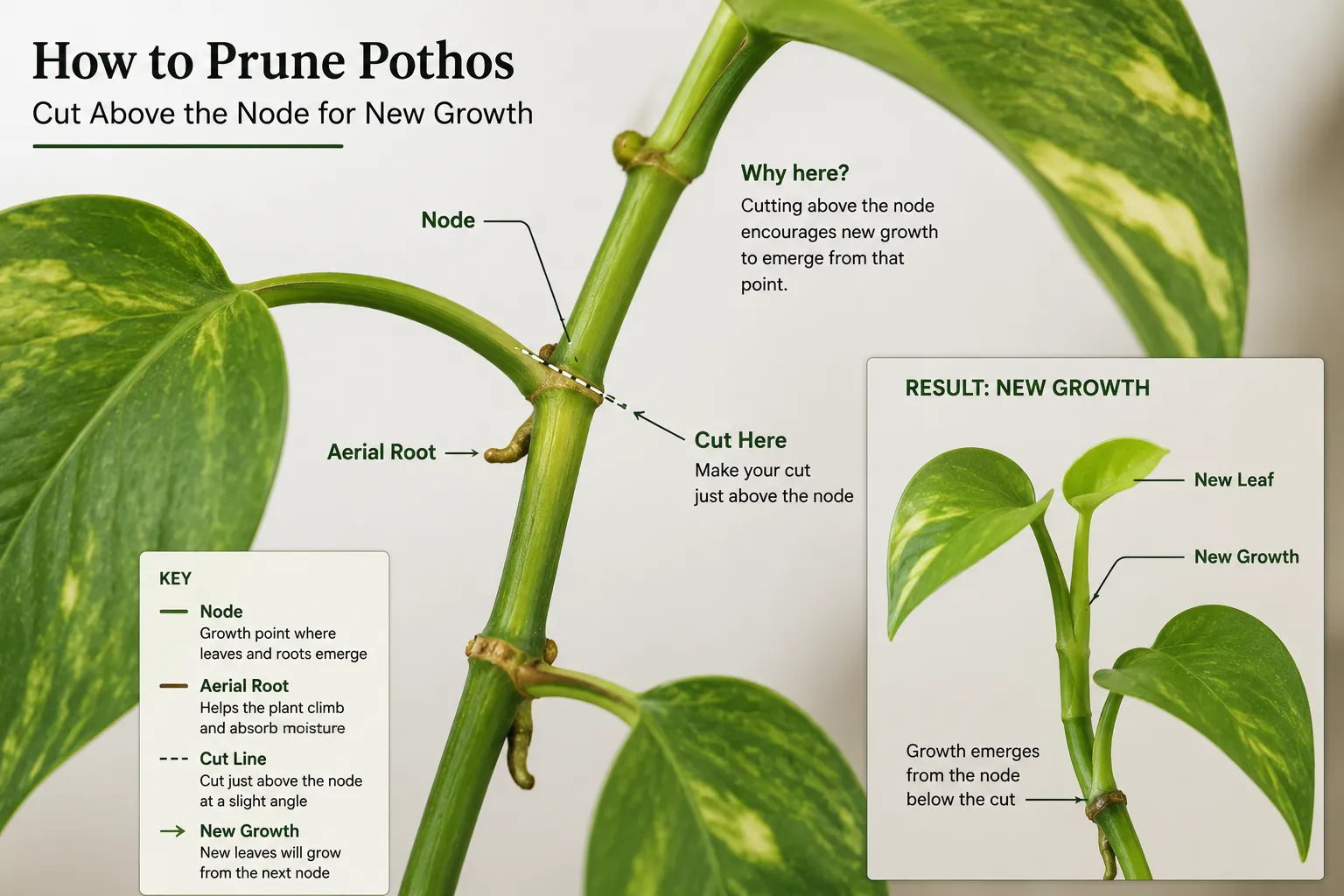
- Cut the stem just above an appropriate node.
- Keep healthy cuttings for propagation.
- Replant rooted cuttings into the same container when appropriate.
- Reassess the plant’s light before pruning heavily.
A plant that has been severely stretched by low light will benefit more from better placement plus pruning than from aggressive cutting alone.
Should pothos trail or climb?
Both work.
Trailing pothos looks natural in hanging baskets or on a high shelf. Climbing pothos can be trained onto a support, and aerial roots at the nodes help the vine attach as it climbs. Penn State notes that pothos works well as a hanging plant or can be trained upward on a totem, while Clemson describes its natural vining habit and recommends a moss pole as a way to encourage climbing indoors.
Climbing can also change the visual character of the plant. A hanging vine creates length. A trained vine creates height.
Why is my pothos long and bare?
A long, sparse vine often points back to the plant’s growing conditions.
Low light can encourage weaker, more widely spaced growth. Old vines can also become less attractive if they are never pruned.
The answer is not always “cut it shorter.” First ask whether the current spot is bright enough to support the growth you want.
How do you prune, propagate, and repot pothos?
Pruning helps control shape and provides cuttings, while propagation lets those cuttings become new plants. Pothos can be propagated from stem cuttings in water or another rooting medium, and repotting is useful when roots become crowded or the container no longer suits the plant.
How do you prune pothos?
- Choose a healthy section of vine with active growth.
- Locate a node before making the cut.
- Cut the stem cleanly just above the selected node.
- Retain the healthy cutting if it will be propagated.
- Reassess the shape and remove only additional growth that improves the plant.
Avoid turning pruning into a haircut with no purpose. Each cut should either improve structure, remove damaged material, or create useful propagation material.
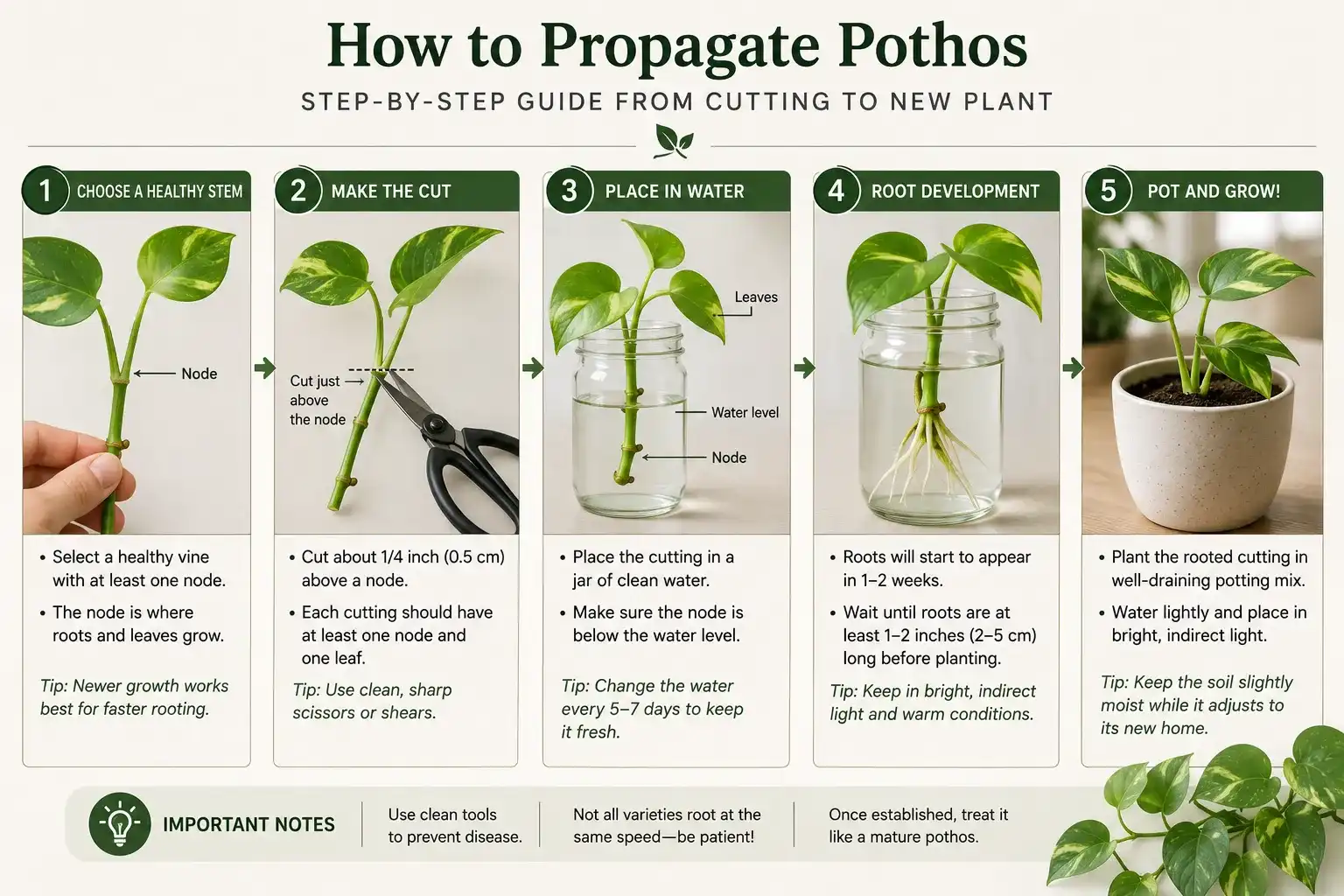
How do you propagate pothos from a cutting?
- Select a healthy stem with at least one viable node.
- Cut the stem into manageable sections.
- Place the cutting in water or a suitable rooting medium.
- Provide warm, bright indirect conditions while roots develop.
- Transfer rooted cuttings into an appropriate potting mix when ready.
Water propagation is one reason pothos is such a popular pass-along plant. Wisconsin Extension reports that pothos cuttings can root in water or vermiculite, while Penn State recommends stem cuttings as a straightforward propagation method.
Pothos plant care in water is best understood as propagation in water, not a substitute for ordinary long-term growing in a jar.
When should you repot pothos?
Repot when the root system is crowded enough that the existing container is working against the plant.
Choose a pot only moderately larger than the current root ball. Use fresh, well-drained mix and avoid saturating the freshly repotted plant.
Penn State specifically advises avoiding overwatering after repotting because the changed root environment can make excess moisture more stressful.
Why are my pothos leaves turning yellow, brown, or unusually green?
Yellow, brown, and unusually green leaves are symptoms, not diagnoses. Start by checking the soil and recent growth, then evaluate light, roots, and environmental stress. Pothos can show yellowing from excess water or direct sun, while reduced variegation often points back toward insufficient usable light.
Why are pothos leaves turning yellow?
Check two things first: the soil and the location.
Direct sun can cause yellowing, according to Penn State. Overwatering can cause yellowing while contributing to root problems, according to Clemson and Wisconsin Extension.
That means “yellow leaf = overwatering” is too simplistic.
Look at the pattern. If the plant is sitting in wet soil and several leaves are declining, the root zone deserves attention. If the plant is exposed to strong direct sun, placement may be the more immediate issue.
Why are pothos leaves turning brown?
Brown areas can have several causes, including watering problems, excess fertilizer salts, temperature stress, and direct-light damage.
Wisconsin Extension notes that blackening leaf margins or tips may result from overwatering, inadequate watering, or excess fertilizer. It also notes that abrupt temperature shifts can produce brown patches.
Do not diagnose a brown leaf from the color alone. Check what the plant and soil are doing around it.
Why is my variegated pothos losing its pattern?
Look at the newest leaves.
If newer growth is noticeably greener than older foliage, light is one of the first variables to examine. Both Penn State and Wisconsin Extension connect lower light with reduced foliage quality or loss of variegation.
This is where the light framework becomes useful. Instead of throwing fertilizer at a color problem, correct the plant’s placement and watch the next few leaves.
Why is my pothos growing slowly?
Start with light.
Then inspect the root ball, watering routine, soil structure, and temperature.
A pothos that receives weak light and stays wet for long periods can be slow for two separate reasons. Improving the environment is more useful than automatically adding more pothos plant fertilizer.
Practitioner detail: A practical diagnostic sequence is new growth → soil condition → root condition → placement. Looking at those four things in that order reduces the temptation to change several variables at once and lose track of what actually helped.
Which pothos varieties are best for bright, medium, or low-light rooms?
Choose the cultivar for the room you actually have. Solid-green cultivars such as Jade give you more flexibility in lower light, while heavily variegated types generally deserve brighter indirect conditions. Neon offers strong chartreuse color without relying on white variegation.
Which pothos is easiest for a lower-light room?
Jade is a strong candidate.
Its solid dark-green leaves do not depend on a white or yellow variegation pattern, and Wisconsin Extension specifically identifies Jade as a cultivar that does well in low-light areas.
That does not mean a dark corner is ideal. It simply means the plant has less visual patterning to lose.
Which pothos is best when you want strong variegation?
Look toward cultivars such as Marble Queen, Pearls and Jade, and Manjula.
These plants make the light question more important because the visual appeal comes partly from their variegated foliage. Wisconsin Extension describes Marble Queen, Pearls and Jade, and other cultivars in terms of their distinct variegation patterns.
If the room is genuinely dim, a less-variegated cultivar may be the smarter choice.
Which pothos is best when you want vivid color instead of variegation?
Neon pothos is an obvious option.
Its chartreuse foliage creates impact without requiring a white variegation pattern. Penn State specifically identifies Neon as Epipremnum aureum ‘Neon’.
It can be a useful choice for someone who wants a bright foliage effect but does not have a heavily variegated cultivar’s maintenance priorities.
What pothos is commonly confused with philodendron?
Pothos and heartleaf philodendron are often mistaken for each other.
One useful distinction is the petiole. Penn State notes that pothos petioles have a groove, while emerging philodendron leaves have a protective sheath called a cataphyll that pothos lacks.
Pothos also belongs to the species Epipremnum aureum, commonly called Devil’s Ivy. Searchers sometimes spell this as “epipremum aureum care,” but the accepted botanical spelling is Epipremnum aureum care.
Some plants sold under the everyday name “pothos” may belong to related species such as Epipremnum pinnatum, so cultivar and species labels are worth checking when identification matters.
Frequently Asked Questions
Which pothos varieties are best for bright, medium, or low-The simplest pothos care routine
The most useful way to think about pothos plant care is not as a checklist of perfect numbers.
Give the plant bright indirect light. Let the soil dry before watering again. Keep the root zone from staying saturated. Use a well-drained mix. Prune long vines when the shape starts to work against you. Then choose a cultivar that matches the room instead of trying to force a high-variegation plant to perform in a dark corner.
That approach works because it treats the plant’s symptoms as clues.
And when variegation is the goal, light is the clue to watch first.