
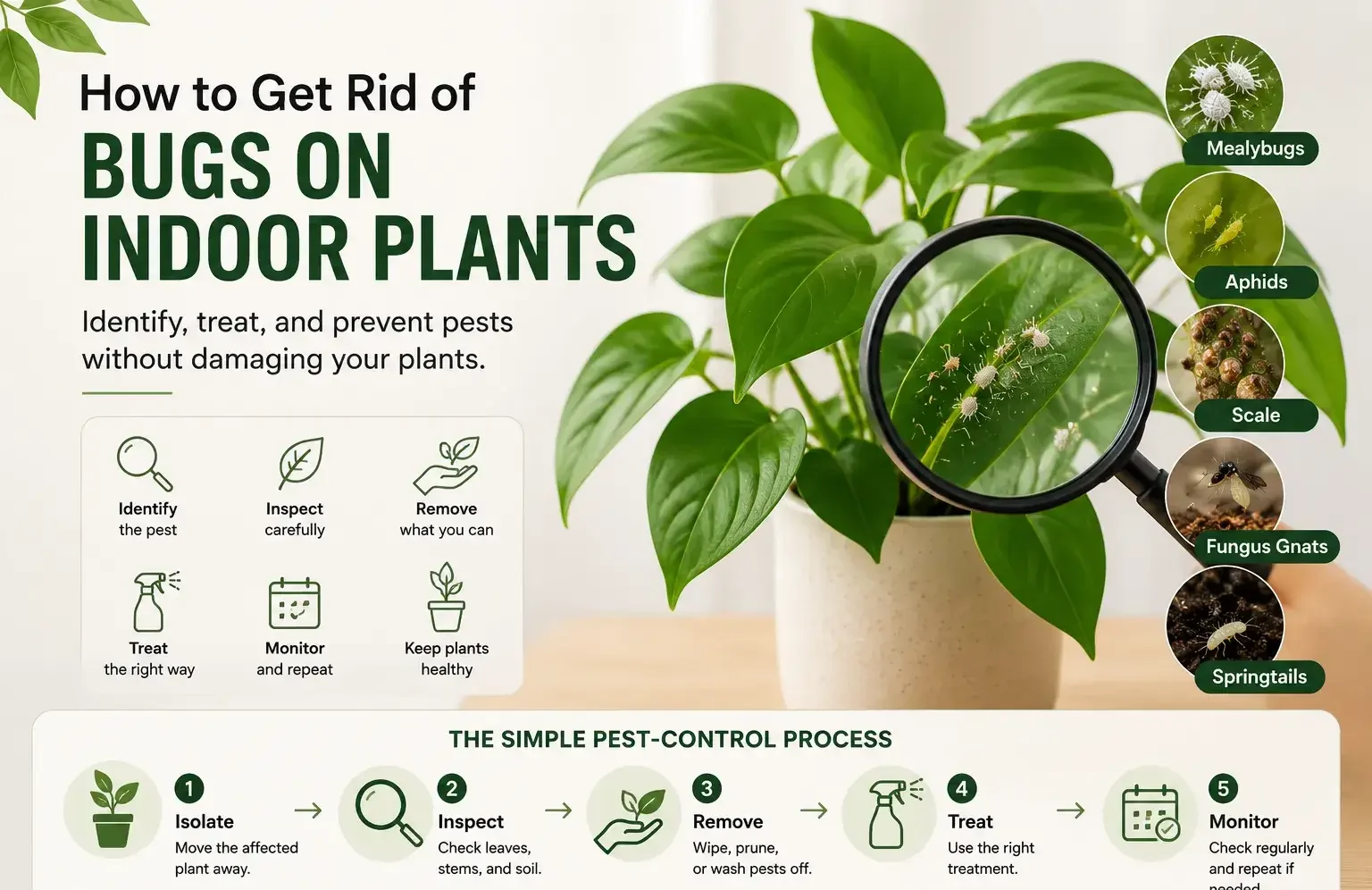
How to Get Rid of Bugs on Indoor Plants Without Damaging Your Plants
A few tiny insects can turn a healthy houseplant into a detective job. You may notice little bugs on the leaves, sticky residue, fine webbing, or flying insects every time you move the pot. The good news is that How to get rid of bugs on indoor plants doesn’t have to mean reaching for the strongest pesticide in the cabinet.
The good news is that you can manage most indoor plant pests once you identify what you’re dealing with. Start by isolating the plant, inspecting the leaves, stems, pot, and soil, and removing what you can physically before choosing a treatment.
The safest approach is not to grab the strongest spray first. Isolate the plant, inspect the leaves, stems, pot and soil, identify the pest, remove what you can physically, then match the treatment to where that pest actually lives. For many minor infestations, washing, pruning, physical removal, and better plant care can solve much of the problem before pesticides are needed.
What should you do first when you find bugs on an indoor plant?
Before deciding How to Get Rid of Bugs on Indoor Plants, identify where the pests are hiding. Start by isolating the affected plant, then inspect leaves, stems, undersides, pot rims, saucers, and soil before choosing a treatment. Correct identification matters because different pests occupy different locations and life stages, so begin with physical removal and plant hygiene, then escalate only when necessary.
Isolate the plant before treating it.
Move the affected plant away from your other houseplants. This simple step matters because pests can spread through contact, handling, tools, or movement between plants. Then inspect nearby plants, and don’t assume the plant with the most visible damage is the only one affected.
Then inspect the plants sitting nearby. Don’t assume the plant with the most visible damage is the only one affected.
For newly purchased plants, University of Minnesota Extension recommends keeping them separate long enough for hidden pest problems to become visible. Its current guidance suggests isolating new plants for one to two weeks.
Check the places people commonly miss
Turn leaves over.
Look where leaves meet stems. Check along veins, inside tight growth points, around the pot rim and beneath the saucer. Some pests are tiny enough that casual inspection won’t catch them.
A magnifying lens helps with very small insects and mites. UMN specifically recommends magnification when inspecting indoor plants.
How can you tell whether the problem is actually pests?
Look for a combination of clues, not just one symptom.
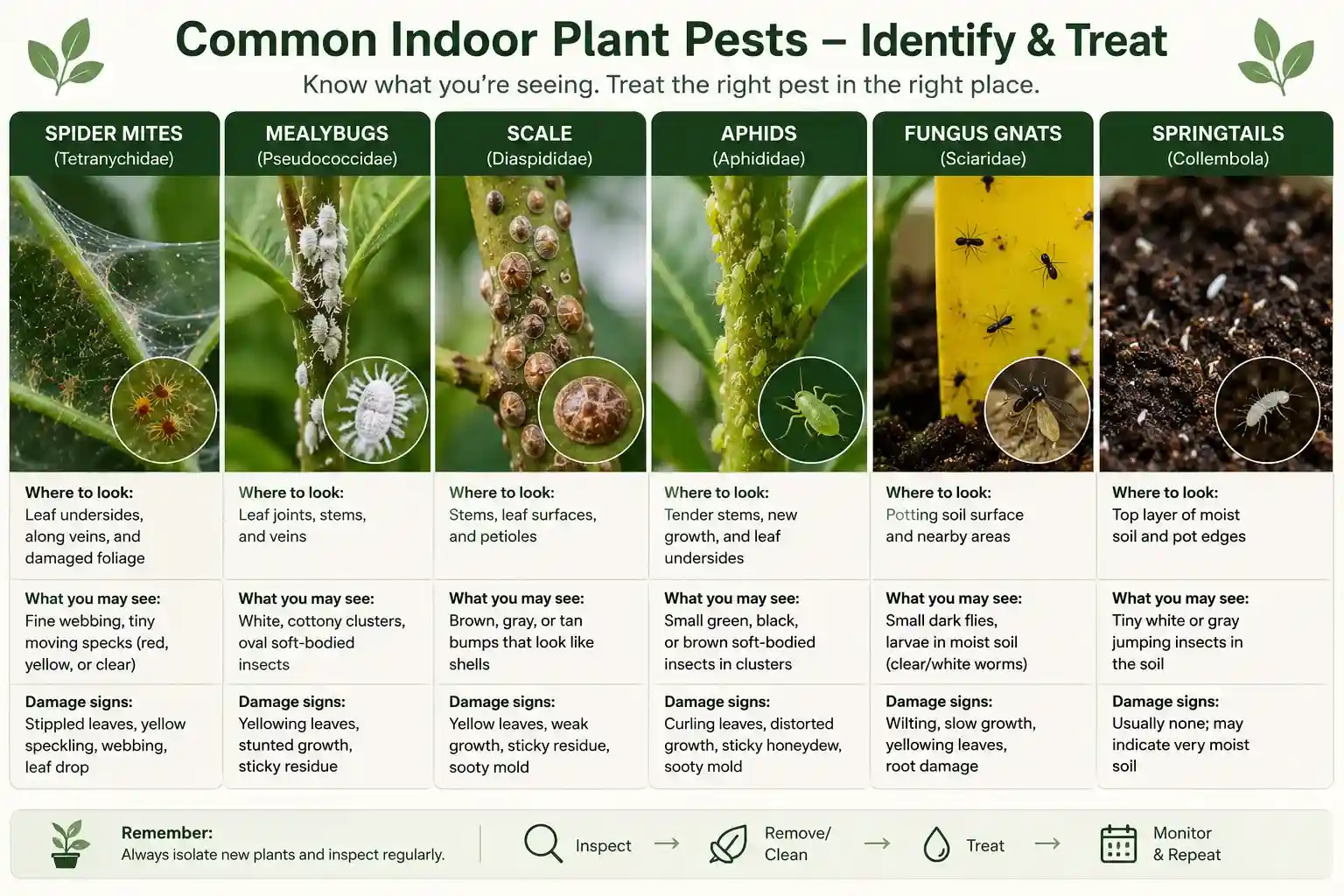
Sticky residue can point toward honeydew-producing insects such as aphids, mealybugs, and scale. Fine webbing and stippled leaves can point toward spider mites. Small dark flies around consistently damp soil suggest fungus gnats, while tiny jumping creatures in damp mix are more likely springtails.
And sometimes the “bug problem” is barely a plant problem at all. Springtails, for example, can appear in damp potting mix while rarely damaging the plant itself.
A useful habit for plant owners is checking for pests while watering, cleaning, or otherwise handling their plants. That’s when small pests often become much easier to spot, and UMN specifically notes that watering can disturb fungus gnats and springtails, making them easier to detect.
Takeaway: Don’t treat an unidentified bug just because it looks creepy. Find out where it is, what it looks like and what damage it is causing.
How do you identify the bug on your houseplant?
Identify the pest by its location, appearance, damage pattern, and behavior rather than treating every bug the same. Webbing points toward spider mites; cottony clusters suggest mealybugs; sticky honeydew can indicate aphids, mealybugs, or soft scale; small flies around moist soil suggest fungus gnats, while jumping soil creatures suggest springtails.
Match the visible sign to the likely pest.
| What you notice | Likely pest | Where to look |
| Fine webbing and speckled leaves | Spider mites | Leaf undersides and damaged foliage |
| White, cottony clusters | Mealybugs | Leaf joints, stems and veins |
| Brown, gray or shell-like bumps | Scale | Stems and leaf surfaces |
| Small clustered insects on new growth | Aphids | Tender stems and leaves |
| Slender insects and silvery-looking damage | Thrips | Leaves and flowers |
| Tiny white flying insects | Whiteflies | Leaf undersides |
| Small dark flies around damp soil | Fungus gnats | Soil and nearby surfaces |
| Tiny pale bugs that jump when disturbed | Springtails | Damp potting soil |
The appearance of the pest can completely change How to Get Rid of Bugs on Indoor Plants. Use symptoms, pest location, and physical appearance together rather than relying on a single visual clue. It notes that whiteflies tend to occur on leaf undersides, while spider mites are often found there too and may require magnification to see.
What are the tiny bugs in houseplant soil?
First, don’t assume every tiny creature in potting mix is a destructive pest.
Fungus gnats are small, dark flies that thrive in damp soil. Their larvae live in the growing medium and feed mainly on fungi and decaying organic matter. They are usually a nuisance, though severe infestations can cause root damage.
Springtails are another common sight. They are usually tiny, light-colored creatures that jump when disturbed. UMN describes them as scavengers that favor damp soil and says they rarely damage indoor plants.
That distinction matters because a plant owner who sees harmless springtails and immediately reaches for a pesticide may create a bigger problem than the bugs did.
What about soil mites?
Soil mites can be alarming because they’re small and move through the potting mix, but the name alone does not tell you that the plant is being harmed. Before treating, identify what you’re seeing and whether the plant is actually being damaged.
When the plant looks healthy and the organisms are confined to the soil, identify them before you treat.
What is the safest way to get rid of bugs on indoor plants?
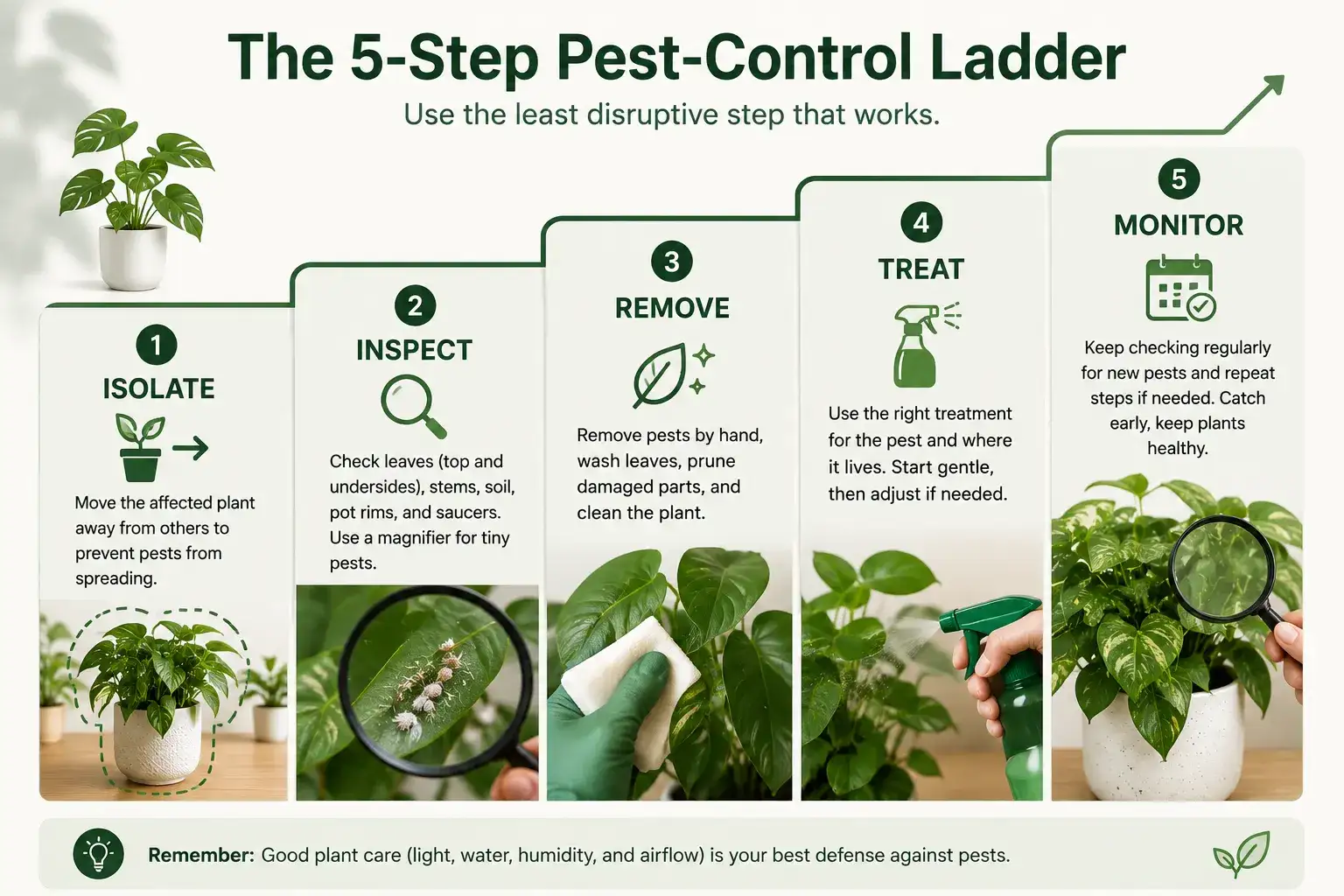
For most indoor infestations, use an escalation ladder: isolate the plant, wash or physically remove pests, correct the growing conditions, then use a labelled insecticidal product when necessary. Soil pests need a different approach from foliage pests, and severe infestations may require pruning, repotting, or removal.
1. Isolate the plant
Move it away from the collection before working on it.
2. Wash or physically remove visible pests
Rinse a manageable plant in a sink or shower, or wipe its leaves with a damp towel. You can sometimes remove larger pests and visible clusters by hand, and UMN recommends these nonchemical methods for many minor infestations.
3. Correct the conditions helping the infestation
Overwatering, poor drainage, unsuitable light and generally weak growing conditions can make pest management harder. Fungus gnats, in particular, are associated with damp potting soil.
4. Use an appropriate labelled treatment
If physical control isn’t enough, select a product labelled for the plant and pest you are treating.
Read the label before use. EPA says the label provides directions for how much product to use, where to use it and how to use it safely and effectively.
5. Recheck the plant and repeat only as directed
One treatment does not automatically mean the infestation is finished because contact products only work when the pest is actually exposed, and some pest problems require repeated applications.
Here’s the unpopular part: stronger treatment is not automatically better treatment.
Most people get this wrong.
The goal of plant pest control is not to use the harshest thing available. The goal is to use the least disruptive method that can reasonably control the identified pest, because a well-matched physical treatment can be more sensible than spraying an unidentified insect with a broad product.
That decision saves the plant from unnecessary stress and gives the treatment a much better chance of targeting the actual problem.
How do you get rid of bugs on plant leaves and stems?
For bugs feeding on leaves or stems, isolate the plant, rinse or wipe the foliage, remove visible pests from protected crevices, and repeat the appropriate control at the interval on its label. Thorough coverage matters, especially on leaf undersides, because many common pests feed or shelter there.
Wash the plant without spreading the infestation.
For a small plant, washing it in a sink can physically remove many insects and reduce the population before you consider another treatment.
Change wiping material regularly if you are wiping leaves. UMN recommends changing towels often to reduce the chance of spreading pests from one area of the plant to another.
Remove pests from stems, joints and crevices.
Aphids may cluster on tender growth. Mealybugs can hide where leaves meet stems. Scale may sit on stems or along leaf surfaces.
For small mealybug populations, UMN recommends physical removal, including tweezers or a cotton swab dipped in alcohol.
The important detail is coverage. A plant can look clean from above while pests are sitting underneath leaves or inside tight joints.
When are insecticidal soap, plant oils or other labelled products appropriate?
Products containing insecticidal soap, horticultural oils, plant oil extracts or other active ingredients can be useful against some common indoor pests. But these products aren’t interchangeable, and their effectiveness depends on the pest, plant, and application.
UMN notes that insecticidal soaps work through direct contact and have no residual activity. Its guidance also warns against making homemade soap mixtures because they can burn plants.
This is why “homemade” does not automatically mean “gentle.”
Penn State Extension updated its guidance in 2026 to warn against untested home remedies such as vinegar, dish soap, and other household mixtures because they may be ineffective or harmful to plants, people, or pets and lack the tested directions found on labelled products.
Why repeat treatment may be necessary.
Contact treatments work on pests they reach. If some pests are hidden, newly emerged, or otherwise missed, the population can return, so check coverage, identification, and the label’s directions first.
The answer isn’t automatically more product. Check coverage, identification and the label’s directions first.
How do you get rid of bugs in houseplant soil?
For soil-dwelling pests, focus on moisture management and the pest’s life stage rather than treating only the leaves. Let the soil surface dry as much as the plant tolerates, remove debris, use sticky traps for flying adults, and repot with fresh mix when soil-borne pests persist.
How do you get rid of fungus gnats?
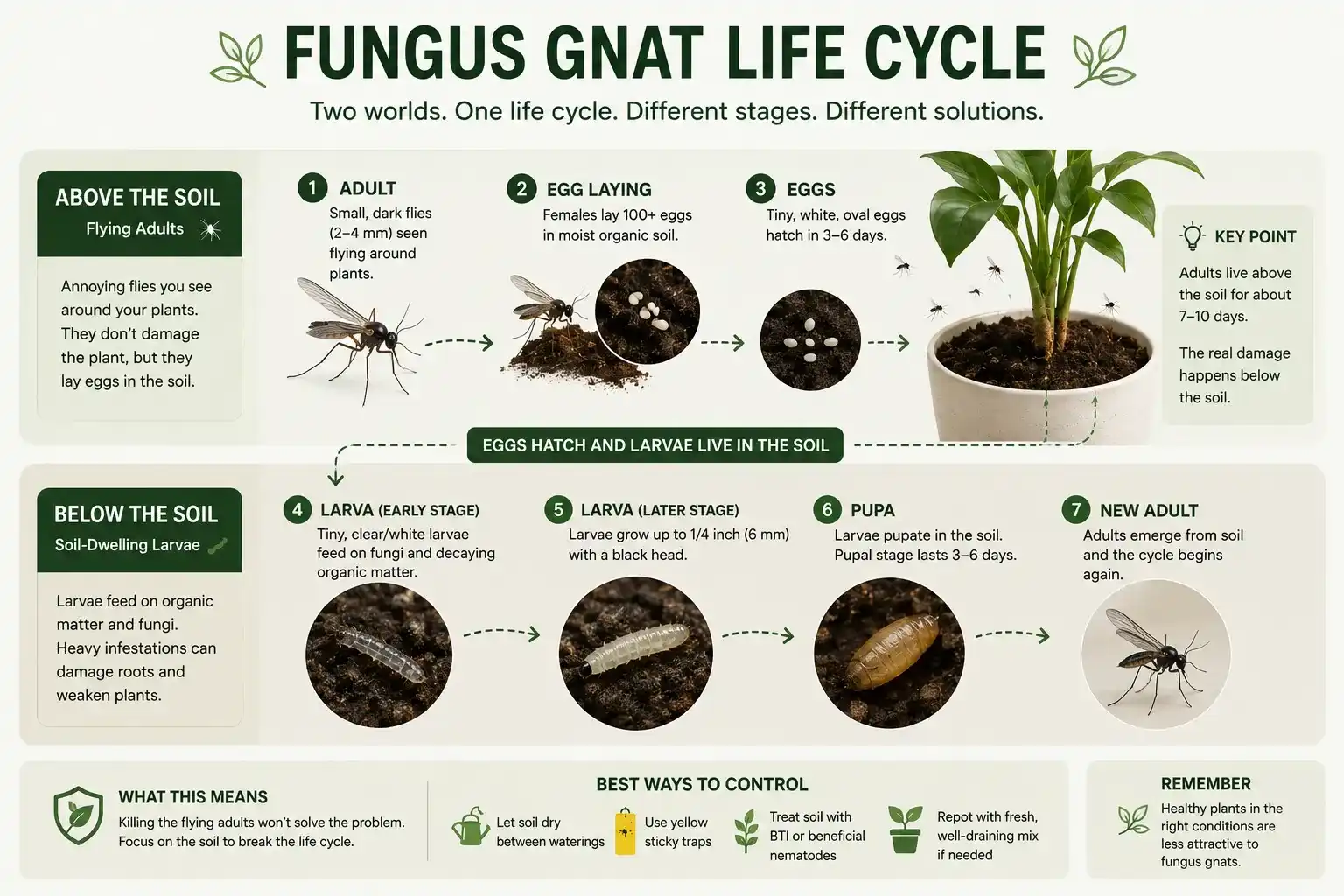
Fungus gnats are the classic example of why treating the leaves alone fails. Their adults are visible, but the problem starts in the soil, where the larvae live and feed.
The adults fly around the plant, but the immature stages live in the soil. UMN recommends allowing the soil surface to dry as much as the plant can tolerate without wilting, using yellow sticky traps to capture adults, and using soil-applied Bti products against larvae.
Sticky traps are useful, but they aren’t a complete solution. They mainly help with adult insects and monitoring. The larvae remain in the growing medium.
What are mosquito bits, and do they work for fungus gnats?
Mosquito Bits contain Bacillus thuringiensis subspecies israelensis, commonly called Bti. The EPA’s product record identifies fungus gnats as a labeled target for Summit Mosquito Bits, and the manufacturer’s current product information states that Bti targets the larval stage.
That distinction is crucial.
Mosquito Bits aren’t a general-purpose spray for every insect flying around the house. Bti targets larvae, so it makes sense to use it when fungus gnats have been identified, and the target is their soil-dwelling larval stage.
Always use the product according to the label for the product in hand. Product labels can vary, and EPA explicitly says the label is the source for proper use.
What should you do about springtails?
Usually, don’t panic.
UMN describes springtails as scavengers that prefer damp potting soil and says they rarely damage indoor plants. Its recommended management is to let the soil surface dry as much as the plant permits between waterings.
If the plant itself looks healthy, the better question may be why the pot stays persistently damp.
When should you replace potting mix?
Repotting becomes more useful when soil-borne pests persist or when the existing growing medium has become part of the problem.
UMN recommends using fresh potting soil and clean containers when repotting to help eliminate soil-borne pests. It also advises washing soil from plant roots during this type of reset.
Don’t repot every plant just because you saw one tiny bug. That creates a new round of plant stress for no good reason.
What is the best treatment for the most common indoor plant bugs?
Treat the pest you actually have: aphids and whiteflies can often be managed with washing and appropriate contact controls; mealybugs and scale may need persistent physical removal; thrips require close attention to foliage and flowers; spider mites need thorough coverage; fungus gnats require attention to the soil as well as adults.
Aphids
Aphids usually feed on tender growth. They may produce sticky honeydew, which can end up on leaves and nearby surfaces.
For troublesome aphid populations, UMN lists insecticidal soap, horticultural oil, neem and pyrethrins among possible controls.
Start by physically removing a small population rather than automatically escalating.
Mealybugs
A mealybug often gives itself away with white, waxy material around its body.
Check leaf joints, veins, stems and other protected areas. UMN recommends washing and physical removal for mealybugs, including tweezers or a cotton swab dipped in alcohol for individual pests.
The annoying part is their hiding behaviour. Removing the obvious bugs while missing the ones tucked into joints can make the infestation appear to disappear and then suddenly return.
Scale
Scale can look like little brown, grey, or pale bumps stuck to the plant.
Some scales are soft and produce honeydew, while armoured scales do not. Both can be difficult to manage because the mature insect is protected by its covering.
For small populations, physical removal can be practical. Heavier infestations may require a properly labelled control.
Spider mites
Spider mites are tiny. Magnification can make identification much easier.
Look for stippling, yellowing, fine webbing and mites on leaf undersides. UMN notes that spider mites thrive in dry, warm conditions and recommends washing along with appropriately labeled insecticidal soap or horticultural-oil products. These products work through direct contact and may require repeat applications.
A practical check is to place a sheet of white paper beneath a leaf and tap the foliage gently. Tiny moving specks may reveal an infestation that is almost invisible on the plant.
Thrips
Thrips can be difficult because they’re narrow, small and easy to overlook.
Inspect leaves closely, especially damaged areas, and check flowers when the plant produces them. Because contact treatments depend on actually reaching the insects, coverage and repeat treatment matter.
Use only a product that is labelled for the specific plant and pest.
Whiteflies
Whiteflies are small, white, gnat-like adults that often fly up when foliage is disturbed. Immature stages are commonly found underneath leaves.
Yellow or blue sticky traps can help detect and capture flying adults, while appropriate washing and labeled controls can address the infestation on the plant.
Fungus gnats
Fungus gnats need a soil-first strategy.
Reduce unnecessarily wet conditions, use yellow sticky traps to monitor adults, and target larvae with an appropriately labeled Bti treatment when needed. Repotting with fresh mix can help when the infestation persists.
That’s the recurring lesson here: the best plant treatment follows the pest’s biology.
How can you prevent bugs from coming back on indoor plants?
Prevention starts before an infestation: inspect new plants, quarantine them, keep foliage and soil surfaces clean, match light and watering to the plant, maintain drainage, and monitor regularly. Avoid persistently wet soil and don’t leave plant debris in pots. Early detection can reduce the need for more aggressive intervention. Prevention is the part of how to get rid of bugs on indoor plants that saves the most repeated work later.
Inspect and quarantine every new plant.
Don’t put a newly purchased plant directly beside the rest of the collection.
Inspect it first. Check both sides of leaves, stems, containers and the soil surface. UMN recommends isolating newly acquired plants for one to two weeks so hidden pests can become visible.
Keep leaves, pots and soil surfaces clean.
Remove dead leaves and flowers from the soil surface. Clean dusty foliage with water rather than relying on leaf-shine products. Clean pots and containers when repotting.
These small habits make inspection easier and reduce debris associated with poor plant hygiene.
Get watering and drainage right.
This doesn’t mean every houseplant should dry completely.
The right moisture level depends on the plant. The goal is to avoid unnecessary, prolonged saturation while still meeting the plant’s watering needs. UMN specifically connects overwatering and poor drainage with fungus-gnat problems and root issues.
Build pest checks into routine plant care.
Check plants when watering, fertilizing or cleaning them.
You’re already touching the leaves. Use that moment.
What should you do if the bugs keep coming back?
Persistent infestations usually mean the treatment is missing part of the pest’s life cycle, the plant is being re-exposed, or the growing conditions continue to favor the problem. Recheck identification, inspect nearby plants, review treatment coverage and timing, and decide whether continued treatment, repotting, or removal makes the most sense.
Recheck identification before changing products
If the same bug keeps returning, don’t assume the product failed.
First ask whether the insect was identified correctly.
A fungus gnat requires a very different approach from a mealybug. You don’t manage spider mites the same way you manage scale. Repeatedly using the wrong treatment is a fast way to waste time.
Inspect every nearby plant.
Walk through the collection.
Check plants that look healthy as well as the obviously damaged one. Some pests can be present before the damage becomes easy to see.
Review coverage, timing and environment.
Did the treatment actually contact the pest?
Did the product label list the correct plant and pest?
Did the plant remain under conditions that favor the infestation?
EPA recommends reading and following pesticide-label directions for proper application and safety.
And sometimes the honest answer is that a badly infested, heavily damaged plant isn’t worth saving. UMN notes that disposing of severely infested plants can be a practical way to protect the rest of a collection.
But before throwing it out, one question deserves attention: is the infestation truly persistent, or has the wrong pest been treated all along?