
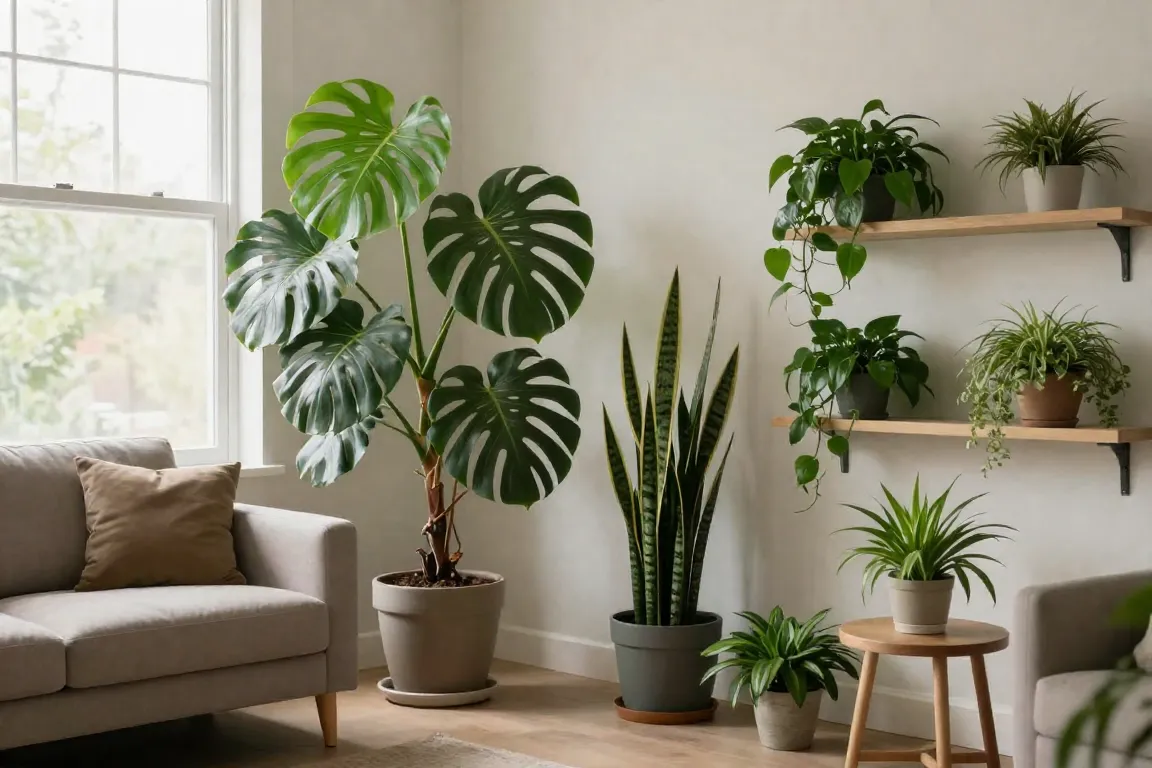
Best Indoor Plants for the Living Room (Large & Small)
A plant can look perfect in a living room and still struggle if it sits too far from the window. The best living room plants are not simply the biggest or most fashionable. They are plants whose light needs, mature size, growth habit and care requirements fit the exact place where they will live.
That is the real issue behind searches for the best indoor plants for the living room, large & small, low. Some rooms need a tall floor plant for an empty corner. Others need a compact plant for a shelf or a low-light option that can handle less natural light. The guide below matches plants to those situations rather than treating the whole living room as one light zone.
What are the best indoor plants for the living room?
The best indoor plants for a living room depend on available light, floor space, ceiling height and how much care you want to provide. Strong options include Monstera, Rubber Plant, Money Tree, Dracaena, Snake Plant, ZZ Plant, Pothos, Spider Plant and Peperomia. Placement then determines which fits best.
| Plant | Best placement | Light | Why it fits |
| Monstera deliciosa | Open floor area | Medium to bright | Large statement foliage |
| Rubber Plant | Floor near a bright window | Medium | Upright, tree-like form |
| Money Tree | Open corner | Medium | Full, structured canopy |
| Dracaena | Narrow corner | Medium | Tall form with a smaller footprint |
| Snake Plant | Tight corner or floor | Low to bright | Upright and space-efficient |
| ZZ Plant | Corner, console or floor | Low to medium | Slow-growing and forgiving |
| Pothos | Shelf or hanging position | Low to medium | Trailing growth |
| Spider Plant | Shelf or hanging position | Medium | Arching leaves and compact habit |
| Peperomia | Side table or shelf | Medium | Small footprint |
The light categories are intentionally broad. Illinois Extension places Pothos, Rubber Plant, Spider Plant and Peperomia in its medium-light group. At the same time, Snake Plant and ZZ Plant are recognized among plants that can tolerate lower-light conditions. It also lists Monstera and Bird of Paradise among plants needing brighter conditions.
How do you choose a living-room plant based on light and space?
Choose the plant for the exact place where it will live, not for the room as a whole. First assess window direction and plant-to-window distance, then check floor width, ceiling clearance and nearby obstructions. A plant that fits visually can still struggle if its final location does not provide enough usable light.
Measure the actual plant location, not just the room.
A living room can contain several different light zones. A plant beside a window may receive much more light than one several feet farther into the room, even though both are technically in the same room.
Illinois Extension gives useful indoor reference points in foot-candles and notes that window orientation, distance, season and outdoor obstructions can change the light reaching a plant. Trees, nearby buildings, curtains and other obstructions matter too.
Measuring Light for Indoor Plants
Match plant height to ceiling clearance
Tall indoor plants for living room spaces need more than an attractive corner. Check the space above the plant for ceiling fans, pendant lights, shelves and curtains.
A tall plant can work beautifully in a high-ceiling room and feel awkward in a low-ceiling space. The goal is not maximum height; it is proportion.
Match mature width to floor footprint.
This is where many plant choices go wrong.
A narrow Snake Plant and a wide Monstera can occupy the same visual height while using very different amounts of floor space. Check the plant’s expected mature spread, not just the size of the specimen sitting in the nursery pot today.
Living Room Plant Placement Matrix
| Room condition | Placement approach | Plant form to look for |
| Bright window area | Near the brighter part of the room | Larger plants with higher light needs |
| Moderate natural light | Near a bright window zone | Adaptable medium-light plants |
| Lower-light area | Closer attention to placement | Plants that tolerate lower light |
| Narrow corner | Keep the footprint tight | Upright or column-like plants |
| Small room | Use vertical or surface space | Compact and narrow plants |
| Large open room | Use floor area deliberately | Broad statement plants |
One useful practitioner rule is simple: measure light where the leaves will actually sit. The room’s overall brightness is not a reliable substitute for conditions at plant height.
Which large indoor plants work best in living rooms?
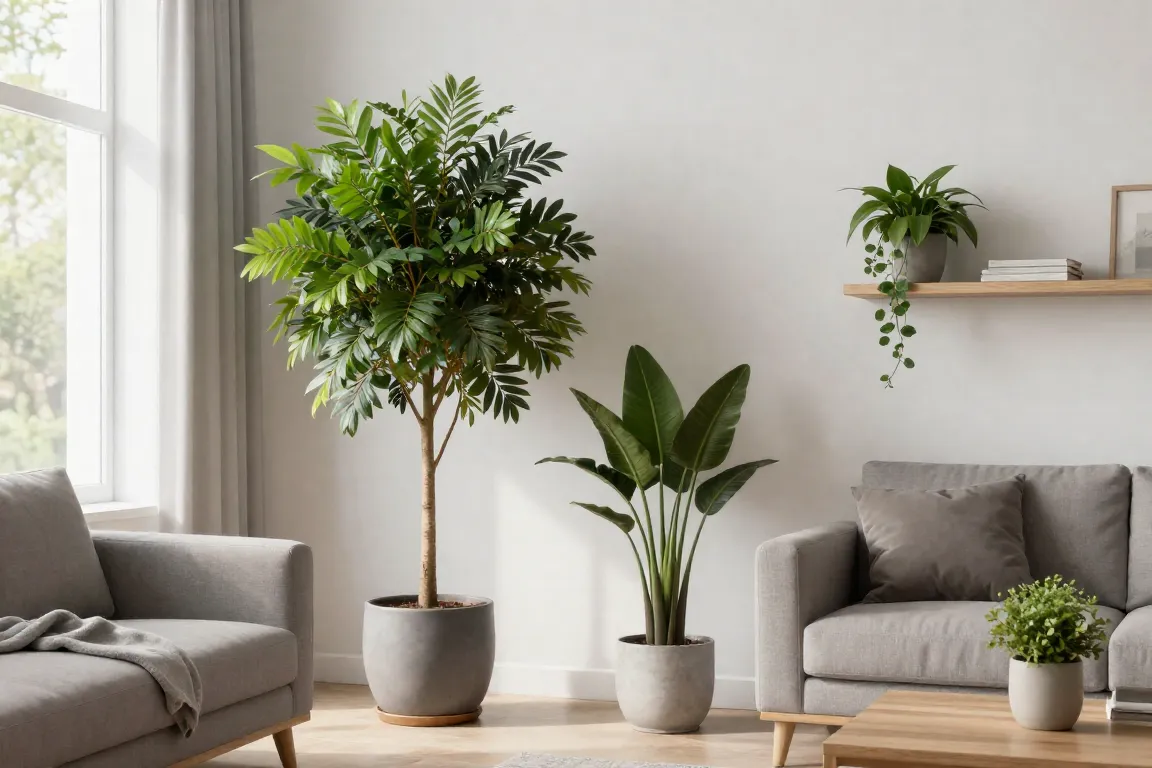
Large living-room plants work best when their mature height, width and light needs match the room’s footprint and ceiling clearance. Monstera suits wider areas, while Rubber Plant, Money Tree and Dracaena provide more upright forms. Bird of Paradise can suit bright, spacious rooms where its leaves have room to develop.
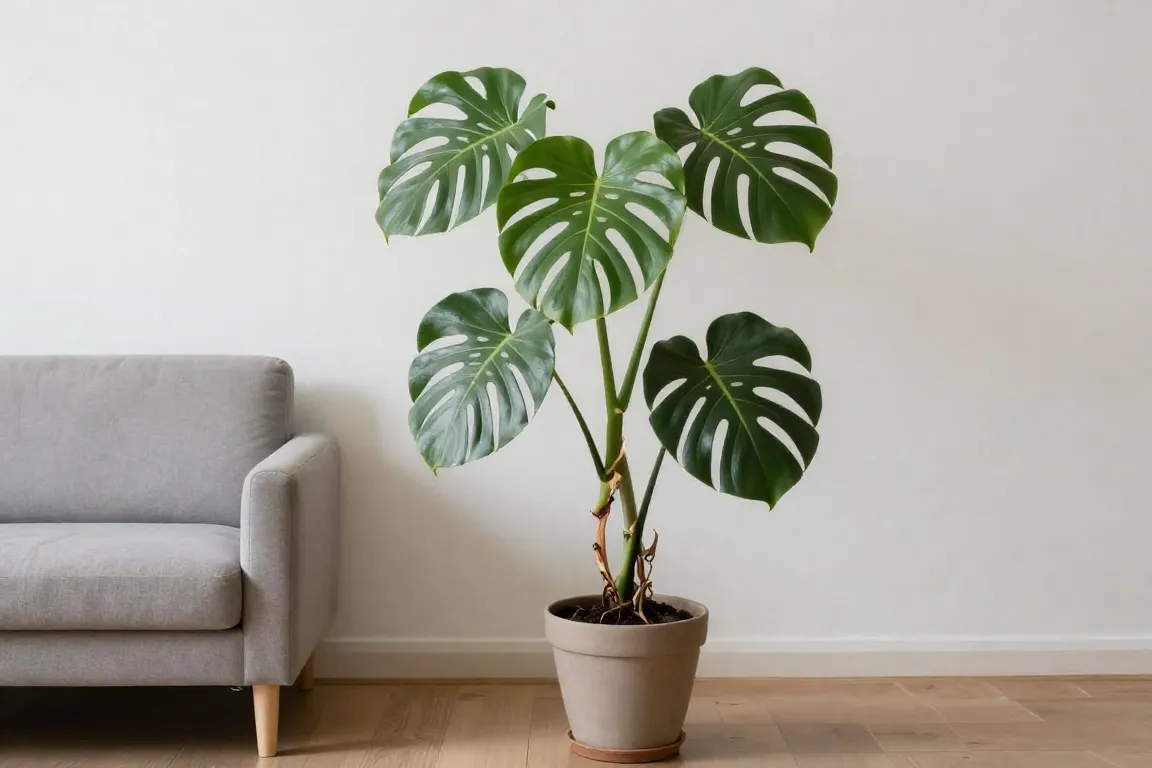
Monstera deliciosa is best for broad statement foliage.
Monstera deliciosa brings large, distinctive leaves and works well as a floor plant where there is enough width around the pot. It is a strong choice for statement plants, but its spread matters. A small young plant can eventually need much more room than its original footprint suggests.
Illinois Extension lists Monstera deliciosa among houseplants associated with bright light.
For homes with cats or dogs, ASPCA lists Monstera deliciosa as toxic because of insoluble calcium oxalate crystals.
Rubber Plant (Ficus elastica) best upright tree-like option
The rubber plant has a more upright shape than many broad-leaved tropical houseplants, so it can fill a room without immediately taking over the entire floor. It suits a living room with moderate natural light and works particularly well beside furniture rather than in a narrow walkway.
Illinois Extension places Ficus elastica in its medium-light group.
Money Tree (Pachira aquatica) best flexible tree form
Money Tree has a structured, tree-like appearance that fits an open corner or a spot beside seating. It gives a living room a substantial plant presence without the broad leaf spread of a large Monstera, and its placement should still suit the available light.
ASPCA lists Pachira aquatica as non-toxic to dogs and cats.
Dracaena best for height with limited floor width
Dracaenas are useful when a room needs vertical interest but has limited floor width. Their upright growth makes them practical for corners, beside cabinets or near furniture where a broad canopy would get in the way, as long as the light matches their needs.
Illinois Extension lists Dracaena among medium-light houseplants. ASPCA lists Dracaena species as toxic to dogs and cats, so it should not be described as pet-safe.
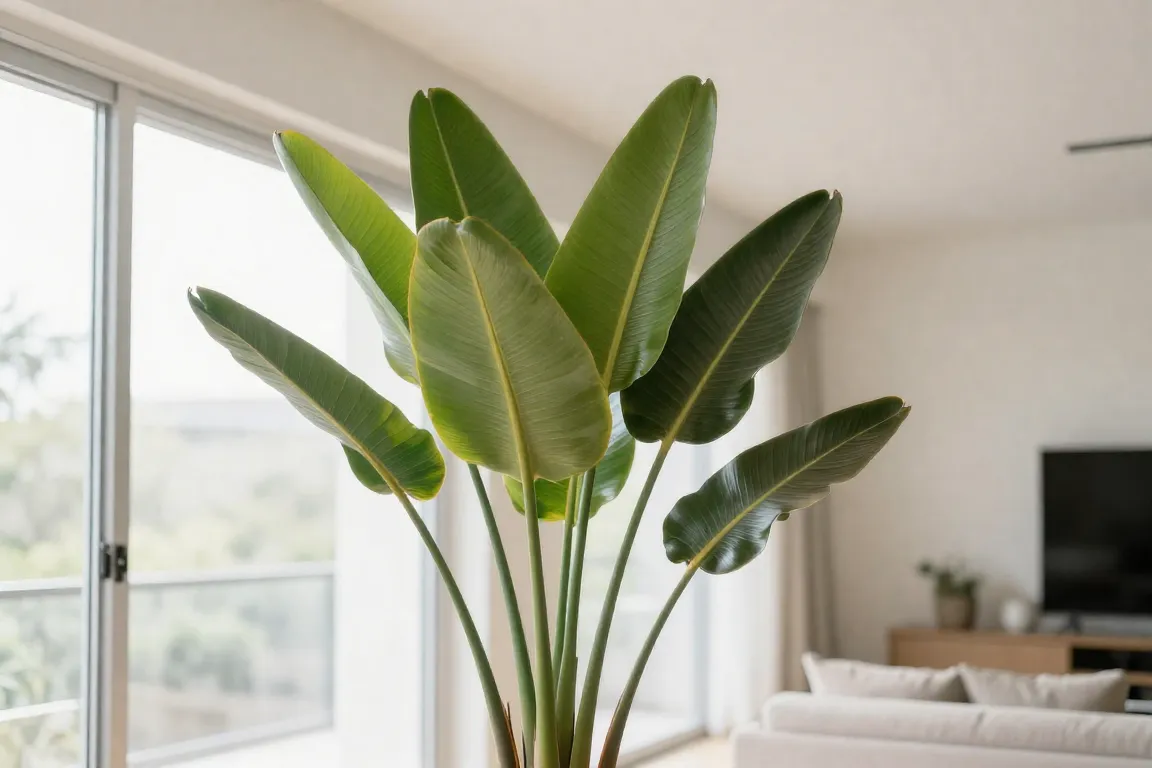
Bird of Paradise is best for a bright, spacious living room.
Bird of Paradise can make a strong architectural statement in a bright room with enough space for its large leaves. It differs from a narrow Dracaena because you need to consider both vertical height and leaf spread.
Illinois Extension places Bird of Paradise among brighter-light houseplants. Also, the common name can refer to different plants. ASPCA distinguishes Strelitzia reginae from another plant called Bird of Paradise, so check the scientific name before making a pet-safety statement.
Pattern worth remembering: People choosing floor plants for living room corners typically get better results when they match the plant’s mature growth habit to the available footprint first, then match light. A narrow plant solves a different problem from a broad plant, even when both reach a similar height.
Which small indoor plants are best for living rooms?
Small indoor plants are useful when floor space is limited or when you want greenery on shelves, tables or bookcases. ZZ Plant and Snake Plant provide compact upright forms, while Pothos trails, Spider Plant arches outward, and Peperomia stays well suited to smaller surfaces and tabletop placement.
ZZ Plant (Zamioculcas zamiifolia) is a best low-maintenance accent.
ZZ Plant is a practical choice for people who want a sturdy-looking plant without creating a large visual footprint. It thrives in lower-light indoor conditions and grows slowly, making it easier to manage in a living room than a fast-growing plant that quickly outgrows its space.
Illinois Extension identifies the ZZ Plant as suitable for low light, and its low-light guidance notes that lower-light plants often grow more slowly.
Keep ZZ Plant away from pets that may chew it. ASPCA includes ZZ Plant among plants that can cause problems for pets.
Snake Plant is the best narrow-corner plant.
Snake Plant is especially useful where floor space is tight because its upright leaves take up relatively little width compared with a broad-canopy plant. It can tolerate low-light conditions, although tolerance does not mean darkness is ideal, so placement should still match the available light.
Illinois Extension lists Snake Plant among low-light houseplants. ASPCA lists it as toxic to cats and dogs.
Pothos (Epipremnum aureum) best trailing living-room plant
Pothos is a good fit for shelves, bookcases and hanging positions because its stems can trail rather than occupying valuable floor space. IIt is commonly grown in moderate indoor light and can tolerate lower-light situations better than many decorative houseplants, depending on placement. Illinois Extension places Pothos in its medium-light group and also includes it among plants commonly used in lower-light spaces.
Pothos is toxic to dogs and cats according to ASPCA.
Spider Plant (Chlorophytum comosum) is best for shelves and hanging spaces.
Spider Plant works well on a shelf or in a hanging planter because its leaves arch outward instead of building a tall, woody shape. Illinois Extension places it in the medium-light category, and ASPCA lists it as non-toxic to cats and dogs.
Peperomia best small tabletop plant
Peperomia is useful when a living room needs a smaller accent for a side table, console or shelf. Its compact growth makes it easier to place without taking up much floor spac, and it fits best where the available light matches its needs.e.
Illinois Extension places Peperomia in the medium-light group. For Peperomia obtusifolia, ASPCA lists it as non-toxic to cats and dogs.
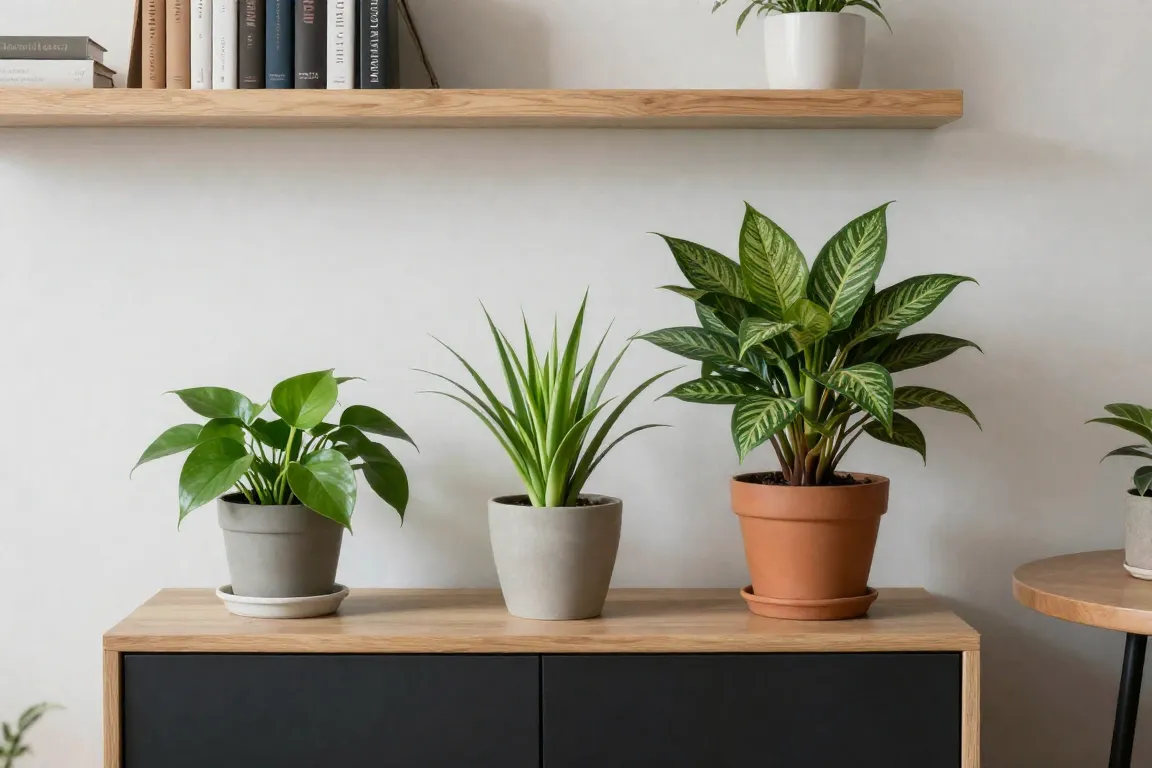
How should you arrange indoor plants in a living room?
Arrange plants by both visual scale and growing conditions. Use one larger plant to anchor an open corner, smaller plants to fill shelves or tables, and trailing plants to soften vertical surfaces. Keep clear space around foliage for light, watering, airflow and normal movement through the room.
Use one large plant as an anchor.
A large plant can give an empty corner a clear focal point. But it does not need to be the biggest plant you can buy.
Choose a size that leaves room for furniture, walking paths and future growth.
Layer tall, medium and small plants
A simple mix works better than filling every surface.
Pair one floor plant with a smaller tabletop plant and, where the light suits it, a trailing plant on a shelf. This creates height variation without turning the room into a crowded plant display.
Keep plants clear of traffic paths, vents and fixtures
Plant placement should make daily care easier, not harder. Avoid putting large pots where people constantly walk past them or where leaves repeatedly touch curtains, fans or heating and cooling vents.
Do not sacrifice plant health for décor.
The assumption that the empty corner is automatically the best place for a plant is wrong.
A corner only works when the plant gets suitable light. Illinois Extension makes the same basic point in its indoor-light guidance: assess the available light first, then choose the plant that fits it.
A lot of plant styling advice starts with the room. Good plant placement starts with the plant.
So the real question is not just where the plant looks good. Does that exact spot provide enough usable light for the plant you chose?
Which living-room plant should you choose for your specific space?
Start with the constraint that matters most: limited floor space, low light, a tall ceiling, a bright window, a shelf or limited time for care. Then choose the plant whose growth habit and light tolerance fit that constraint, rather than choosing by appearance alone.
For a bright living room
Choose plants that tolerate brighter indoor conditions, such as Monstera or Bird of Paradise, and place them in a suitable spot near the window. Illinois Extension lists both among plants associated with higher light needs.
For a low-light living room
Snake Plant and ZZ Plant are practical starting points for lower-light areas. Pothos can tolerate lower-light situations too. Low light doesn’t mean no light, and plants can stretch or lose quality when light is inadequate.
For a small living room
Use vertical plants such as a Snake Plant or Dracaena when floor space is tight. Shelves and side tables can take Pothos, Spider Plant or Peperomia without using valuable walking space.
For a large living room with empty corners
A large Monstera, Rubber Plant, Money Tree or Bird of Paradise can fill an open area, but mature width matters as much as height. Leave enough room for the plant to develop without blocking furniture or circulation.
For a busy beginner
Start with plants that tolerate a wide range of indoor conditions and don’t require constant attention. ZZ Plant, Snake Plant, and Pothos are commonly used in lower-light settings and are generally more forgiving than more demanding houseplants.
The best choice is usually the one that fits your actual room, not the one that looks best in a product photo.
Frequently Asked Questions
Final selection rule
A living room does not have one single light level. It has zones.
Pick the location first. Check the light there. Measure the available footprint and ceiling clearance. Then choose the plant.
That simple order prevents a common mistake: buying a plant because it looks right in the room, then discovering that the room is wrong for the plant. So before buying any houseplants for your living room make sure that you have all available data of your room, windows and light conditions. It is never a plant die after the purchase, it’s the conditions.
Pet-safety note
ASPCA’s plant database notes that plant toxicity can vary by species and recommends checking the exact plant name. In this guide, Snake Plant, Pothos, Monstera and Dracaena are not pet-safe choices according to ASPCA listings, while Money Tree, Spider Plant and Peperomia obtusifolia are listed as non-toxic to cats and dogs.