
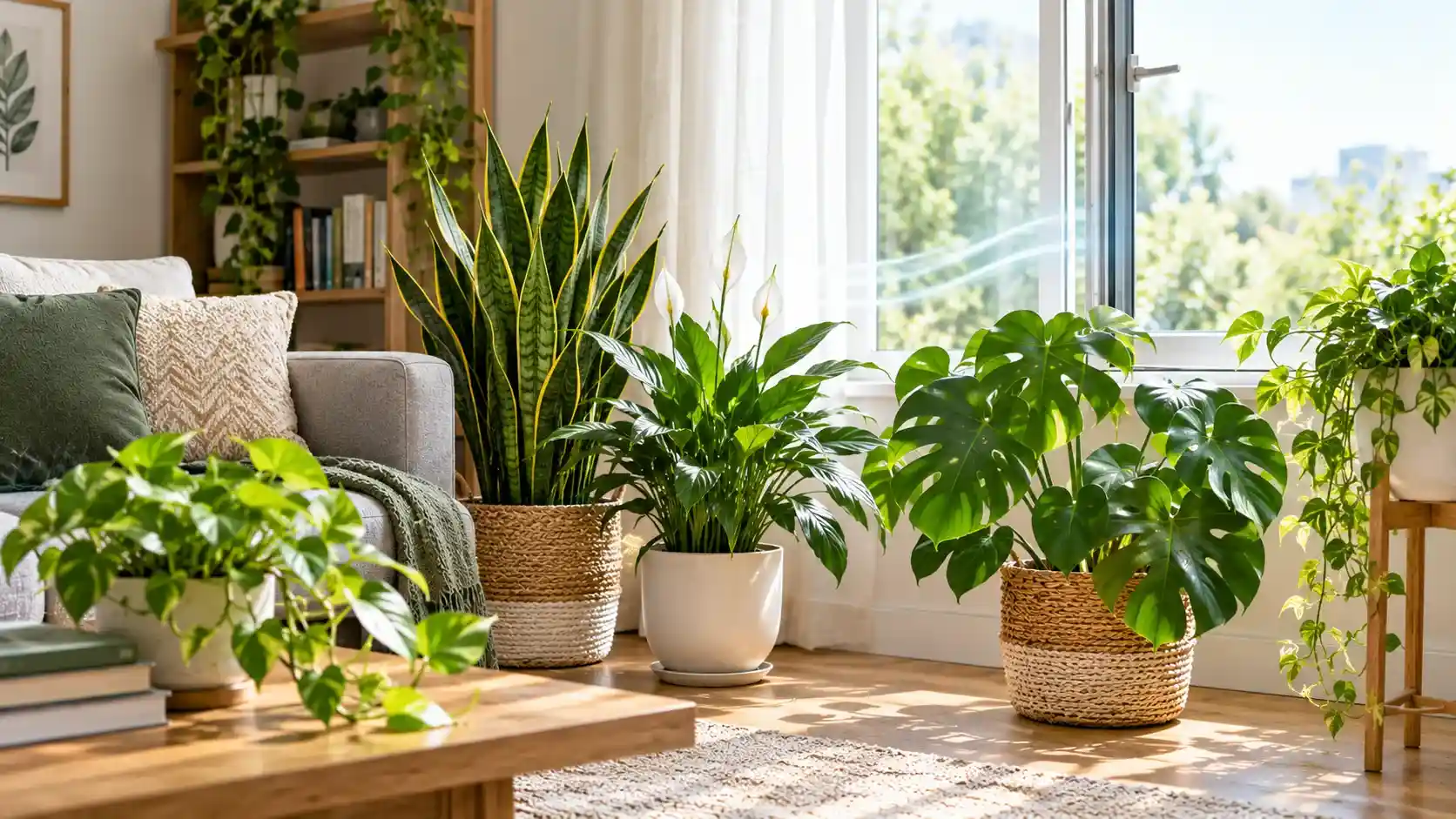
Do Indoor Plants For Air Quality? What NASA’s Study Really Means for Your Home
You scroll past a snake plant photo captioned “NASA proved plants cleaIndoor Plants for Air Qualityn air.Indoor Plants for Air QualityIndoor Plants for Air Quality” The next post says every bedroom needs a peace lily. So do indoor plants improve air quality, or is this just a very persuasive houseplant legend?
Not enough to matter in a real home. Houseplants do remove tiny amounts of airborne chemicals in sealed test chambers, but ventilation dilutes indoor pollutants far faster. A 2019 review found plants would need to be present in impractically huge numbers to rival even open windows.
Maybe your living room does feel fresher with plants. That feeling is real, but it doesn’t come from filtered air. Below you’ll see what the NASA clean air study actually tested, why the results don’t carry over to your home, and what plants are genuinely good for. Curious how plants affect humidity instead? Read our guide Do Indoor Plants Need Humidifiers? for more.
What Did NASA’s Clean Air Study Actually Test?
NASA’s 1989 Clean Air Study, led by B.C. Wolverton, placed plants in small sealed chambers and measured how much of three chemicals, benzene, formaldehyde, and trichloroethylene, disappeared over 24 hours. It grew out of concerns about sealed environments like space facilities, not ordinary homes.
The final report came out in September 1989, backed by NASA and a landscaping trade group. Researchers sealed common houseplants in test chambers, added a measured dose of each chemical, and tracked how much vanished. All three are VOCs, volatile organic compounds that off-gas from paint, glue, and some building materials. That’s where the idea of formaldehyde plants and benzene-busting plants comes from.
In the chamber, some plants cut those chemicals noticeably within a day. The NASA plant study measured VOC removal in a sealed box, and that’s all it measured. The jump from “works in a sealed box” to “cleans your living room” came later, one social media caption at a time.
The experiment was real. The claim built on top of it wasn’t.
Why Doesn’t the NASA Study Work in a Real Home?
A sealed chamber has essentially no fresh air, so plants are the only thing removing chemicals. Real homes exchange indoor and outdoor air through windows, doors, and vents, diluting pollutants much faster than plant leaves and soil can remove them. Researchers measure this with clean air delivery rate (CADR).
Picture a bathtub with the drain wide open and a teaspoon trying to empty it. That’s a potted plant versus normal ventilation. A 2019 review by Cummings and Waring took data from decades of potted-plant experiments and converted each result into a CADR, the same measure used to rate air purifiers. In every case, the plants’ VOC removal in a chamber was orders of magnitude slower than the rate at which a typical building swaps its air with the outdoors. Those air-cleaning houseplants did work, but only over many hours or days, inside a box with no fresh air coming in.
Here’s how the options compare in a real home:
| Option | Best at tackling | Real-world impact | Effort |
| Open windows and exhaust fans | Gases and particles from indoor sources, by dilution | High, when outdoor air is clean enough | Free, depends on weather |
| Source control (low-VOC products, no indoor smoking) | Pollution before it starts | Usually the biggest single improvement | Low to moderate |
| HEPA purifier with activated carbon | Particles (HEPA) and some gases (carbon) | Solid for particles, partial for gases | Purchase plus filter changes |
| One potted plant | Tiny amounts of some VOCs in lab tests | Too small to measure in a home | Ongoing care |
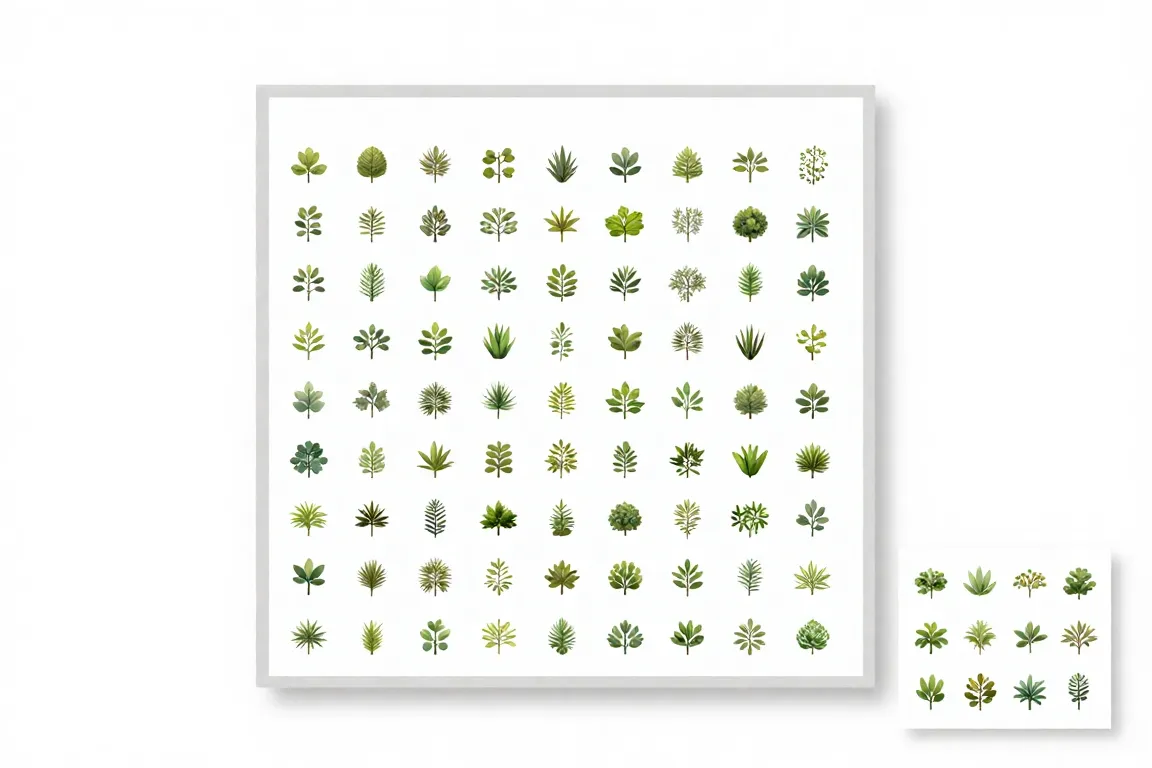
[IMAGE SUGGESTION: top-down diagram of a 10×10 ft room filled with 93 plant icons, with a small inset showing 20 plants]
A plant isn’t useless. It’s just the smallest tool in the shed.
How Many Plants Would You Need in a 10×10 Room?
By the 2019 Cummings and Waring estimate of 10 to 1,000 plants per square meter, a 10×10 ft room (about 9.3 m²) would need roughly 93 to 9,300 plants to match ventilation. Even the low end means about one plant on every square foot of floor.
Two quick calculations show the gap. Both use numbers from the 2019 review and a 10×10 ft room.
Method 1: plants per square meter. The review estimated that 10 to 1,000 plants per m² of floor would be needed to match the cleaning that normal air exchange already provides.
- Low end: 10 plants × 9.3 m² ≈ 93 plants
- High end: 1,000 plants × 9.3 m² ≈ 9,300 plants
Method 2: clean air delivery rate. Assume an 8 ft ceiling, which makes the room about 22.7 m³. A typical building swaps its air about once an hour, so the room needs roughly 22.7 m³ of air cleaned every hour. The median single plant in the 2019 analysis cleared about 0.023 m³ per hour.
- 22.7 ÷ 0.023 ≈ 985 plants to match ordinary ventilation
- A room with 20 plants would deliver about 0.46 m³ per hour, roughly 2% of what’s needed.
Your ceiling height and your home’s air exchange will shift these numbers, and individual plants vary by orders of magnitude. The conclusion doesn’t move.
Most people get this wrong, and most listicles feed the mistake. The NASA air-purifying plants list invites you to hunt for the “best” species. But even at the most favorable end of the range, this small room would need about 93 plants. No better species can close a gap that size, so buy plants because you like them.
Twenty plants sounds like a lot, and it’s still about 2%.
Do Houseplants Have Any Real Benefits?
Yes, but not for air purification. Some studies suggest indoor plants may support relaxation or mood, but the evidence varies by outcome and remains limited. Plants release oxygen, but a few houseplants do not meaningfully change the oxygen level in a room. Their value is primarily enjoyment and possible wellbeing benefits, not cleaner air.
Research reviews suggest possible benefits for relaxation and mood, but the evidence varies in quality, and relatively few trials have studied some outcomes. For a fuller look at the evidence, read our guide to indoor plant benefits: what’s proven and what’s a myth.
Here’s the truth about choosing indoor plants for air quality: they’re not a filter. Choose for light, space, and how much care you’ll realistically give.
One detail plant lists skip: in the original chamber work, the researchers pointed to the roots and the microbes living in the potting mix as likely doing a good share of the chemical removal, not just the leaves. Later researchers have called for studying that uptake directly. Whether it could ever become a working biofilter at home scale is still an open question.
What Actually Improves Indoor Air Quality?
Ventilation, source control, and filtration do most of the real work. Open windows or run exhaust fans, choose low-VOC paints and products, and avoid indoor smoking. For particles, a HEPA purifier helps. For gases, activated carbon filters can help reduce them.
- Cut the source. Store open paint, solvents, and cleaners outside the living area, choose low-VOC paints and furnishings, and don’t smoke indoors.
- Ventilate. Open windows when the weather and outdoor air quality allow. Run kitchen and bathroom exhaust fans that vent outdoors while you cook or shower.
- Filter. HEPA captures particles such as dust and smoke. Gases need activated carbon, which is much less common in home purifiers, so check the spec before you buy.
Growers in small, closed-window apartments during the cold months (December to February in the Northern Hemisphere) typically add more plants to fix a stuffy room, hoping for fresher air, because greenery feels like a natural filter. The stuffiness comes from low air exchange, though, and plants barely change that. A short stretch of cross-ventilation does more than 10 extra pots.
[ADD YOUR EXPERIENCE: readings from your own air quality monitor before and after opening a window versus adding plants, if you have one]
Good air starts with fewer pollutants and more fresh air. Plants are a bonus.
Frequently Asked Questions
WH2: Keep the Plants, Open the Window
In 2026, that NASA caption is still everywhere. Now you know what’s underneath it: a real experiment, run in a sealed box, whose results have been stretched far beyond what it showed. Houseplants can remove some airborne chemicals under certain conditions, but a few pots can’t clean indoor air fast enough to replace ventilation, source control, or effective air filtration. They can still make a room feel lived in, and looking after them may add enjoyment to your day.
So keep the snake plant. Write it a better caption, something like “This makes my room feel better,” and mean it. When the air feels stale, open a window. And to keep every plant you own alive, start with the watering and overwatering guide.