
Peace Lily Propagation and Repotting Blooming & Long-Term Care
A Peace Lily can live 15 years or more if you know when to leave it alone and when it needs help. Many owners repot too often, expect flowers every season, or assume a plant that stopped blooming is dying. In reality, most mature Peace Lilies spend years growing healthy foliage with occasional blooms, especially indoors. That’s normal.
The biggest milestones in a Peace Lily’s life don’t happen overnight. A crowded root system eventually needs a larger pot. Healthy clumps can be divided into new plants. Flowering varies with light, nutrition, and age. Understanding these natural cycles helps you stop trying to “fix” your plant and instead help it thrive.
Here, you’ll learn when to repot without causing transplant shock, how to propagate Peace Lilies successfully, what encourages indoor blooming, and long-term care habits that keep these elegant houseplants healthy for years. Whether caring for your first Peace Lily or a decade-old favorite, these tips will help you enjoy a stronger, longer-lasting plant.
Advanced Care Forcing Blooms & Long-Term Ownership Timeline Year 1–3 Progression
Peace lilies flower when mature, usually 1–2 years old, well-established, and in bright indirect light. Most apartment peace lilies never bloom because light supports survival, not flowering. To encourage blooms: provide bright indirect light, maintain 50%+ humidity, fertilize monthly, and wait for the plant to mature. Blooming typically resumes in years 2–3 with proper conditions.
The question Why isn’t my peace lily blooming? tops plantThe question Why isn’t my peace lily blooming? tops plant parent anxiety lists. The honest answer is most apartment peace lilies don’t bloom, and that’s not failure; it’s the reality of apartment lighting.
Most common cause: Insufficient light. Apartment indirect light 10,000–12,000 lux supports growth but not flowering. Blooming requires 15,000–20,000 lux. Most apartments don’t offer this without a plant positioned directly near an east-facing window.
Secondary cause: Young plant. Peace lilies need to reach maturity 18+ months before they’re physiologically capable of flowering.
Tertiary cause: Low humidity <45% or skipped fertilizing. Plant prioritizes survival over reproduction when stressed.
Myth: “Peace lilies never bloom indoors.” False. With proper light and maturity, they bloom reliably spring/summer.
Big picture: Blooming is a bonus for apartment dwellers, not a requirement for health. A peace lily that grows steadily with healthy foliage but no flowers is still thriving.
Encouraging Blooms
Light upgrade: Move the plant to the brightest indirect spot available. If in a north-facing window with 12,000 lux max, reposition to an east-facing window within 2–3 feet or a west-facing window with a sheer curtain. This often triggers blooming. Ease to 55%+. Use a humidifier, mist 3× weekly, or place on a humidity tray. Humidity is a signal to the plant that conditions are favorable for reproduction.
Fertilizing consistency: Apply monthly during the growing season March–August. Skip fall and winter. This provides the nutrient surplus needed for flower production.
Fertility wait: If the plant is under 18 months, blooming won’t happen regardless of conditions. Be patient.
Cool winCool winter period: Some growers report blooming success after a cool, dry winter at 60–65°F with reduced watering. Not guaranteed but worth trying in years 2–3.–3 Ownership Timeline:
This timeline reflects real apartment ownership, not nursery greenhouse conditions. Most guides skip it because it requires real observation, not just horticultural facts.
YEAR 1 Establishment Phase
Months 1–3 Adjustment: The plant settles. Expect 1–2 lower leaves to drop as normal adaptation from nursery to home. Growth is slow as roots establish in new soil. You learn your apartment’s watering rhythm.
Months 4–8 Growth: New leaves emerge monthly with visible size increase. The plant gains confidence. No flowers yet; this is normal for a young plant. Watering rhythm is now predictable; you know if your apartment needs watering every 7, 9, or 12 days.
Months 9–12 Stability: The plant reaches about 80% of its original nursery size; it may have shrunk slightly in the first 3 months due to adjustment stress. Watering schedule is locked in. The plant looks established.
Year 1 outcome: Healthy, stable, no blooms. This is complete success. Many plant parents think they have failed if no flowers appear; you haven’t.
YEAR 2 Maturation & Potential Blooming
Months 13–18: The plant reaches full maturity. It may produce its first white spathes, usually April–June, if light and humidity are adequate. If blooms don’t appear, light is likely the limiting factor; this is normal and not a failure.
Months 19–24: If blooming began in month 13, expect consistent blooms with 2–3 spathes visible at a time. The plant reaches peak health and vigor and looks lush.
Year 2 outcome: Blooms are likely if light exceeds 15,000 lux; no blooms are normal if light is lower. Either way, the plant is thriving.
YEAR 3 Peak Performance or Refresh Cycle
Months 25–36: Sustained blooming occurs if light supports it, with vigorous growth and lush foliage. The plant may slow growth by month 30; this is normal as it has reached optimal size.
Refresh option: By month 30, if roots are bound and visible at the drainage holes, repot to the next-size pot. Or prune stems to encourage a bushier shape rather than single-stem height.
Year 3 outcome: Established, mature plant. Low-maintenance routine is locked in.
Peace Lily Propagation and Repotting Expanding Your Collection & Refreshing Mature Plants
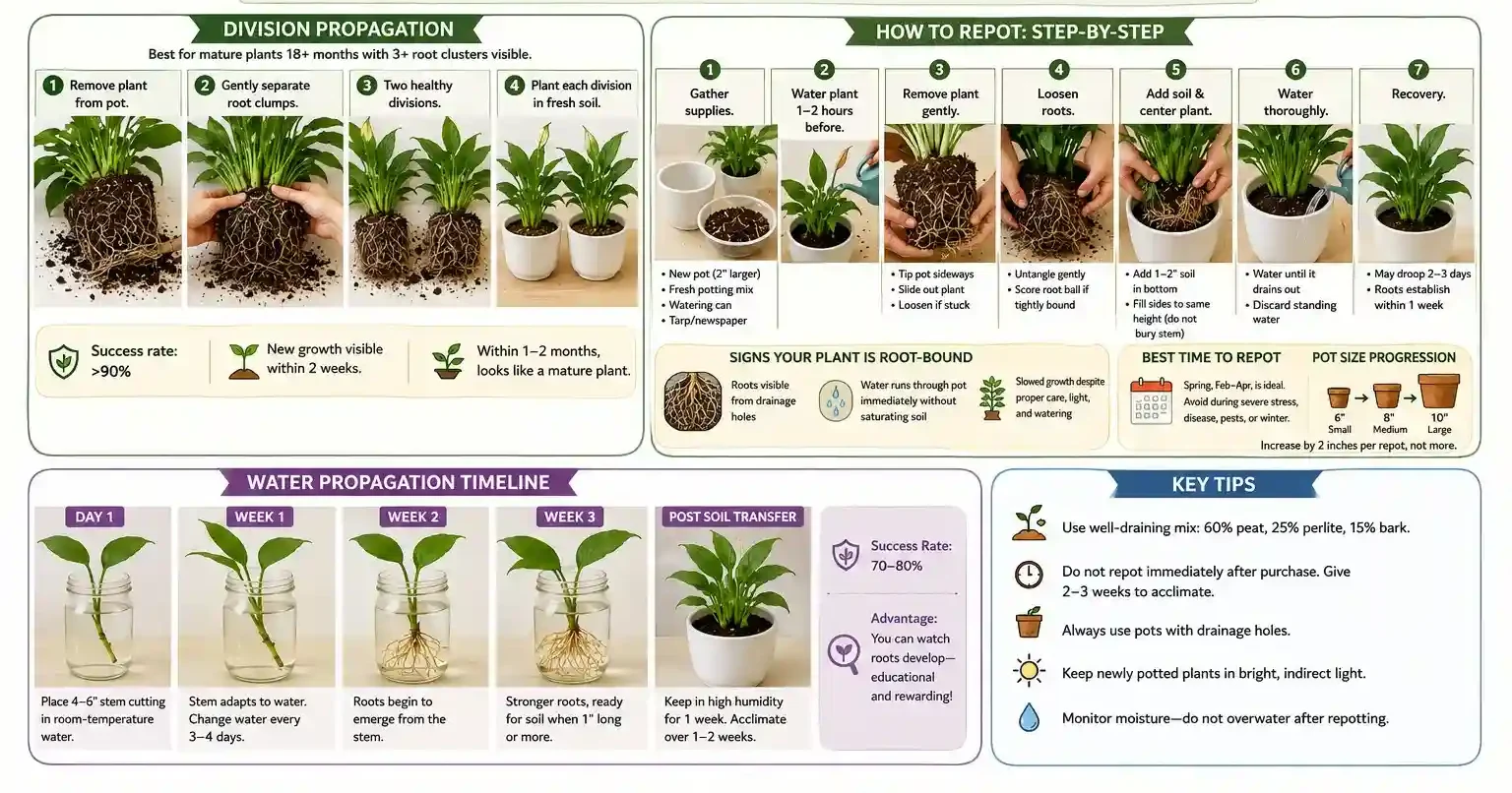
Repot peace lilies every 12–18 months as they grow. Signs include roots protruding from drainage holes or slowed growth. Propagate via division by separating root clumps into 2–3 plants, or water-propagate stem cuttings for 2–3 weeks, then transfer to soil. Both methods succeed within 4–6 weeks.
Once your peace lily is thriving, the next step is expansion: either refresh the plant through repotting or multiply it through propagation.
How to Repot
Signs the plant is root-bound:
• Roots visible protruding from drainage holes
• Water runs through pot immediately without saturating soil; roots are so dense they block water
• Slowed growth despite proper care, light, and watering
Timing:
Spring, February–April, is ideal. The plant has transition energy. Avoid repotting during severe stress, disease, pest infestation, or winter.
Size progression: 6-inch pot small, 8-inch medium, 10-inch large. Increase pot size by 2 inches per repot, not more. Too much extra soil holds excess water, and roots take longer to establish in oversized pots.
How to Repot Step-by-Step
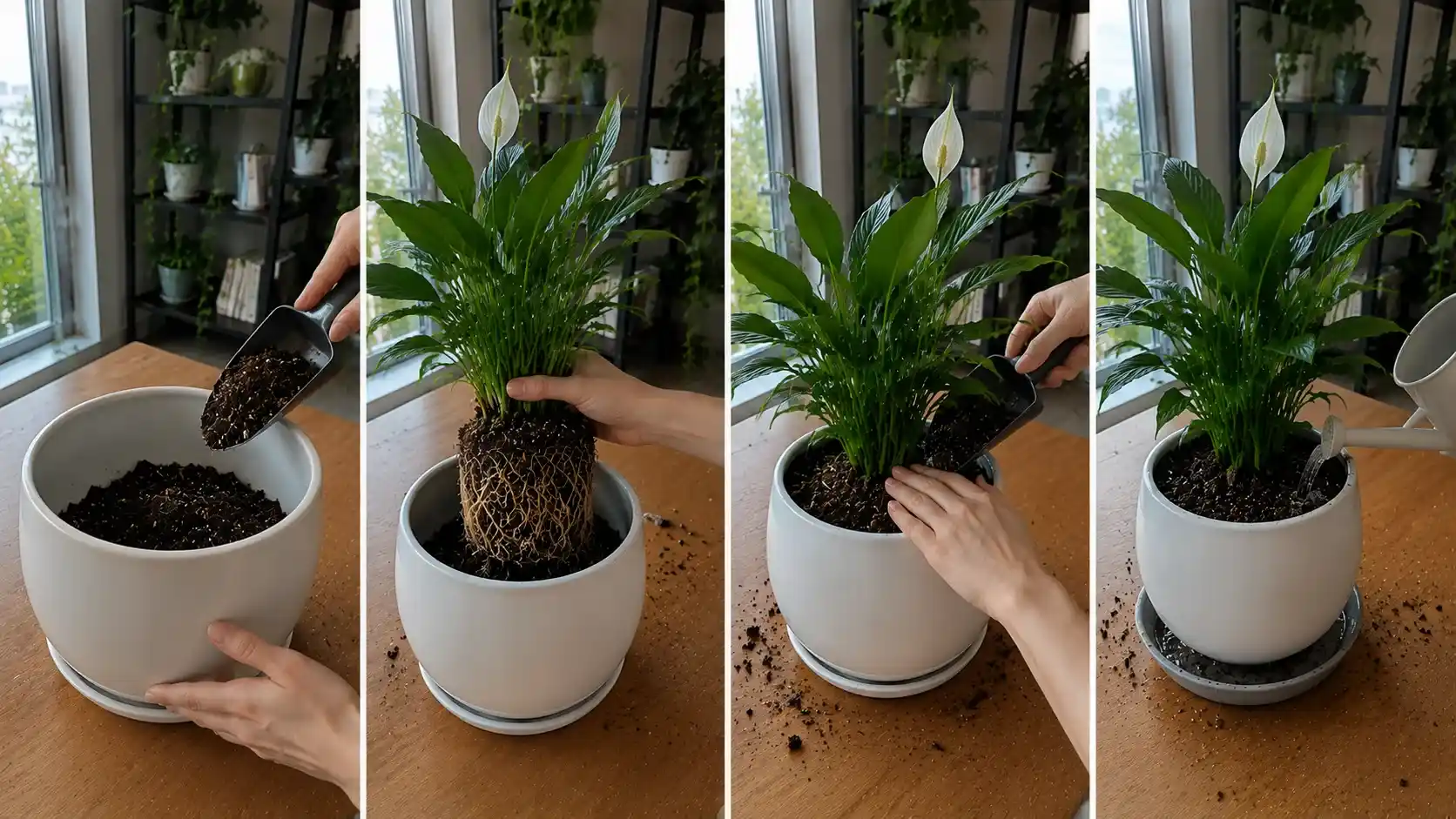
1. Gather supplies: New pot with a drainage hole 2 inches larger, fresh potting mix 60% peat, 25% perlite, 15% bark, watering can, newspaper or tarp for mess.
2. Water the plant 1–2 hours before: hydrated roots slide out easier and suffer less shock.
3. Remove the plant: tip the pot sideways and gently slide the plant out. If stuck, run a knife around the pot’s interior edge or tap the pot on the ground to loosen it. If still stuck, break the pot if it is disposable terracotta; do not force and damage roots.
4. Loosen roots: gently untangle roots with your fingers or a wooden skewer; do not break them. If roots circle tightly in a root-bound spiral, lightly score the root ball with a knife to encourage outward growth into fresh soil. soil.
5. Add soil to new pot: 1–2 inches in the bottom. Center the plant. Add soil around the sides, filling to the same height as the original pot. Do not bury the stem deeper; this causes stem rot.
6. Water thoroughly: Until water drains from the drainage holes. Discard standing water in the saucer.
7. Recovery: Plant may droop slightly for 2–3 days; normal transplant shock. Recover as roots establish in fresh soil within 1 week.
Avoid repotting immediately after purchase; give the plant 2–3 weeks to acclimate to your home first.
Division Propagation
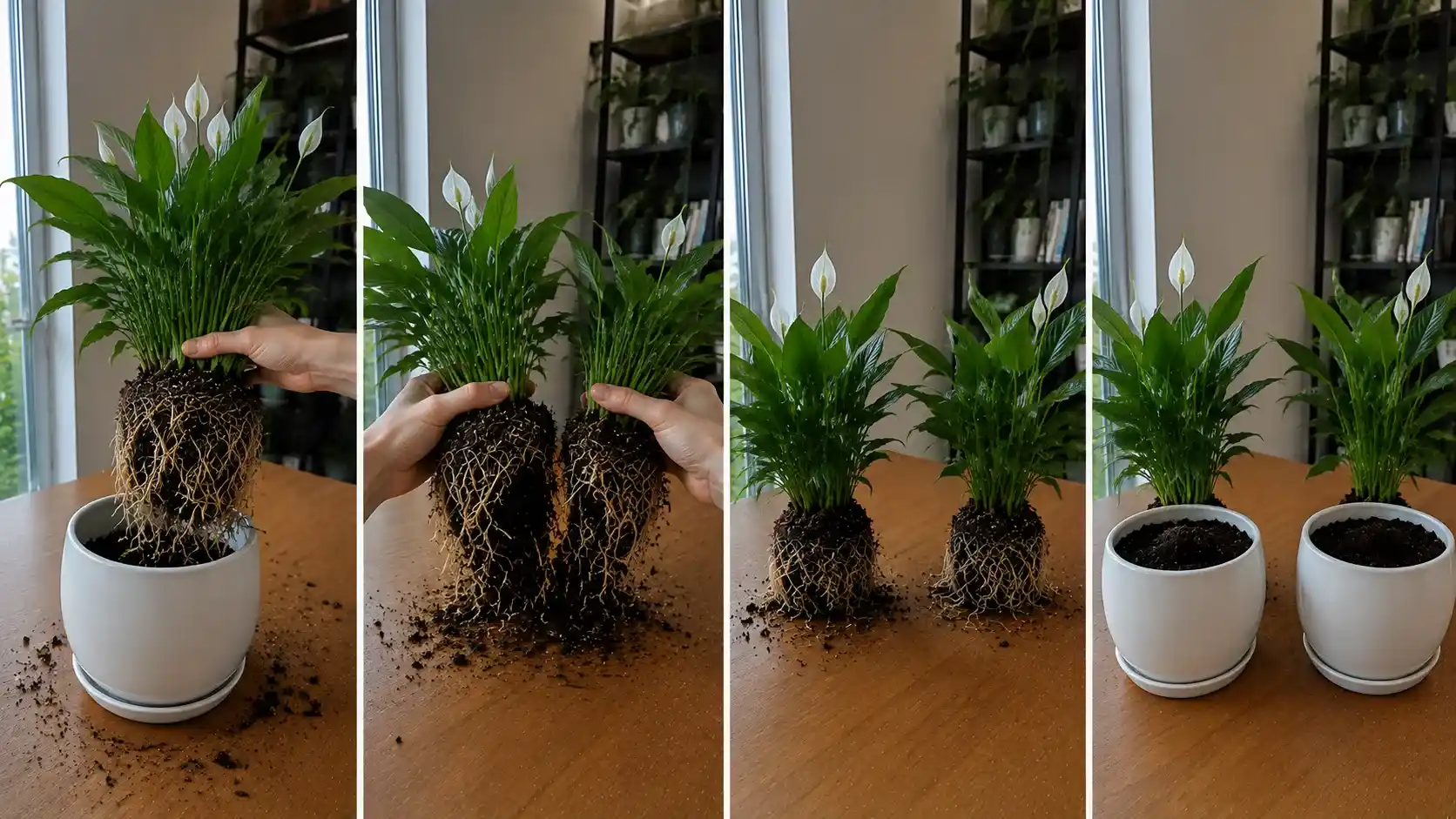
Best for mature plants 18+ months with 3+ root clusters visible.
Method: At repotting time, gently separate root clumps with fingers or a knife. Ensure each division has 2–3 stems and attached roots.
Potting: Place each division in fresh potting mix, water lightly.
Success rate: >90%. Each division becomes a standalone plant within 4–6 weeks.
Timeline: New growth visible within 2 weeks. Within 1–2 months, the division looks like a mature small plant.
Water Propagation
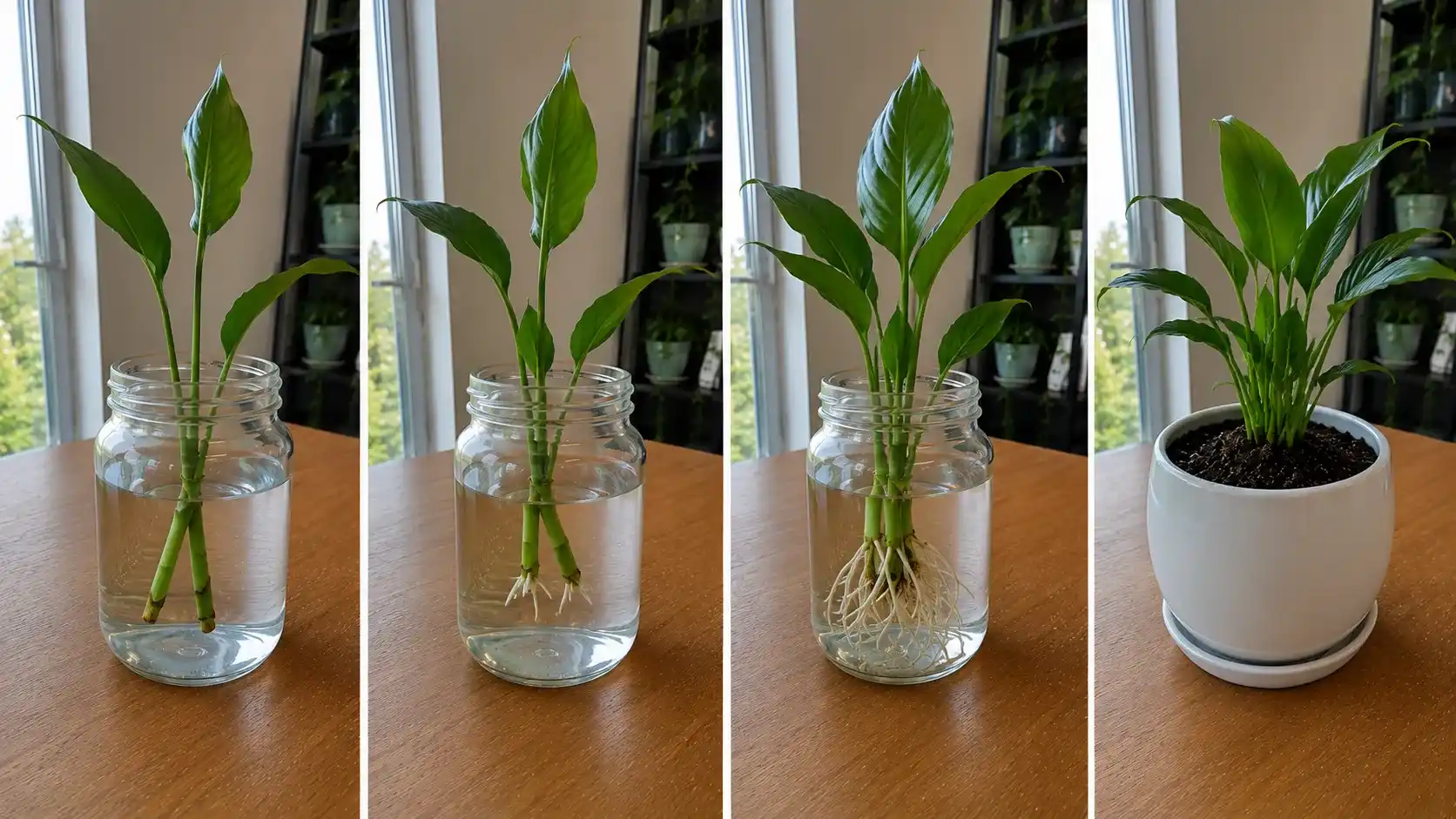
Method: Cut a 4–6 inch stem from a healthy plant. Remove lower leaves; keep 2–3 upper leaves. Place the stem in a glass of room-temperature water. Change water every 3–4 days.
Timeline: Roots emerge within 2–3 weeks; tiny root nubs visible.
Soil transition: Once roots are 1 inch long, transfer to potting soil. Keep in high humidity for the first week: a humidity dome or plastic bag cover. Acclimation to regular air takes 1–2 weeks.
Success rate: 70–80%; some stems rot in water if bacterial/fungal contamination occurs. Experiment with 2–3 stems to ensure at least one succeeds.
Advantage: You can watch roots develop; it’s educational and rewarding.
Peace Lily vs. Similar Plants Comprehensive Comparison for Choosing the Right Low-Light Houseplant
Peace lilies thrive in low light but prefer 15,000+ lux for blooming; Pothos tolerates lower light better and survives 5,000 lux; ZZ Plant is more drought-tolerant; Snake Plant requires the least water and light. Choose peace lily for blooming + humidity benefits, Pothos for trailing growth, ZZ for neglect tolerance, and Snake Plant for minimal care.
Peace lilies are popular, but they’re not the only low-light option. If you’re deciding between similar plants, here’s how they actually compare.
|
Feature |
Peace Lily |
Pothos |
ZZ Plant |
Snake Plant |
|
Botanical Name |
Spathiphyllum spp. |
Epipremnum aureum |
Zamioculcas zamiifolia |
Dracaena trifasciata formerly Sansevieria |
|
Light Requirements |
Bright, indirect light preferred; tolerates low light. Blooms best around 15,000–20,000 lux. |
Bright to low indirect light; one of the most adaptable low-light plants. |
Low to bright indirect light; slow growth in dim spaces. |
Low to bright indirect light; extremely adaptable. |
|
Watering Frequency |
Every 7–10 days; keep soil evenly moist but never soggy. |
Every 7–14 days; allow the top 1–2 inches of soil to dry. |
Every 2–3 weeks; prefers soil to dry completely. |
Every 2–4 weeks; highly drought tolerant. |
|
Humidity Preference |
Medium to high 50%+ preferred. |
Average household humidity is sufficient. |
Low to average humidity. |
Low humidity is fine. |
|
Growth Rate |
Moderate |
Fast |
Slow |
Slow to moderate |
|
Flowers |
Produces white blooms indoors with proper care. |
Rarely flowers indoors. |
Flowers are uncommon indoors. |
Rarely flowers indoors. |
|
Pet Safety |
❌ Toxic to cats and dogs calcium oxalate crystals. |
❌ Toxic to cats and dogs. |
❌ Toxic to cats and dogs calcium oxalate crystals. |
❌ Mildly toxic to cats and dogs. |
|
Difficulty Level |
Easy |
Very Easy |
Very Easy |
Very Easy |
|
Best For |
Apartments, offices, beginners who want flowers. |
Beginners, hanging baskets, trailing vines. |
Busy people, frequent travelers, low-maintenance homes. |
Minimal-care plant lovers and drought-prone homes. |
|
Maintenance |
Moderate; occasional feeding, higher humidity, annual repotting. |
Low; occasional pruning and feeding. |
Very low; infrequent watering and repotting every 2–3 years. |
Extremely low; minimal watering and little maintenance. |
|
Appearance |
Glossy green leaves with elegant white blooms. |
Cascading vines with heart-shaped leaves. |
Upright stems with glossy oval leaflets. |
Tall, upright sword-like leaves with bold architectural form. |
|
Air Purification |
Moderate evidence for VOC removal in laboratory settings; aesthetic benefits in homes. |
Similar laboratory evidence; real-world impact is limited. |
Limited evidence; primarily valued for appearance and resilience. |
Limited evidence; mainly grown for its sculptural look. |
|
Typical Indoor Size |
1–4 ft 30–120 cm |
Vines up to 10+ ft 3+ m indoors |
2–4 ft 60–120 cm |
1–5 ft 30–150 cm, depending on variety |
Analysis & Decision Framework
If you prioritize blooming & elegance: Choose Peace Lily. Flowers are a bonus reward for patient, attentive plant parents; foliage is lush year-round.
If you prioritize trailing growth & fast results: Choose Pothos. Fastest-growing option; achieves jungle in a jar aesthetic within weeks. Toxicity is the same as peace lily, but growth is dramatic and rewarding.
If you want a set and forget plant: Choose ZZ Plant. Extremely low-maintenance, architecturally interesting, non-toxic. Slower growth is a feature; stable, minimal pruning.
Suppose you want the absolute minimum care: Choose Snake Plant. Neglect-tolerant to the point of thriving from inattention. Most sculptural. Minimal watering means minimal thinking.
If you have pets and want flowers: Peace Lily with high-placement shelf/hanging is feasible. ZZ Plant is safer if peace lily placement is risky. Snake Plant is safest but no flowers.
Secondary consideration: price & availability:
• Peace lilies: $15–$40 common, widely available
• Pothos: $8–$25 cheapest, most available
• ZZ Plant: $20–$50 less common, more expensive
• Snake Plant: $15–$45 common, widely available
Workplace & Office Benefits Productivity, Wellness & Setup for Professional Spaces
Peace lilies are popular office plants because they tolerate fluorescent lighting, contribute modestly to air quality, and boost morale visually. Reported benefits include reduced stress and improved focus, though research is mixed. For offices, place on desk corners, shelves, or conference tables for aesthetic and wellness value without disruption.
Peace lilies are office staples. Here’s the honest assessment of why and what the science actually says.
Air Quality Claims
The 1989 NASA Clean Air Study led by Dr. B.C. Wolverton tested peace lilies and other plants in sealed chambers, exposing them to formaldehyde, benzene, and trichloroethylene. Results showed measurable removal of these compounds.
Here’s what changed: Modern research, particularly a 2020 study by Cummings and Waring, clarified that NASA’s sealed-chamber conditions don’t reflect real homes. Living rooms have air exchange every 1–3 hours via ventilation, doors opening, and HVAC systems. In sealed chambers, the plant is the only thing removing VOCs. In your office, ventilation is competing with the plant, and ventilation wins.
Honest framing: Peace lilies do remove formaldehyde and benzene measurably in lab settings. Contribution in actual offices is modest; ventilation systems handle 99% of air cleaning.
Real benefit: The humidity contribution is measurable. Peace lilies transpire water vapor; multiple plants together raise office humidity 5–10%, improving air comfort, helping sinuses, and reducing skin irritation and static electricity.
Reported Wellness & Productivity Benefits
Stress reduction: Looking at plants does reduce cortisol, a stress hormone, measurably in some studies; the effect is modest, ~5–10% reduction. Works better combined with breaks or mindfulness practices.
Focus & attention: Green plants in offices improve concentration, especially for creative tasks. Effect is strongest when the plant is in direct line of sight.
Aesthetic morale: Peace lily’s elegant white flowers, when blooming, provide visual interest and lift mood.
Important caveat: These benefits are reported and weakly supported by research, not proven to be causally linked. A healthy plant presence helps; don’t expect dramatic productivity surges. Combine with good lighting, ventilation, ergonomics, and actual rest.
Practical Office Setup
Desk placement: Corner of desk out of the way but visible. Benefits the worker without creating clutter.
Shared table: Conference table centerpiece. Adds elegance and is visible to all during meetings. Creates a calming focal point.
Cubicle shelf: Top shelf of cubicle divider. Receives ambient fluorescent light 10,000–12,000 lux, sufficient for survival. Adds life to an otherwise bland workspace.
Bathroom/break room: Peace lily thrives in bathroom humidity. Small morale boost for communal areas.
Watering responsibility: Assign one person weekly water duty. Peace lily’s drooping signals neglect quickly, making it easy to catch before problems escalate. Set a calendar reminder to prevent guilt-driven overwatering.
Considerations for Office Spaces
Fluorescent light: Sufficient for survival, not ideal for blooming, but adequate.
AC vents: May create drying drafts. Avoid placing directly under vents.
Temperature stability: Offices maintain consistent 70–72°F, which is actually ideal for peace lilies.
Allergy risk: Minimal. Peace lilies don’t produce heavy pollen like cut flowers. Non-allergenic for shared spaces.
Companion Planting & Humidity Grouping Strategies Using Multiple Plants to Create a Thriving Ecosystem
Grouping 3+ plants together raises ambient humidity 5–10% above isolated plants, creating a microclimate that benefits all. Best companions are tropical houseplants sharing humidity/light needs: Pothos, Philodendron, Calathea. Grouped plants shield each other from direct AC drafts, create visual impact, and improve all plants’ health through humidity multiplication.
One peace lily is nice. Three plants grouped is a game-changer.
The Humidity Multiplication Effect
Science: Plants transpire water vapor during photosynthesis. One isolated plant barely impacts room humidity. Three+ plants within 3 feet of each other release enough moisture to raise humidity measurably.
Real effect: 5–10% humidity boost above the room’s baseline. For an apartment with 35% humidity, grouping 3 plants raises the microclimate to 40–45%, enough to prevent brown leaf tips on humidity-sensitive plants.
Practical benefit: Less misting needed per plant. Reduced brown tip risk. Better growth for all plants in the group.
Grouping layout: Stagger plants at different heights shelf, floor stand, hanging above so foliage doesn’t overlap. This allows air circulation and prevents fungal issues.
Best Companion Plants for Peace Lily
Pothos Epipremnum aureum: Identical care: 7–10-day watering, indirect light. Trails gracefully. Creates “jungle” aesthetic. Upside: grows fast. Downside: can overtake shelf if not trimmed.
Philodendron various species: Similar care to Pothos. Larger leaves, slower growth. Requires support: moss pole or stakes. Pairs beautifully with peace lily aesthetically.
Calathea various species: Loves humidity 50%+. Thrives in grouped microclimate. Dramatic foliage: pink, white striped leaves. Higher maintenance needs 2× weekly misting but rewarded by grouping.
Ferns Boston, Maidenhair: Love humidity and indirect light. Delicate but beautiful. Repay humidity grouping with lush fronds. Pair well with peace lily’s solid structure.
Plants to Avoid Grouping with Peace Lily
Snake plants, ZZ plants: Prefer drier conditions, less frequent watering. Incompatible watering rhythm creates a standoff: one thrives while the other oversaturates.
Succulents: Risk rotting in a humid microclimate. Keep separate.
Arrangement Tips
• Place the largest plant, peace lily or Philodendron, as a backdrop.
• Trailing plants, Pothos in front or hanging above, create layers and visual interest.
• Humidity-loving plants, such as Calathea and ferns, in the center benefit most from a microclimate.
• Rotate plants 180° every 2 weeks for even light exposure.
• Use saucers under all pots to catch drainage without water pooling, which prevents fungal issues.