
How to Care for a Monstera Plant Indoors
A healthy Monstera is less about following a rigid routine and more about reading what the plant is telling you. Bright indirect light, a well-draining growing mix, thorough watering after the root zone has partly dried, a stable indoor environment, and suitable support form the foundation of reliable monstera plant care.
The biggest beginner mistakes are surprisingly consistent. People water on the same weekday regardless of conditions, expect a juvenile plant to produce mature fenestrated leaves immediately, or confuse humidity with keeping the foliage wet.
There is another easy mistake to avoid. A plant sold as a split-leaf philodendron is still Monstera deliciosa, not a Philodendron. Kew recognizes M. deliciosa as an accepted species in the Araceae family, native from Mexico into Guatemala. The genus Monstera contains many species, so not every plant sold with a Monstera label has identical growth habits.
For a broader foundation, see Indoor Plant Care Fundamentals.
How do you care for a Monstera plant indoors?
Monstera Plant care indoors means matching five variables to the specific plant and environment: light intensity, root-zone moisture, drainage, ambient warmth, and physical support. The correct routine is observational. Adjust watering, feeding, and placement as the plant grows and as seasonal conditions change.
The five variables in order of priority
1. Light exposure drives the amount and quality of growth a plant can sustain.
2. Root-zone moisture supports healthy roots without keeping the pot permanently saturated.
3. Drainage and potting medium make the watering routine work. A good watering technique cannot rescue a pot that stays waterlogged.
4. Warmth and a stable environment reduce stress from sudden changes. RHS describes Swiss cheese plants as warm-growing houseplants that prefer a moist but well-drained setup and moderate humidity.
5. Space and support become increasingly important as a Monstera matures. Monstera is a climbing genus with aerial roots and climbing forms adapted to tropical forest environments.
That combination explains why two apparently identical indoor monstera plants can behave completely differently. One might be pushing large leaves every few weeks while another sits quietly in the same-sized pot. The difference is usually environmental, not mysterious.
Why water once a week fails
A fixed watering day ignores evapotranspiration. A Monstera sitting in a bright, warm room can lose water much faster than the same plant in a cool, dim room. Indoor conditions shift with season, window exposure, heating, air movement, pot size, and plant size.
The better rule is simple: check the root zone, assess the pot, then decide.
A useful beginner routine is to inspect soil moisture, look at leaf orientation, check for new growth, and note any new symptoms. Change one variable at a time. Moving the plant, changing the watering schedule, and adding fertilizer on the same day makes diagnosis almost impossible.
Takeaway: The goal is a repeatable observation system, not a perfect schedule.
What kind of light does a Monstera need?
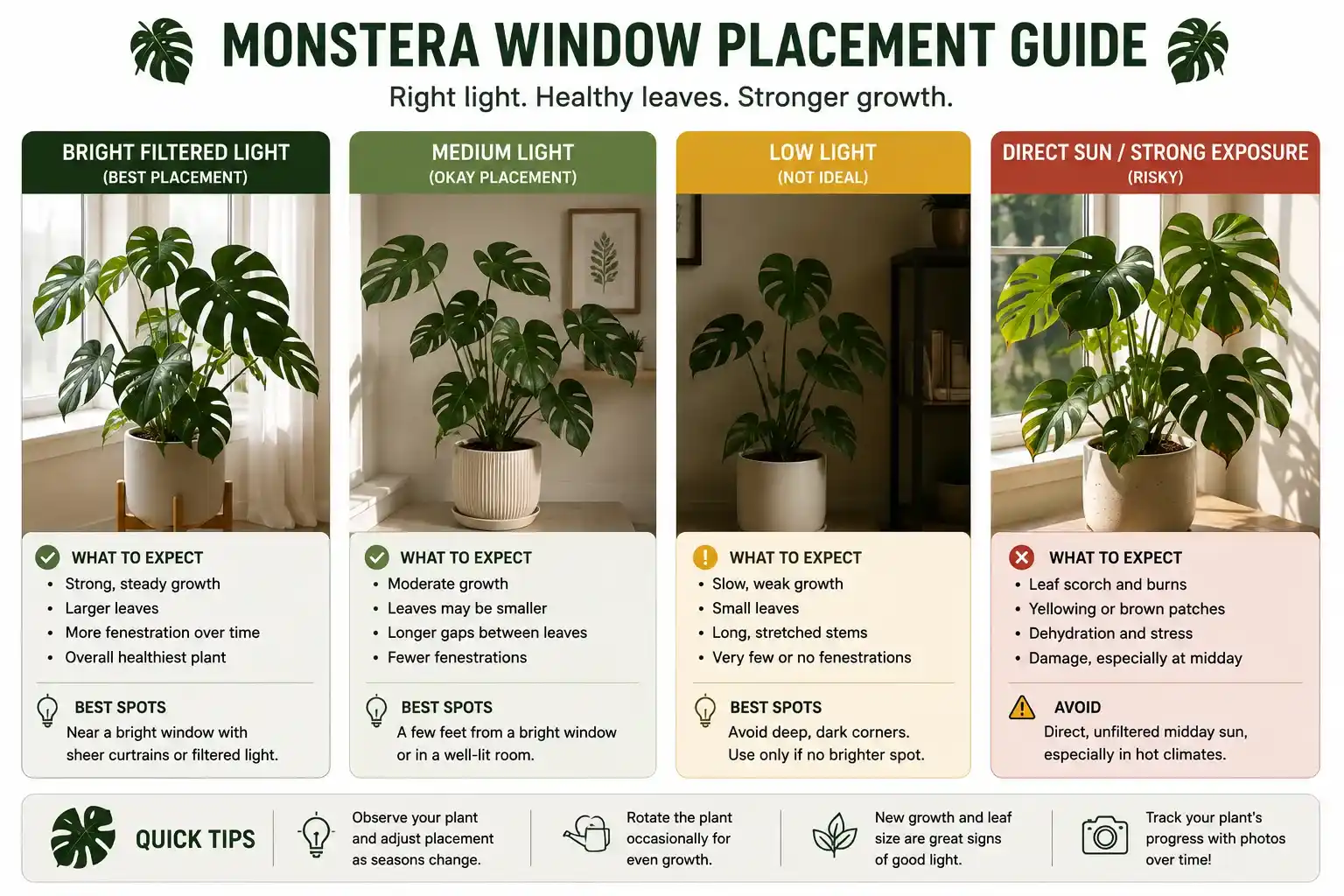
Monstera performs best in bright, indirect light. Lower light can slow growth and produce longer spacing between leaves, while harsh direct exposure can scorch foliage. The best placement is usually the brightest practical spot where the leaves are protected from intense direct beams. RHS likewise recommends bright conditions with protection from strong direct sunlight for variegated Swiss cheese plants.
Compare common growing positions
| Growing position | Relative light | Likely growth pattern | Best use |
| Close to a bright filtered window | Bright, indirect | Stronger, steadier growth | Best long-term setup |
| A few metres from a bright window | Medium, filtered | Slower growth and longer stems | Rooms with limited space |
| Deep inside the room | Low | Slow, stretched growth | Temporary placement |
| Strong unfiltered midday sun | High, direct | Higher scorch risk | Use only with careful acclimation |
How to read your plant’s light signals
Small leaves combined with long gaps between leaf nodes can indicate that the plant is not receiving enough usable light for vigorous growth. A plant that repeatedly leans toward a window is telling you something else too. Light is directional, and the plant is responding to it.
Slow new growth despite otherwise stable care can be another clue. Brown, papery patches that appear soon after strong direct exposure are different from gradual browning at the leaf edges and should not be treated as the same problem.
The key is to read several signals together rather than diagnosing light from one leaf.
Light and fenestration: the real relationship
The assumption that more light equals more holes is too simplistic.
Light matters. Maturity matters. Plant architecture matters. Recent research on Monstera deliciosa has found that fenestration and leaf dissection vary along light gradients, showing that leaf structure is environmentally influenced rather than controlled by one simple switch.
At the same time, Monstera is a climbing plant with distinct growth forms, and its leaf architecture changes as the plant develops. Kew describes the genus as including climbing hemiepiphytes associated with tropical moist and humid forests.
That is why a better question is not How do I force holes? It is How do I create conditions that allow this plant to continue developing?
A juvenile plant sitting directly against a sunny window may still produce solid leaves. A more mature plant can develop increasingly complex foliage under moderate but suitable light. Chasing maximum light without considering heat, scorch risk, and the plant’s growth stage is a poor strategy.
The most useful goal is sustained healthy growth. Fenestrations are one visible result of that process, not a care score.
Takeaway: Light fuels growth, while leaf development reflects the plant’s growth stage and environment working together.
Watering, drainage, and soil as one system
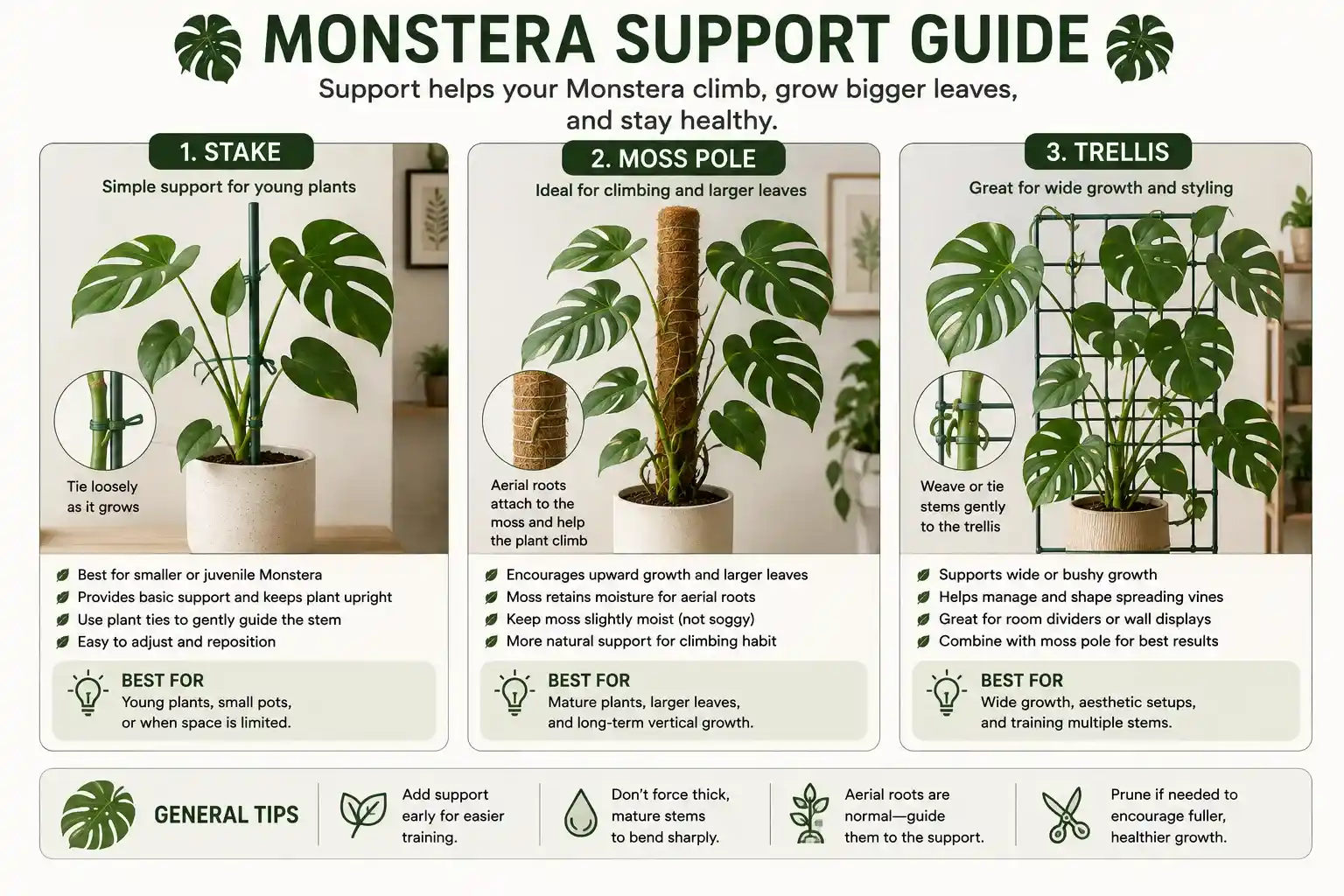
Water when the upper part of the growing mix has dried sufficiently for the plant and container, then water thoroughly so excess drains freely. Frequency changes with light, temperature, pot size, soil composition, and season. The pot, medium, and watering behavior must be treated as one system.
RHS recommends watering Swiss cheese plants when the top few centimetres of compost feel dry and stresses good drainage to reduce the risk of root problems.
How to know the soil is ready
Use more than one clue.
- Check the soil: Feel down into the mix rather than judging only the surface.
- Lift the pot: A noticeably lighter container is a useful comparison with a recently watered one.
- Use a moisture meter if helpful: Treat it as another data point, not an automatic watering command.
- Check drainage: Water should move through the pot freely rather than sitting in the outer container.
The exact drying point will vary. A small small monstera plant in a relatively small pot behaves differently from a large monstera plant in a heavy container.
What to do if soil stays wet too long
Persistent wetness often comes from a combination of factors. The container may be much larger than the root system. The mix may hold too much water. Light may be too low for the plant’s current growth rate. A decorative cover pot may be concealing standing water.
The fix is not automatically water less. First find out why the root zone remains wet.
A well-draining soil mix gives the roots access to both moisture and air. If water drains poorly, improve the overall pot-and-medium setup rather than simply extending the calendar between waterings.
One especially practical check is the outer pot. A decorative cache pot can hide the fact that the actual nursery pot is sitting in collected drainage water.
Guttation vs. overwatering
Water droplets at leaf tips can be guttation. That does not mean the plant has been overwatered, and it does not mean the plant needs less water simply because droplets appeared.
Overwatering is better diagnosed from the condition of the root zone and the broader symptom pattern. Repeatedly wet soil, poor drainage, yellowing foliage, and declining roots form a different picture from an occasional drop on a leaf tip.
The distinction matters because treating every visible water droplet as a watering mistake can send the routine in the wrong direction.
The cover-pot problem
A decorative cover pot with poor drainage visibility can create a particularly frustrating cycle. The surface feels dry, the grower waters again, and the lower portion of the container remains saturated.
Always check the actual growing pot, not just the decorative shell.
Takeaway: Read root-zone conditions first. Only then decide whether to water.
Does a Monstera need a moss pole or support?
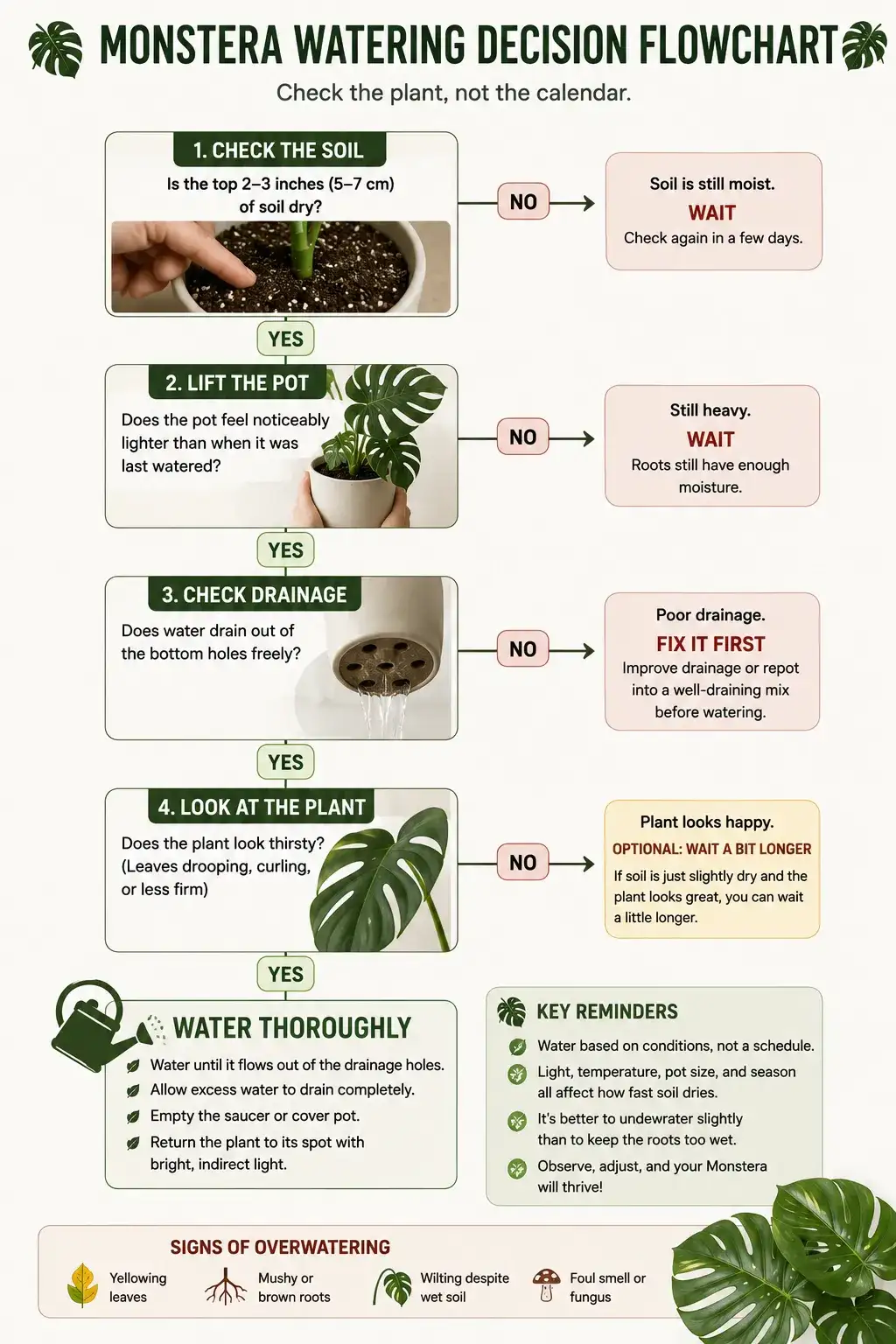
Yes. Monstera is a climbing plant with aerial roots, and support can help organize growth vertically, reduce the plant’s footprint, and give a climbing stem a stable structure to work against. The support should follow the vine’s natural direction instead of forcing a thick established stem into a sharp new angle.
When to add support
Support is easiest to introduce before the plant becomes heavily lopsided. Line the support up with the stem’s existing growth direction and pay attention to where aerial roots are developing.
The aim is not to strap every part of the plant tightly against a pole. The aim is to give the climbing stem something stable to work with.
Stakes, moss poles, and trellises
A stake is simple and useful for a young plant that needs a little guidance.
A moss pole gives the plant a vertical surface and can provide a moist structure that aerial roots may interact with. RHS specifically notes that Monstera can use aerial roots to climb when given support such as a moss-covered pole.
A trellis makes sense when the main challenge is managing spread rather than forcing a narrow vertical shape.
There is no universal best Monstera plant support. The right choice depends on the stem, the available space, and the direction in which the plant is already growing.
What are Monstera aerial roots?
Aerial roots are part of the plant’s climbing structure. They help the plant interact with its surroundings as it climbs and can be directed toward a suitable support.
They do not need to be hacked off simply because they look unusual. If one is interfering with a walkway or catching on furniture, it can be redirected or managed for practical reasons.
Retraining a mature, already-lopsided stem is very different from supporting a young plant. A thick established stem should not be bent aggressively into a new angle in one session. Gradual positioning is safer and gives the plant time to adapt.
Takeaway: Support cooperates with the vine’s architecture. It does not simply hold it upright.
How to diagnose common Monstera problems
Diagnose Monstera problems by inspecting the root zone, light exposure, recent care changes, and the specific leaf pattern before changing multiple variables. Yellowing, browning, curling, pests, and stalled growth can have overlapping causes, so isolate one variable at a time.
Yellow leaves
Start with the age and location of the leaf.
Older lower leaves that yellow gradually can be part of normal leaf turnover. Yellowing associated with consistently wet soil points toward a very different problem, especially when drainage is poor.
New leaves showing unusual chlorosis should trigger a broader check of light, root condition, and nutrition rather than an automatic fertilizer dose.
The mistake is treating yellow as a diagnosis. It is a symptom.
Brown, crispy edges or tips
Crispy margins can appear when the plant is experiencing water stress, dry indoor air, accumulated fertilizer salts, or other environmental pressure.
Patchy brown areas are more complicated. Look at where the damage appears, when it started, whether the leaf was recently exposed to strong sun, and whether the plant has been kept damp with poor airflow.
Sudden large damaged areas after a placement change deserve an exposure check before reaching for a disease treatment.
Curling leaves
Curling is another symptom with several possible causes.
- Curling with very dry soil: Check whether the plant is losing water faster than the roots can replace it.
- Curling combined with yellowing: Inspect drainage and root-zone condition.
- Curling after relocation: Look for transplant stress, temperature changes, or a sharp shift in light.
Do not correct all three situations with the same watering response.
Slow or stalled growth
Start with light. Then check the season and the root system. A plant receiving substantially less light in winter can slow down, and a recently repotted Monstera may need time to re-establish.
Root crowding is another possibility, but visible roots at the drainage holes are only one clue. Look at the entire watering pattern. If water suddenly races through the pot, the root system and growing medium may need a closer inspection.
Pests
Spider mites can produce fine webbing and stippled foliage. Thrips can leave silvery damage and dark specks. Scale and mealybugs may appear as raised or cottony clusters around stems and leaf axils.
Inspect early. Isolate a visibly infested plant from nearby houseplants and choose a treatment suited to the pest and the plant.
Use this diagnosis sequence
- Identify the symptom and whether it affects new or old leaves.
- Inspect root-zone moisture and drainage.
- Check for pests, drafts, and recent environmental changes.
- Eliminate the most obvious cause before adding new treatments.
- Change one variable at a time.
- Observe the next growth response before making another major adjustment.
The common beginner trap is changing everything at once. A little more water, a different window, fertilizer, a new humidifier, and a larger pot can create a completely new set of variables. Then nobody knows what actually helped.
Takeaway: Diagnose the environment before diagnosing the leaf.
How to encourage larger leaves and mature fenestrations
Large, fenestrated leaves develop through sustained healthy growth, appropriate light, suitable support, and time. Juvenile foliage cannot simply be forced to produce holes with a single care trick. The practical strategy is to create conditions that let the plant continue through successive growth stages.
Juvenile vs. mature growth
Young Monstera leaves can be smaller and less divided. As the plant develops and climbs, foliage can become larger and more complex.
RHS describes Monstera deliciosa as a vigorous climbing plant with large glossy leaves that can become highly perforated.
That does not mean every plant follows the same timetable. A fixed promise such as your plant should fenestrate after a certain number of leaves is too rigid for an indoor-care guide.
What actually drives maturity indoors?
Four factors matter most in practical care:
- Support: Gives a climbing plant a structure to work against.
- Light: Supplies the energy needed for sustained growth.
- Time: Mature morphology develops across successive growth cycles.
- Nutrition: Supports active growth when the plant is actually growing.
The contrarian point is worth repeating because it prevents a lot of bad advice: fenestration is not a light meter.
A recent study found that leaf fenestration and dissection can vary across light gradients, which supports a more nuanced view. Light influences leaf structure, but it does not make maturity irrelevant.
What should you track?
For growers who want something more useful than it looks bigger, keep a simple record over several months:
- Leaf length and width
- Number of new leaves
- Fenestration count on each mature leaf
- Time between new leaves
- Window position and light conditions
- Major changes in watering or support
This turns monstera plant large from a vague goal into something measurable.
A real time-lapse can make this even more useful. If original photos and measurements are available, add them here rather than inventing a generic growth claim. The value comes from the actual observation.
Takeaway: Measure progression, not just appearance. Mature leaves are the outcome of a healthy system maintained over time.
What changes once the same Monstera moves from juvenile growth into a mature climbing phase?
Pruning and propagation basics
Prune to control shape or remove damaged material. Propagate from stem cuttings that include a viable node. Both jobs become easier once the stem structure is understood before making the cut.
When and how to prune
Pruning is most useful when there is a clear reason. Remove damaged foliage cleanly rather than repeatedly trimming individual leaf edges for cosmetic reasons.
For shaping, identify the node before cutting. The goal is to influence future growth, not simply shorten the plant.
Avoid heavy, unnecessary pruning when the plant is already stressed.
What makes a viable cutting?
A practical cutting should include a section of stem and at least one node. A leaf helps the cutting continue photosynthesis while it establishes.
Water propagation can work for suitable cuttings, but monstera plant in water should not be confused with growing the entire plant permanently in a glass of water. Propagation and long-term cultivation are different systems.
Use clean cutting tools and provide bright indirect light during propagation. Extension guidance likewise recommends clean tools, suitable rooting media, indirect light, and warm, evenly moist conditions for many houseplant cuttings.
The plant’s fruit is a separate maturity topic. RHS lists cream, cone-like fruit following the flowers of mature Monstera deliciosa, but fruit production is not part of routine indoor monstera care.
Takeaway: Prune with purpose. Propagate from identifiable growth points, not random stem pieces.
Frequently Asked Questions
These answers focus on edge cases and common naming or care misunderstandings that the main sections do not fully resolve.
A simple long-term Monstera care routine
The best monstera plant care routine is not complicated. It is consistent.
Check the soil before watering. Watch the light before blaming the fertilizer. Inspect new growth before deciding the plant is unhealthy. Give the stem something to climb before it becomes impossible to position neatly.
And keep the goal realistic. A healthy Monstera does not need to look like a jungle centerpiece every week. Young plants grow differently from mature plants. Seasonal changes alter water use. Individual plants respond differently to the same room.
The useful skill is learning the plant’s pattern.
That is what turns Swiss cheese plant care from a collection of internet rules into an actual care system.