Bottom Watering Indoor Plants: How to Do It & When to Use It
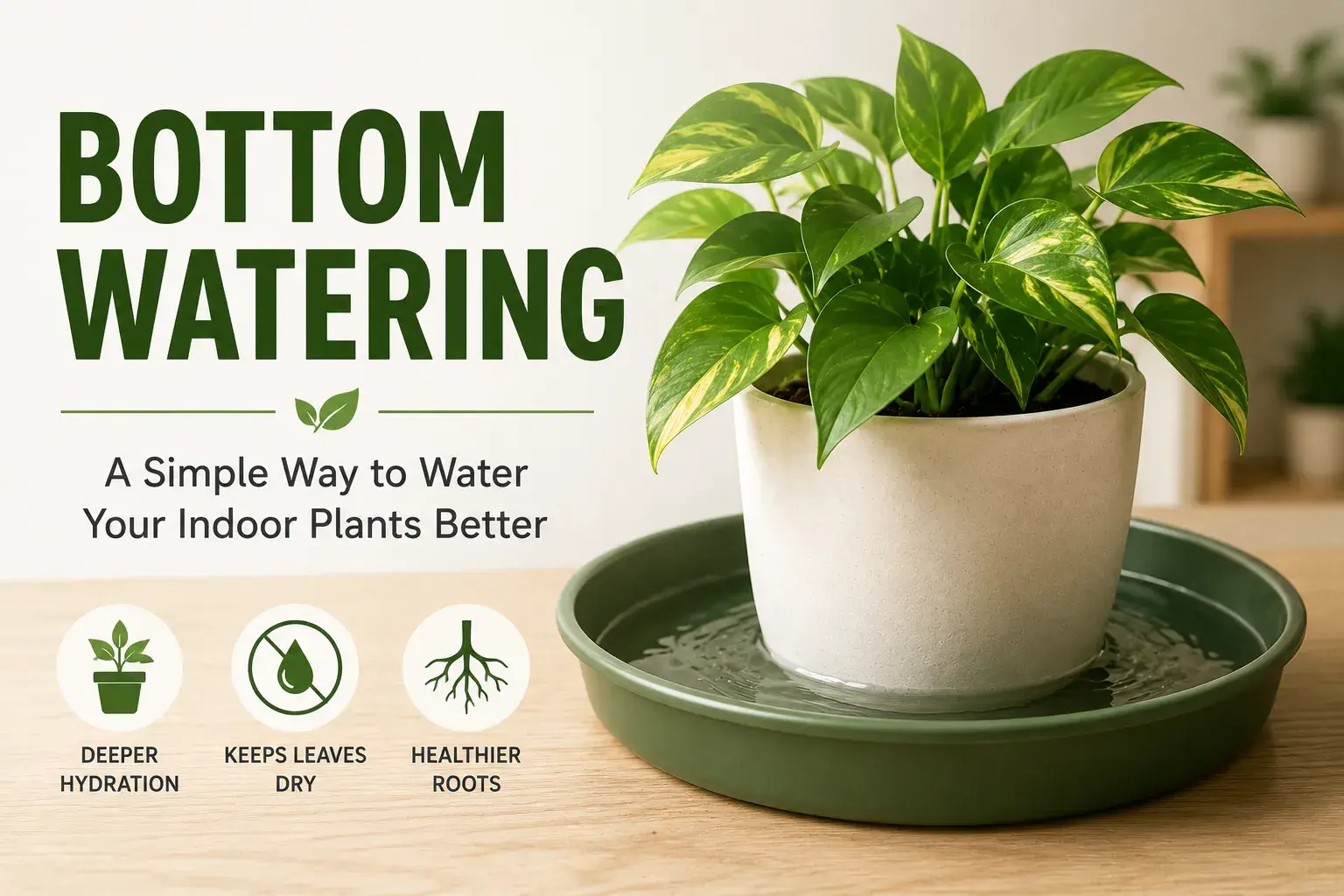
A plant can look thoroughly watered while parts of its root zone are still dry. That is one reason bottom watering has become so popular: it lets a potting mix draw water upward through drainage holes instead of taking it in from the surface.
So is bottom watering indoor plants better than ordinary top watering? Not automatically. Bottom watering can help plants with dense foliage, plants that dislike wet leaves, and potting mixes that have become hard to rewet. But top watering still has a major advantage when a plant needs the entire root zone flushed with fresh water.
The best approach is simple: choose the method that actually hydrates the roots, fits the potting mix, and lets the container drain properly. In 2026, that basic rule still matters more than any fixed watering schedule.
For a broader guide on timing and checking moisture, see our how often to water indoor plants guide.
What Is Bottom Watering Indoor Plants, and How Does It Actually Work?
Bottom watering houseplants means placing a draining pot in water so the potting mix pulls moisture upward through its lower openings. Water moves through the mix’s pores by capillary action. The method works only when water can enter the container and reach the part of the root zone that needs moisture.
What happens inside the pot?
With bottom watering, water enters through the drainage holes and moves upward through the potting mix. The mix acts somewhat like a sponge, pulling moisture into its pore spaces. Bottom watering houseplant is a way to hydrate potting soil through this upward movement of water.
That doesn’t mean the whole pot becomes evenly wet at the same speed. Container height, potting-media structure, dryness, and root placement all affect how water moves. A short pot with a moisture-friendly mix can behave very differently from a tall pot filled with coarse material.
Many simple guides miss this detail. A wet bottom layer doesn’t mean every root is hydrated.
Why a very dry root ball can behave differently
Very dry potting media can become difficult to rewet. Virginia Tech notes that hydrophobic potting soils may take longer to hydrate, and severe drying can require repeated water applications.
A useful diagnostic is to check the mix itself rather than judging only by the amount of water added. Check moisture in the potting medium and use pot weight as another practical clue.
Takeaway: Bottom watering is a way to deliver water. It doesn’t guarantee that every part of the root zone is equally wet.
Is Bottom Watering Better Than Top Watering for Houseplants?
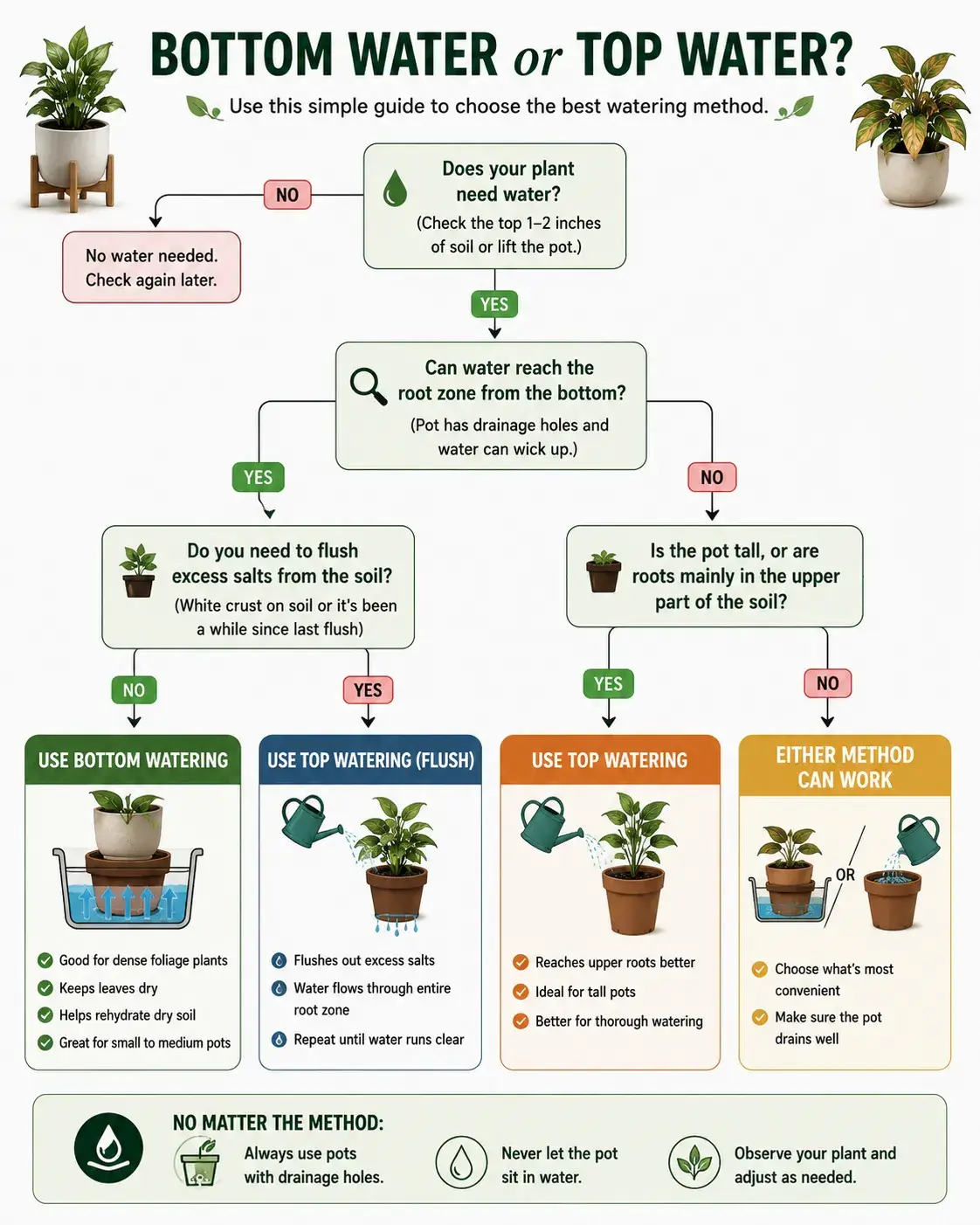
Bottom watering is not automatically better than top watering. It can help hydrate a dry potting mix while keeping foliage dry, but top watering has an important advantage: water can pass through the full root zone and carry accumulated soluble salts out of the container. The best method depends on the plant and pot setup.
| Main strength | Delivers water from below | Delivers water across the full surface |
| Wet foliage | Easier to avoid | More likely unless directed carefully |
| Salt flushing | Limited | Better suited to flushing salts |
| Very dry mix | Can help rewet it | Can help rewet it with repeated watering |
| Tall containers | May leave upper areas dry | Easier to reach the full pot |
| Dense foliage | Convenient | Can be awkward |
| Best use | Specific plant and pot situations | General thorough watering and flushing |
When bottom watering has a practical advantage
Bottom watering is especially useful for plants that do not tolerate wet foliage well or are difficult to water from above. Virginia Tech specifically lists African violets, begonias, cyclamens, some cacti and succulents, and plants with dense foliage among situations where bottom watering can be useful.
It can make sense for small pots, crowded plant collections, or plants whose leaves make it awkward to direct water onto the growing medium.
Another benefit matters in everyday plant care. Keeping water off foliage can reduce the problems associated with repeatedly wet leaves.
When top watering is the better tool
Top watering wins when the pot needs a thorough flush.
Water from the top until water drains freely from the bottom when the goal is to wash out excess soluble salts. Those salts can accumulate as water evaporates and may interfere with normal water uptake.
Top watering can make more sense when roots are concentrated toward the upper part of a tall pot, when the growing medium does not wick water upward well, or when the main goal is flushing the container rather than simply supplying moisture.
The assumption that bottom watering prevents overwatering is wrong. The direction water enters the pot doesn’t remove the risk of prolonged saturation. Poor drainage and excess moisture can reduce oxygen around roots and damage them.
That distinction matters. A plant can be overwatered from the bottom just as it can from the top.
Takeaway: The better watering method is the one that solves the plant’s actual problem.
How Do You Bottom Water Indoor Plants Step by Step?
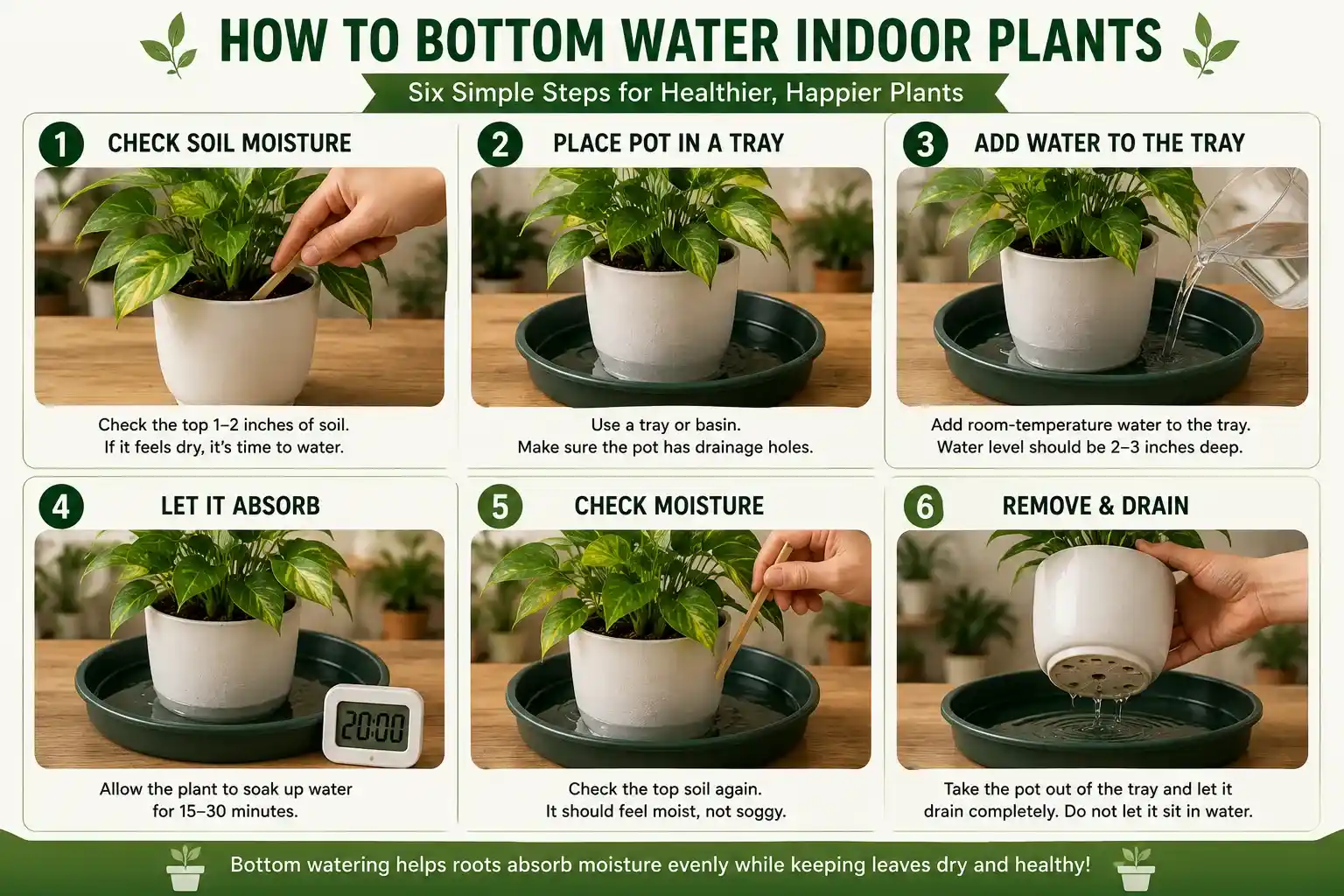
To bottom water, first confirm that the plant needs water. Then place a pot with open drainage holes in a shallow container of water, let the potting mix absorb moisture, check whether the root zone is hydrated, remove the plant, and let excess water drain completely.
1. Check whether the plant actually needs water
Look at the plant and the potting mix before adding water.
University of Maryland Extension advises watering based on plant need rather than a fixed calendar. Its guidance includes checking the moisture in the potting medium and using pot weight as a useful indicator.
The practical point is simple: bottom watering is still watering. Starting with already-moist soil can keep the root zone wetter for longer than necessary.
2. Make sure the pot can actually take up water
Use a container with drainage holes in the bottom.
The drainage openings must allow water to contact the potting medium. A decorative cachepot without drainage is not a true bottom-watering setup.
Virginia Tech specifically notes that bottom watering is possible only when the container has drainage holes at the bottom.
3. Add water to the tray or basin
Place the pot in a shallow tray, saucer, sink, or basin and add water around the pot.
Use roughly 2 to 3 inches of water, and leave the plant in the water for about 15 to 30 minutes, depending on soil dryness. It also recommends checking whether the soil has become adequately hydrated rather than treating the time as an absolute rule.
The important part is not the exact depth. Water must make reliable contact with the drainage openings.
4. Let the pot absorb water and monitor progress
Watch the potting mix rather than staring at a clock.
Virginia Tech recommends checking the soil and the plant’s condition to confirm the root zone has received enough water.
A noticeably heavier pot can be a useful clue. University of Maryland Extension recommends lifting pots to compare their weight as the growing medium dries.
5. Check whether water reached the root zone
This step separates useful bottom watering from blind soaking.
When practical, check the surface of the mix, and use a finger or another suitable moisture check deeper in the pot when the container allows it. Virginia Tech recommends checking for dry spots within the potting mix when confirming that the root zone has been hydrated.
A pot can absorb plenty of water while still leaving a dry area where roots are actually growing.
6. Remove the plant and drain it
Take the pot out of the water and let excess water drain from the container.
Do not leave a houseplant sitting in runoff. University of Maryland Extension explicitly advises emptying excess water from saucers and warns against keeping houseplants sitting in water.
How to Save a Dying Indoor Plant

Takeaway: Good bottom watering ends with a hydrated root zone and a drained pot, not a pot that has simply sat in water for a set amount of time.
Which Houseplants Benefit From Bottom Watering, and When Should You Avoid It?
Bottom watering indoor plants is most useful when a plant grows in a draining container, and the potting mix can pull water upward. It suits plants with dense foliage or leaves that don’t handle repeated wetting well. It is less useful when roots remain above the wet zone or when the substrate needs flushing from above.
Good candidates for bottom watering
People often ask which plants like bottom watering. No universal list exists, but some categories make sense.
African violets, begonias, cyclamens, some cacti and succulents, and dense-foliage houseplants are examples where the method can be useful.
Seedlings can be another good fit in the right container. Bottom watering works for soil blocks because pouring water over the top can disturb the blocks and developing seedlings.
When bottom watering can underperform
A tall pot is one common trouble spot. Water entering from the bottom may hydrate the lower portion first while the upper root zone remains too dry.
Very coarse media can behave differently, too. How much water a pot can move upward depends on the medium’s physical structure, so a longer soak isn’t always the answer.
This is why “soak it longer” is weak advice. Sometimes the setup itself is the problem.
Special setups need their own rules.
Orchids in bark-heavy mixes, self-watering containers, and semi-hydroponic systems shouldn’t be treated like ordinary houseplant pots.
Orchids and other epiphytes need very porous growing media because their natural root environment differs from ordinary soil-grown plants.
A reservoir system is different again. Self-watering containers use a bottom reservoir and wick to keep the media moist over time. That is a designed irrigation system, not simply a pot placed in a tray for one watering session.
Takeaway: Plant species matter, but container design and growing medium can matter just as much.
How Long Should You Bottom Water, and How Do You Know When to Stop?
There is no universal bottom-watering time. Virginia Tech’s 2026 guidance suggests roughly 15 to 30 minutes depending on dryness, but it also recommends judging success by whether the potting mix has become adequately hydrated. Container size, potting medium, dryness, and root position can all change the result.
Why fixed soaking times fail
A fixed timer sounds easy. It is not very precise.
One pot may absorb water quickly. Another may have dense or hydrophobic media. A tall pot may still have dry material near the top after the lower section is saturated.
So treat the clock as a guide, not the finish line.
Better stopping signals
Look for evidence that the root zone has actually received water.
The surface of the mix can become moist as water moves upward. The plant may recover from wilting. Inspect the mix itself when the container allows. These are all more useful than assuming every pot behaves identically.
The opposite situation is equally important. If the lower portion is wet while the upper root zone remains dry, extending the soak indefinitely is not a smart fix.
Takeaway: Measure bottom-watering time by hydration, not by the timer alone.
Can Bottom Watering Cause Root Rot, Fungus Gnats, or Salt Buildup?
Bottom watering itself does not make a plant immune to root problems. Root stress can still occur when a container stays excessively wet or drains poorly. Bottom watering can help keep the surface and foliage drier, but it does not replace good drainage or remove the need to flush accumulated salts with water from above.
Can bottom watering cause root rot?
The more accurate question is whether the root zone stays too wet.
University of Maryland Extension explains that excess water can reduce oxygen in the potting medium and damage fine roots. Poor drainage and overwatering are major contributors to these problems.
That means the watering direction is only one part of the picture.
A pot with poor drainage can remain problematic whether you water from above or below.
What about fungus gnats?
Bottom watering is sometimes promoted as a way to solve fungus gnat problems. That claim is too strong.
Keeping the upper surface drier may help create less favourable conditions for some moisture-loving pests; this is one possible advantage of bottom watering. But it doesn’t guarantee fungus gnats will disappear.
Pouring excess saucer water away helps prevent problems with fungus gnats and other insects.
Why salt buildup is the bigger limitation
Fertilizers and other dissolved minerals can build up in potting media as water evaporates.
Symptoms include brown leaf tips, reduced growth, wilting, and visible salt deposits around the soil line or drainage holes. It recommends periodically flushing the pot with water from above to move excess salts out of the container.
That is one reason a bottom-watering routine should not become a rule that says “never water from above.”
Should you fertilize while bottom watering?
You can use bottom watering to deliver a diluted fertiliser solution, and Virginia Tech specifically describes that use. The same guidance warns against using fertilizer solutions too frequently and recommends alternating with regular water.
Follow the fertilizer label rather than inventing a stronger concentration for the sake of faster growth.
Takeaway: Bottom watering can be part of a healthy routine, but periodic top watering still has a job to do.
What Should You Do When Bottom Watering Isn’t Reaching the Roots?
When bottom watering leaves the lower mix wet but the upper root zone dry, don’t just keep extending the soak. Check water contact, drainage-hole position, pot height, growing-medium structure, and root placement. Then adjust the watering method or the container setup so water actually reaches the roots.
Problem: The bottom is wet but the top stays dry
This is often a geometry problem.
A tall container gives water farther to travel. Roots may be concentrated in the upper section. A coarse medium may not move water upward in the same way as a finer mix.
The answer is not automatically “more water.”
Problem: The pot barely absorbs water
Start by checking whether the drainage holes are actually contacting the water.
Then check the growing medium. Severely dry or hydrophobic media may take longer to absorb water. Virginia Tech notes that hydrophobic soil may require longer hydration or repeated watering.
Problem: The same plant keeps drying unevenly
At this point, stop treating the watering method as the main issue.
A potting medium can break down over time. A root-bound plant can have a dense, uneven root ball. A container can simply be poorly matched to the plant.
Practitioner detail: A useful diagnostic sequence is to check water contact first, substrate second, and root position third. If the container is taking up water but the upper roots stay dry, changing the potting mix or watering from above is often more sensible than repeatedly extending the same bottom soak.
Pattern claim: Growers dealing with small, manageable pots often adjust the watering method after checking where moisture is actually reaching, because two containers that look identical from the outside can behave differently once their mixes and root systems change.
Takeaway: When bottom watering fails, diagnose the setup before blaming the plant.
What Does Bottom Watering Actually Change About Root Development?
Bottom watering changes where water enters the container, but it doesn’t mean every houseplant will grow deeper or stronger roots. Root response depends on the plant, growing medium, moisture distribution, and irrigation system. Research shows subirrigation can affect growth and root traits in some crops, but that is not a universal houseplant rule.
A better way to test the root question
This is where a real home experiment is more valuable than a sweeping claim.
Set up matched plants and keep the major variables the same. Use the same plant type, container size, potting medium, light conditions, and general growing conditions. Give one group top watering and the other bottom watering. Record the watering method and inspect the root systems at the same stages.
That creates something genuinely useful for readers: an original observation rather than another recycled sentence saying bottom watering “encourages deeper roots.”
Do not publish a result such as “bottom watering produced deeper roots” unless the experiment has actually been performed and documented.
What the research does show
A 2022 study on tomato seedlings compared top-sprinkle irrigation with ebb-and-flow subirrigation and reported differences in root growth and morphology under the tested conditions. That is useful evidence that the irrigation method can influence plant responses in some systems. It does not establish the same result for every indoor houseplant.
Other research on ornamental crops has likewise examined how different subirrigation regimes affect water status and root-rot development. Results depend on the irrigation system and growing conditions.
Takeaway: “Bottom watering creates better roots” is too broad. The evidence supports a more careful claim: irrigation method can change the moisture environment around roots, and plant responses depend on the system.
What Is the Best Bottom-Watering Routine for Indoor Plants?
A reliable routine treats bottom watering as one technique, not a fixed schedule. Check the plant’s moisture needs, confirm the container drains, let the mix absorb water, verify the root zone is hydrated, remove excess water, and switch to top watering when the substrate needs flushing.
A repeatable routine
- Check the potting mix before watering.
- Use bottom watering when the container and plant are a good match.
- Monitor whether moisture reaches the root zone.
- Remove the pot from the water when adequately hydrated.
- Let excess water drain away.
- Use top watering when salts need flushing or when the upper root zone is not being reached.
- The key is consistent observation, not a calendar.
When to change methods
Switch methods when the plant repeatedly shows uneven hydration, the pot stays wet too long, or salt deposits build up.
If you’re unsure when your plant needs water, use our Indoor Plant Watering Calculator to get a simple watering estimate based on your plant and growing conditions.