
Snake Plant Propagation Guide: Varieties, Benefits & Care
Snake plant propagation is one of the easiest ways to grow new plants from a healthy snake plant. Whether you want to multiply your favorite plant, explore different snake plant varieties, or discover their benefits, this guide covers everything you need. You’ll learn the best propagation methods, popular varieties, practical benefits, and essential care tips for growing healthy indoor plants.
Fortunately, they’re easy to propagate, available in a wide range of shapes and colors, and valued for far more than their good looks. In this guide, you’ll learn the best ways to propagate a snake plant, explore popular varieties, and discover the practical benefits that make this hardy houseplant a lasting addition to homes and offices alike.
Snake Plant Propagation Growing New Snake Plants From Your Existing Plant
Propagate by leaf cuttings or rhizome division. For leaf cuttings, cut a leaf, dry it 2–3 days, plant in soil, and wait 4–8 weeks for roots and shoots. For division, separate rooted sections. Success rates are 60–80% for cuttings and 80–90% for division.
Why Propagate The Plant
Psychological win: Successfully propagating a plant is a confidence milestone. It shows you can keep plants alive and create new life from an existing one. This mindset shift opens doors to trying trickier species.
Economic reason: One $15 plant becomes 3–4 plants in 12 weeks. Multiply this across a large collection and you save hundreds of dollars.
Genetic copy: Unlike seeds, which are genetically unique, propagations are clones of the parent plant. You get an identical plant without waiting for seed germination or worrying about variation.
Gift-friendly: Propagated plants make perfect moving gifts for friends or family. They are free, personal, and beautiful.
Rescue backup: If your main plant is dying from an unfixable problem, propagate pieces before it’s gone. You save the genetics and have a backup.
Step-by-Step Propagation via Leaf Cuttings
Materials needed:
- Healthy, mature snake plant leaf cut cleanly at the base.
- Paper towels for drying
- Small pots 2–3 inches in diameter
- Cactus or succulent soil mix
- Water for initial moisture only
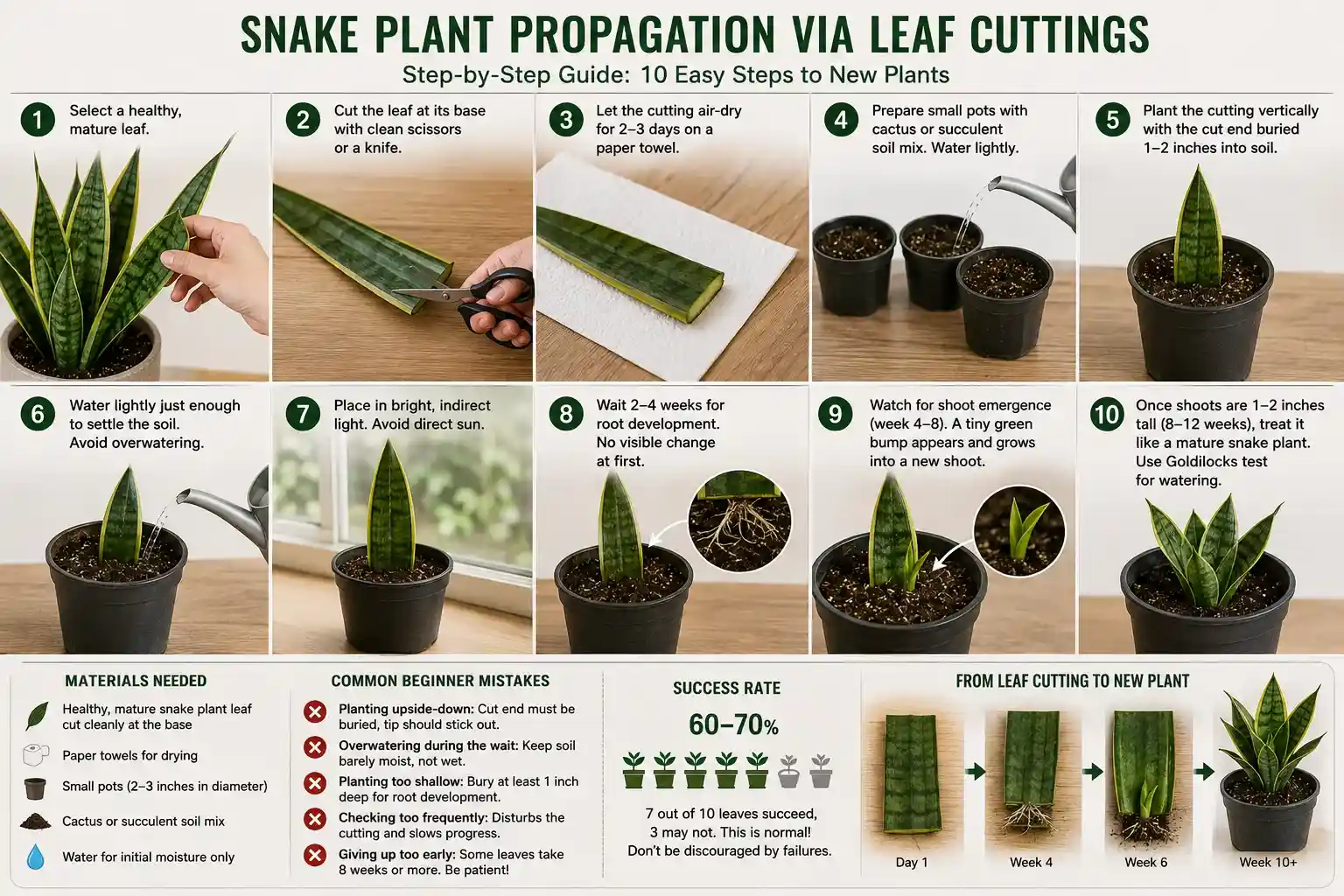
The leaf cutting process: 10 steps:
- Select a healthy leaf from the mid-section of the plant. Avoid the very bottom old leaves and the very top tiny leaves. A mature, full-size leaf has the best chance of success.
- Cut the leaf at its base where it connects to the stem. Use clean, sharp scissors or a knife. Make one clean cut, not a rough tear. The cut edge is where roots will develop.
- Let the cutting air-dry for 2–3 days. Place it on a paper towel in a dry spot away from direct sun. This allows the cut edge to callus over and form a protective seal, preventing rot when planted.
- Prepare small pots with cactus or succulent soil mix. Fill each pot and water lightly just enough to dampen, not saturate. You can pot multiple leaf cuttings in one pot if they don’t touch each other.
- Plant the cutting vertically with the cut end buried 1–2 inches into soil. The tip of the leaf should stick out. This orientation matters because roots grow from the buried base and shoots grow from the tip.
- Water lightly just enough to settle the soil. Avoid heavy watering; the goal is barely moist soil, not soggy.
- Place in bright, indirect light. A windowsill or shelf 3–5 feet from a window is perfect. Avoid direct sun.
- Wait 2–4 weeks for root development. No visible change occurs during the first 2–3 weeks, which is normal. Tiny white roots form at the buried base but are not visible. Resist the urge to check or disturb the soil.
- Watch for shoot emergence week 4–8. After roots establish, a tiny green bump appears at the base of the leaf. This is the beginning of a new shoot, the baby plant. It grows into a rosette of leaves.
- Once shoots are 1–2 inches tall, usually after 8–12 weeks, the plantlet is independent. At this point, begin treating it like a mature snake plant. Use the Goldilocks test for watering and increase light exposure gradually.dually.
Common beginner mistakes:
- Planting upside-down: The cut end should be buried and the tip should stick out. If planted backwards, roots cannot develop from the tip and rot begins.
- Overwatering during the wait: Keep soil barely moist, not wet. Overwatering causes rot before roots even develop.
- Planting too shallow: If the cut end isn’t buried deeply enough, roots can’t form. Bury at least 1 inch.
- Checking too frequently: Opening the pot to “see if roots developed” exposes the cutting and disrupts the process. Leave it alone for 4–6 weeks.
- Giving up too early: If a leaf hasn’t rooted after 8 weeks, it’s unlikely to. It’s normal for 30% of leaf cuttings to fail. Try again with a different leaf.
Success rate: 60–70%. This means 7 out of 10 leaves succeed, 3 fail. This is normal and acceptable. Don’t be discouraged by failures.
Propagation via Rhizome Division For Experienced Growers
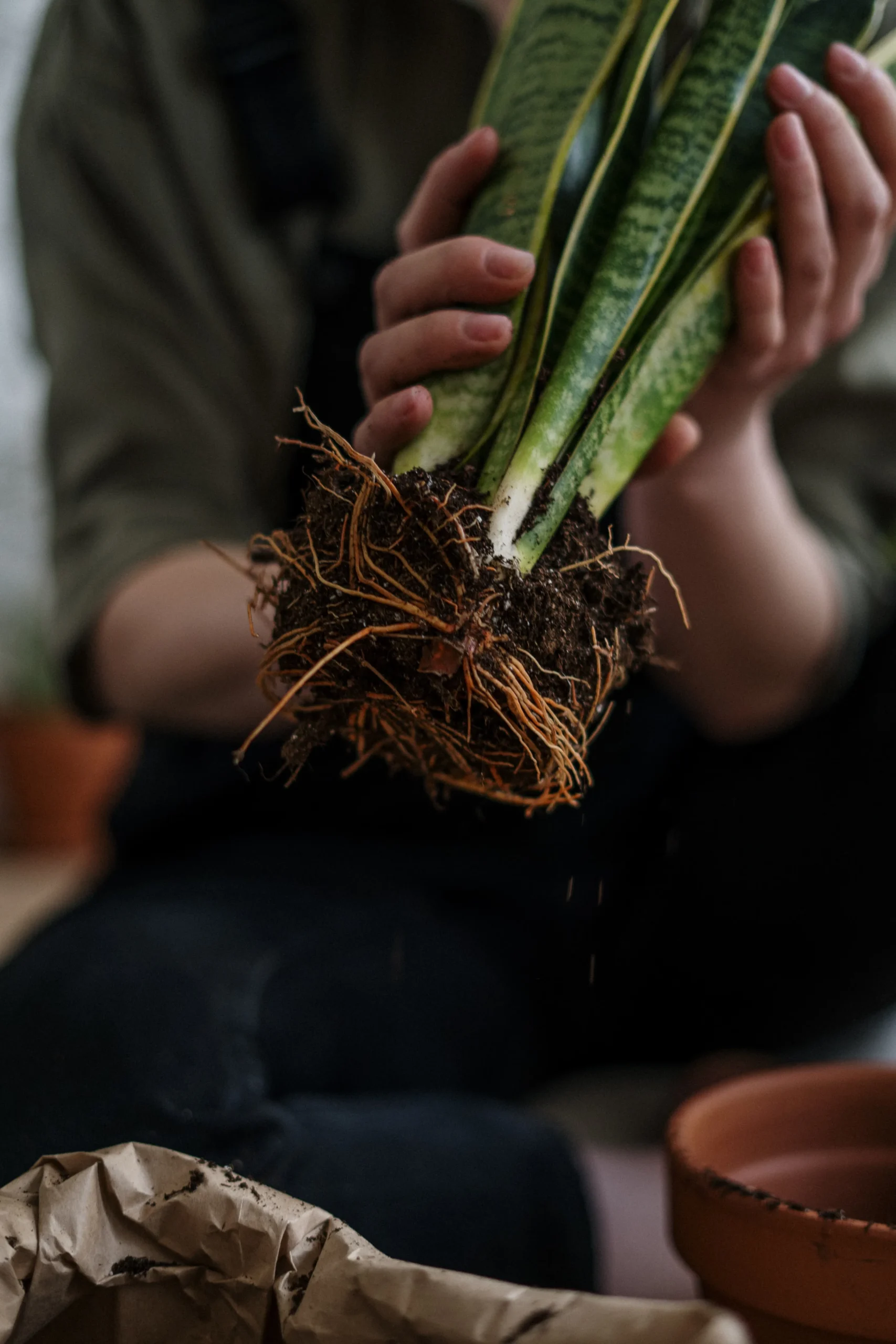
What it is: The rhizome is the underground stem where roots attach. It’s thick and woody. Multiple shoots grow from one rhizome. If you separate rooted sections, each becomes an independent plant.
When to do it: During repotting, when the plant is already out of the pot. The best time is late spring when growth is accelerating.
The division process: 6 steps:
- Remove the plant from the pot and gently brush away soil so you can see the rhizome clearly. Look for natural break points where sections are already partially separated.
- Identify distinct sections. You’re looking for parts of the rhizome that have roots attached and at least one shoot leaf.
- Cut the rhizome into 2–4 sections using a clean, sharp knife. Each section needs roots and at least one shoot to survive.
- Let cuts dry for 1–2 hours to callus over.
- Pot each section in fresh cactus soil at the same depth it was growing before; don’t bury the rhizome too deep.
- Water lightly and wait 1 week before normal watering. Roots are already present, so new growth usually appears within 2–4 weeks.
Success rate: 80–90%. Division is more reliable than leaf cuttings because each section already has a root system.
Practitioner detail: Variegated snake plants like Laurentii, with white/yellow edges, sometimes revert to solid green during propagation. Leaf cuttings of variegated varieties occasionally produce solid green plantlets. If you have a variegated variety and want to maintain the variegation, use rhizome division instead. Division preserves variegation.
Propagation Timeline and Patience Realistic Expectations
|
Week |
Leaf Cutting Progress |
Rhizome Division Progress |
|
Week 0 |
Fresh cut, air-drying 2–3 days |
Fresh cut, air-drying 1–2 hours |
|
Week 2–4 |
Callous formed, no visible roots yet |
Roots already present; new growth possible |
|
Week 4–6 |
Tiny white roots emerge at base |
Shoots begin to emerge |
|
Week 6–8 |
Green shoot appears 1–2 mm |
Multiple shoots visible |
|
Week 8–12 |
Shoot grows to 1–2″ with 2–3 new leaves |
N/A established earlier |
|
Week 12–16 |
Independent plantlet ready for potting |
N/A |
PROPAGATION After timeline
|
Method |
Time to Success |
Success Rate |
Difficulty |
Best For |
|
Leaf Cutting |
12–16 weeks |
60–70% |
Easy beginner-friendly |
Abundant leaves, patience, learning |
|
Rhizome Division |
4–6 weeks |
80–90% |
Moderate requires careful handling |
Fast results, mature plants only |
The mindset shift: Propagation is not a fast process. Impatience is the #1 killer. People water more frequently thinking it speeds things up, or they dig up the soil checking for root development. Resist this. Wait.
What success looks like:
- Week 2–4: No visible change; this is normal; root development is underground
- Week 4–6: First visible sign is a tiny white root at the base; requires close inspection
- Week 6–8: A small green bump; the shoot appears at the base
- Week 8–12: The shoot grows and develops into a cluster of leaves
Failure recovery: If a leaf cutting doesn’t root within 8 weeks, it’s unlikely ever to root. This is normal. 30% failure rate is standard. Try another leaf. Don’t obsess over the one that failed.
Baby Plant Care Post-Propagation
First 8–12 weeks as propagule:
- Keep soil barely moist, not wet.
- Indirect light is fine; no direct sun stress.
- Don’t fertilize; the young plant has no energy for growth yet; it’s establishing roots and shoots.
- Don’t repot yet; the soil is perfect for this stage.
After 12 weeks as an independent young plant:
- Transition to normal snake plant care; use the Goldilocks test for watering; begin standard fertilizing schedule.
- Gradually increase light exposure if it’s been in shade for 12 weeks; move it to brighter conditions over 2 weeks.
When to repot: Once roots are visible circling the 2–3-inch pot, usually 6–9 months after propagation, move to a 4–6-inch pot. Use the same well-draining soil.
Growth rate: Young plants grow slightly faster than mature plants initially trying to establish, then slow back down once they reach maturity 12–18 months after propagation.
Snake Plant Varieties: Choosing The Right Type For Your Space
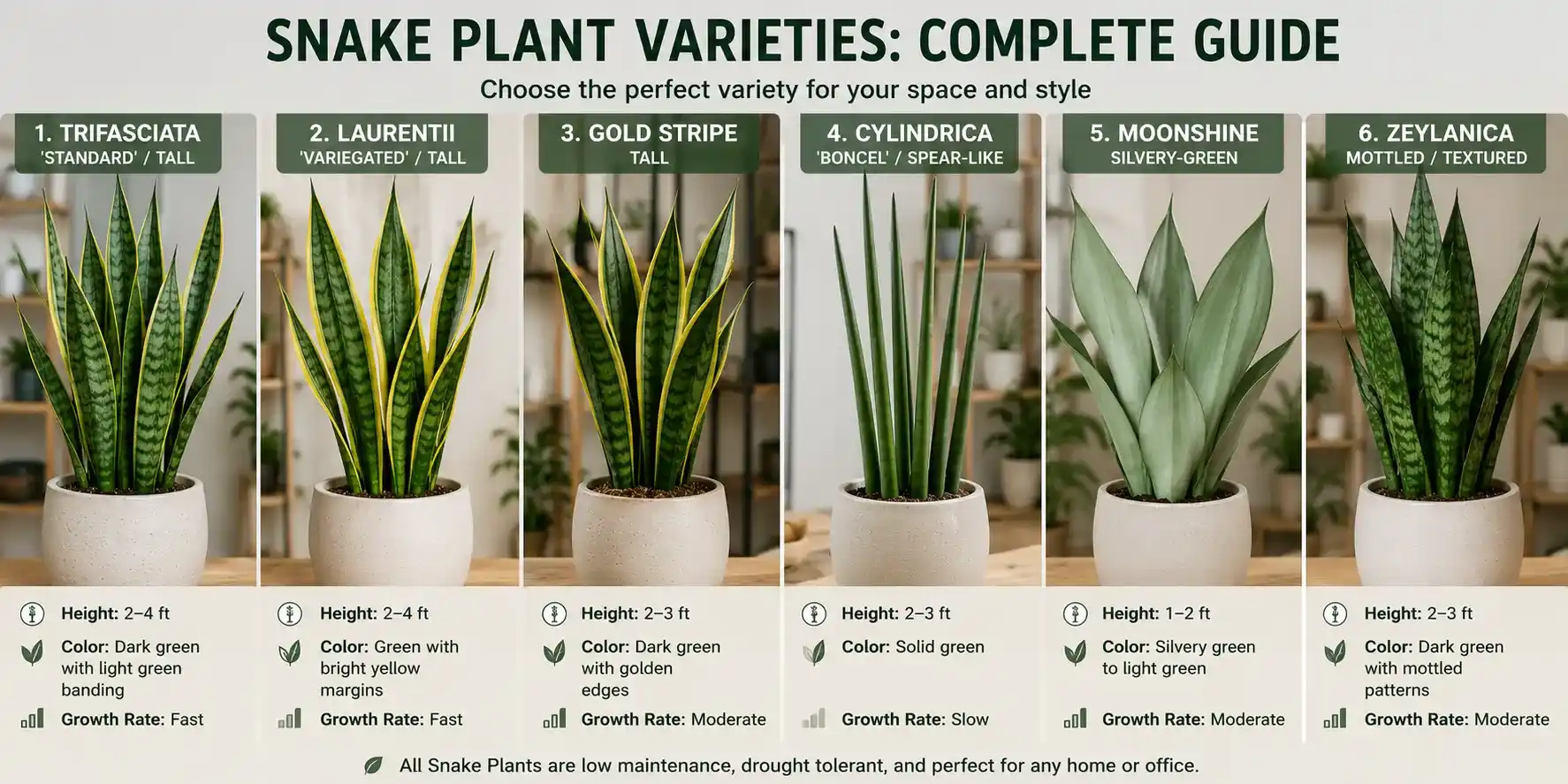
Trifasciata: tall, green; Laurentii: green with gold edges; Cylindrica: thin, spear-like; Moonshine: pale silver; Hahnii: compact, nest-like. All need identical care; differences are visual only.
The Big Five Varieties Overview
Sansevieria trifasciata Mother-in-Law’s Tongue, Classic Snake Plant:
- Height: 2–4 feet
- Growth rate: Medium
- Color/pattern: Deep green with mottled, wavy horizontal patterns
- Best for: Statement pieces, tall corners, traditional décor
- Why it’s popular: The OG snake plant; most available; classic look
Sansevieria trifasciata ‘Laurentii’ Golden Snake Plant:
- Height: 2–4 feet, identical to trifasciata
- Growth rate: Slow, slower than trifasciata
- Color/pattern: Green with gold or yellow edges on every leaf
- Best for: Visual contrast, modern minimalist décor, adding color interest
- Why it’s popular: The gold edges are striking; more expensive but worth it for visual impact
Sansevieria cylindrica African Spear:
- Height: 12–24 inches
- Growth rate: Medium
- Color/pattern: Thin, cylindrical leaves not flat like other varieties
- Best for: Modern aesthetic, compact spaces, architectural interest
- Why it’s popular: Unique form sets it apart from typical snake plants; sculptural.
Sansevieria ‘Moonshine’ Silvery Snake Plant:
- Height: 18–36 inches
- Growth rate: Slow
- Color/pattern: Pale silvery-green, no mottled pattern like trifasciata
- Best for: Contemporary design, light-colored walls; pale leaves pop, elegant spaces
- Why it’s popular: Soft, sophisticated color; calming presence
Sansevieria hahnii Bird’s Nest Snake Plant:
- Height: 4–12 inches, compact
- Growth rate: Slow
- Color/pattern: Deep green, rosette form leaves radiate outward from center
- Best for: Shelves, desks, small spaces, apartments
- Why it’s popular: Doesn’t take up much room; cute, compact form.
Choosing by Your Space
Tall and dramatic 2–4 feet: Trifasciata or Laurentii. Place in corners, next to furniture, or next to a wall for maximum visual impact. These create vertical interest without taking up floor space.
Compact and cute under 1 foot: Hahnii or other dwarf varieties. Perfect for desks, shelves, small apartments, or windowsills. These fit anywhere and add presence without bulk.
Modern and architectural: Cylindrica or Moonshine. Sleek forms that match contemporary, minimalist, or Scandinavian aesthetics. These are statement pieces.
High-color pop: Laurentii or other variegated types if you want visual contrast and color. Standard green is calming and neutral; variegated is sophisticated and intentional.
Beginner-friendly: All are equally easy to care for. Don’t hesitate based on variety. They’re all nearly impossible to kill.
Less Common Varieties Brief Mention
Sansevieria zeylanica: Mottled green, similar to trifasciata but from a different geographic origin.
Sansevieria stuckyi: Dark green, compact, rosette form similar to hahnii.
Sansevieria ‘Fernwood’: Hybrid with specialized aesthetic; harder to find.
Braided or topiary forms: Some nurseries sell braided snake plants multiple plants twisted together or trained into topiary forms, spirals, etc. These are gimmicky but fun. Care is identical; unwrap the braid gently if growth becomes too tight.
Where to source: Specialty plant shops, online nurseries, Costa Farms, online retailers, or big-box garden centers. Basic varieties trifasciata, Laurentii, and hahnii are widely available. Rare varieties require specialized searching.
|
Variety |
Height |
Growth Rate |
Leaf Color/Pattern |
Best For |
Difficulty |
|
Trifasciata |
2–4 feet |
Medium |
Deep green, mottled |
Statement pieces, tall corners |
Easy |
|
Laurentii |
2–4 feet |
Slow |
Green + gold edges |
Visual interest, modern décor |
Easy |
|
Cylindrica |
12–24″ |
Medium |
Thin, cylindrical |
Modern aesthetic, compact |
Easy |
|
Moonshine |
18–36″ |
Slow |
Silvery-green, soft |
Contemporary, light walls |
Easy |
|
Hahnii |
4–12″ |
Slow |
Compact rosette |
Shelves, small spaces, desks |
Easy |
|
Zeylanica |
18–30″ |
Medium |
Mottled green |
Texture variation, mid-height |
Easy |
Snake Plant Benefits More Than Just A Decorative Plant
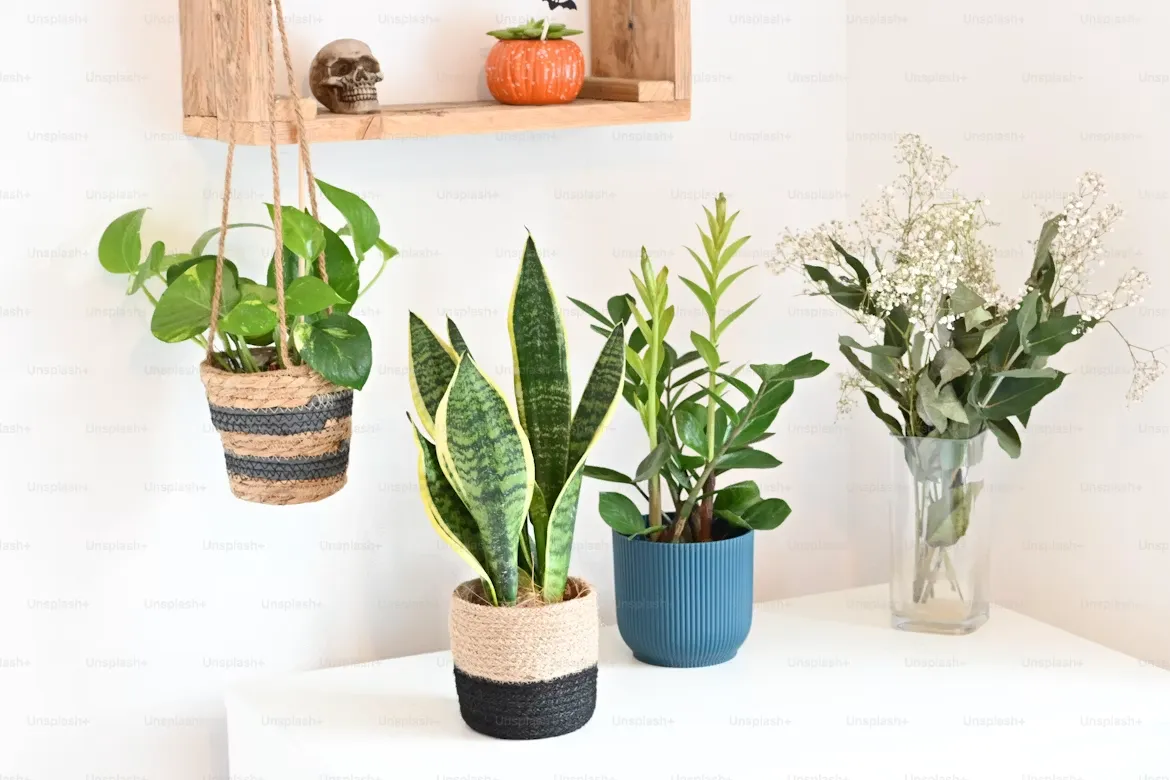
Snake plants purify air though modestly, add visual interest, require minimal care, and are non-toxic to pets. They’re affordable, propagate easily, and last 20+ years a long-term home investment.
Air Purification With a Reality Check
The myth: “Snake plants remove 90% of toxins overnight.”
This claim comes from a famous NASA study published in 1989. The study tested various houseplants in sealed chambers and found that snake plants absorbed some formaldehyde and benzene.
The reality: [VERIFY air purification effectiveness before drafting] That 1989 study was conducted in controlled laboratory conditions sealed rooms with no air circulation, concentrated pollutant levels, and optimal growing conditions. Real homes don’t work this way. Air circulates through windows, vents, and HVAC systems. Pollutant levels are lower. Plants don’t sit in perfect conditions.
In a normal home, a single snake plant has negligible air-purifying power compared to opening a window, using an HVAC system, or running an actual air purifier.
What is true: Snake plants do absorb some formaldehyde and benzene through their leaves, a process called phytoremediation. But the amount is tiny. If your goal is clean air, open a window. If your goal is a beautiful plant that happens to absorb trace pollutants, then yes, snake plant.
Bottom line: Don’t buy a snake plant expecting to cure indoor air pollution. Buy it for beauty and ease. The air purification is a minor bonus, not the main reason.
Aesthetic and Psychological Benefits
Visual appeal: Architectural form, modern look, clean lines. The plant fits any décor style without clashing. It’s neutral and intentional-looking.
Space perception: Tall varieties create vertical interest in small apartments. This visual trickery makes spaces feel larger without taking up floor space.
Mindfulness: Caring for a living thing creates routine and purpose. For busy professionals, this becomes meditation. For anxious people, it’s a controllable system: feed plant, plant lives, cause and effect in an unpredictable world.
Stress reduction: Research shows that being around plants lowers cortisol, the stress hormone, and increases a sense of well-being. This is real, measurable, and documented. It’s not mystical; it’s neurobiology.
Low-Maintenance Lifestyle Benefit
Mental load reduction: A plant that doesn’t demand constant attention frees mental space. You’re not anxious about watering schedules or checking soil moisture daily. You can actually relax around it.
Reliability: Knowing the plant will survive neglect reduces anxiety for busy people or frequent travelers. There’s psychological safety in owning something forgiving.
Confidence building: Successfully caring for a low-maintenance plant is a gateway to attempting trickier species. Many plant enthusiasts started with a snake plant and grew from there.
Long-Term Value and Cost-Effectiveness
Lifespan: 20+ years or longer with basic care. Many plant owners report their snake plants thriving for 15–30 years. This is a long-term investment, not a one-season purchase.
One-time cost: $10–30 for a small plant. Add $3 for a bag of soil that lasts multiple plants. Pots you might already own or pick up for $5–15.
Annual cost: Over 20 years of ownership, total investment is $50–100. That’s $2.50–5 per year. Cheaper than a monthly coffee.
Comparison: Ficus trees demand repotting, fertilizing, pest control, and occasional replacement, $2,000+ over 20 years. Peace lilies need consistent watering and humidity: $1,000+ over time. Snake plants cost almost nothing over decades.
|
Benefit |
Reality Check |
Your Bottom Line |
|
Air Purification |
Marginal effect in typical homes; not a medical device |
Nice bonus, not the main reason to buy |
|
Aesthetic Appeal |
Fits any décor style; modern, architectural form |
Strong visual asset for any space |
|
Pet Safety |
Non-toxic per ASPCA; mild oral irritation possible if chewed rare |
Safe choice for pet owners |
|
Low Maintenance |
Truly low effort; neglect-forgiving |
Best for busy, frequent travelers |
|
Lifespan |
20+ years with basic care; outlasts most houseplants |
One-time investment; decades of enjoyment |
|
Cost |
$10–30 per plant; $2–3 annual cost over 20 years |
Cheapest long-term houseplant investment |