South Facing Window Plants: Best Choices and How to Keep Them Healthy
A south-facing window can be a brilliant place for houseplants, but “bright” doesn’t automatically mean “safe for every plant.” A plant can thrive in strong light while another sitting beside it develops pale patches and crispy leaves.
So which south facing window plants are best choices & care instructions actually work?
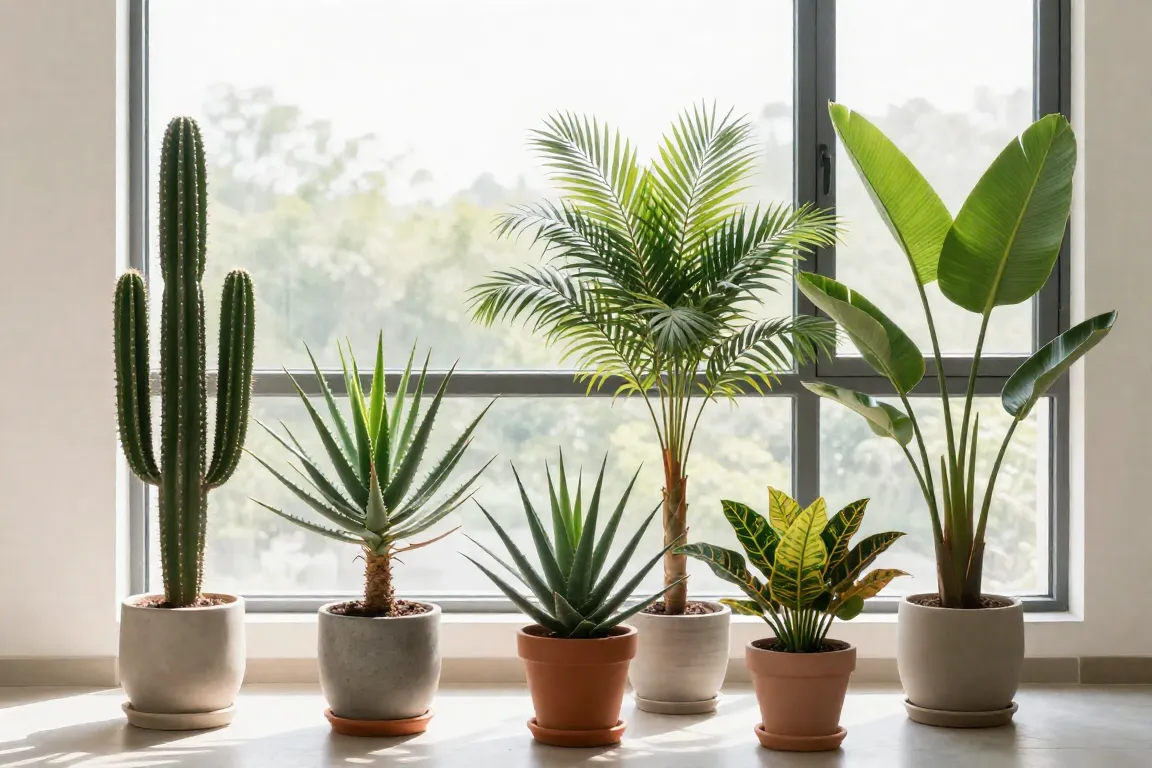
In the Northern Hemisphere, a south-facing window generally provides strong indoor light and can suit sun-loving plants such as many cacti, succulents, and jade plants. But the right choice depends on what reaches the leaves, not just the window’s direction. Distance, filtering, season, and the plant’s own light tolerance all matter. The RHS specifically recommends true sun-loving houseplants for bright south-facing positions while warning that some plants can struggle with intense summer exposure.
This guide breaks down south facing window indoor plants by plant type and placement, so it’s easier to decide what belongs on the sill, what should sit farther back, and what needs filtered light.
What makes a south facing window different for houseplants?
A south-facing window generally provides some of the strongest natural indoor light in the Northern Hemisphere. That makes it useful for high-light plants, but the actual growing conditions still depend on exposure duration, distance, obstructions, curtains, glazing, and seasonal changes.
The important distinction is between window direction and leaf-level light.
A plant directly beside clear glass can receive much stronger light than another plant several feet back in the same room. A sheer curtain, nearby building, tree, tinted glass, or blind can further change that exposure. University of Maryland Extension identifies intensity, duration, and light quality as important parts of indoor lighting, with light intensity changing as the plant moves farther from the light source.
That is why indoor plants in south facing window conditions shouldn’t all be treated the same. A cactus may be happy with intense direct light, while a rainforest plant may do better in bright filtered conditions.
And seasons matter. Gardening Australia explains that the sun changes position through the day and across the year, so a plant’s indoor light conditions can shift even when the plant never moves.
For people comparing south facing light indoor plants, the useful question isn’t simply whether a plant likes “bright light.” The better question is:
How much direct light can this particular plant handle at this particular window?
Takeaway: The compass direction gives you a starting point. The leaf tells you what the plant is actually experiencing.
Which plants are best for a south facing window Plant?
The best plants for south-facing window locations generally tolerate strong light, including many cacti, succulents, jade plants, and other sun-loving species. But species and cultivars differ, so a plant marketed as a “sun lover” doesn’t automatically belong against hot glass all day.
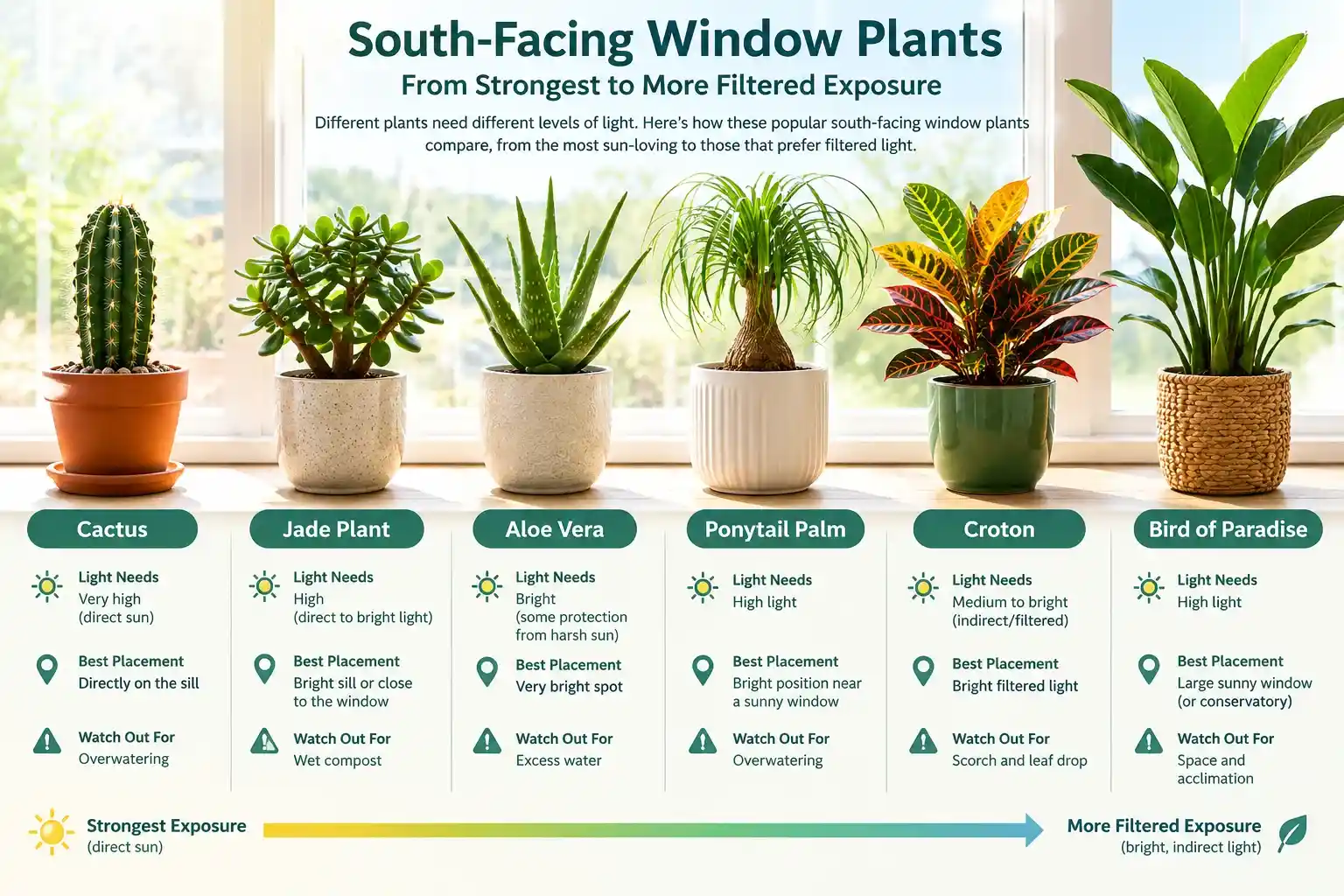
| Plant | Best placement | Direct-sun tolerance | Main watch-out |
| Jade plant (Crassula ovata) | Bright sill or close to a sunny window | High, depending on form and acclimation | Wet compost |
| Aloe vera | Very bright spot, with protection if harsh sun causes browning | Bright-light tolerant, but harsh direct sun can cause damage | Excess water |
| Cacti | Brightest available position | High for suitable species | Individual species differ |
| Ponytail palm | Bright position near a sunny window | High light | Overwatering |
| Croton | Bright filtered or indirect light | Not a harsh-direct-sun choice | Scorch and leaf drop |
| Bird of Paradise | Beside a large sunny window | High light | Space and acclimation |
The RHS currently lists cacti and succulents as strong choices for sunny rooms. It lists jade among plants suitable for full sun, while its current Aloe vera profile recommends bright indirect light and warns that harsh direct sunlight can brown the leaves. Croton is another important correction. Its RHS growing guide recommends bright but indirect light and specifically warns that full summer sun through glass can cause overheating and scorch.
That means a useful list of Houseplants For South Facing Window Plant should not simply rank plants by how “tropical” or attractive they look. It should tell readers where each plant belongs within the window’s light range.
Small plants for south-facing window
For small plants for south-facing window spaces, compact cacti, many succulents, aloe, and jade are practical choices when the exposure suits the individual plant.
These work especially well on narrow sills because they don’t require the floor space large foliage plants do. Haworthias are an interesting exception within the succulent world. Gardening Australia notes that they prefer protection from direct sunlight and can do well near a bright south-facing window when a sheer curtain filters the exposure.
Large indoor plants for south facing window
For large indoor plants for south facing window spaces, Bird of Paradise is a strong candidate for a large, bright room. RHS recommends placing Strelitzia beside a large sunny window or in a conservatory because it needs plenty of bright light.
The plant can become substantial, so space is often the real constraint rather than light. RHS says established Bird of Paradise plants can grow well over a metre wide, which makes placement against a crowded sill impractical.
Best plants for south facing window box
For a best plants for south facing window box arrangement, compact sun-tolerant plants are usually easier to manage than large foliage species.
Cacti, suitable succulents, compact jade forms, and some aloe plants can make sense where the window receives strong light. Avoid mixing plants with sharply different watering needs simply because they look good together.
Takeaway: Choose the plant first, then match it to the right spot. Don’t let the window dictate the plant.
Where should you place plants in a south-facing window?
Not every plant belongs directly against south-facing glass. Put genuine sun-lovers in the brightest position, move less tolerant plants farther back, and use filtering when needed. The best location depends on the plant, the season, the window, and how much direct sun reaches its leaves.
This is one of the biggest differences between useful advice and a generic plant list.
Assuming a south-facing window means the plant should sit directly on the sill is wrong. The window gives an exposure direction, not a universal placement instruction.
A strong pattern appears across indoor growing advice. When users move a plant from weaker light into much stronger exposure, the safer response is usually to increase exposure gradually rather than make the full jump at once. University of Maryland Extension gives hardening-off guidance for plants moved from lower indoor light toward full sun, because sudden exposure can cause sunburn.
Directly on or very close to the glass
Reserve the strongest position for plants that genuinely tolerate intense light.
Many cacti and suitable succulents belong here. Some jade plants can too. The RHS currently lists Crassula ovata with full-sun exposure and a south- or west-facing aspect, so jade can be a reasonable choice for a bright sill when conditions suit it.
But direct sun is not a badge of honour. A plant adapted to lower light can scorch if you move it there abruptly.
A short distance back from the window
This position works well for plants that need lots of light but don’t need the strongest possible exposure.
It is particularly useful for broad-leaved plants and plants that show stress under harsh direct sun. The farther a plant sits from the window, the lower the light intensity becomes.
That gives the grower another control point before the only option becomes moving the plant into a dim room.
Behind a sheer curtain
Filtered light can be the middle ground.
Gardening Australia describes filtered light as bright light that has been diffused and recommends sheer curtains for plants that cannot handle strong direct exposure.
This can make a South Facing Window Plants more usable for foliage plants that need brightness without the harshest direct rays.
Tall and hanging plants need a different placement strategy
For tall plants for South Facing Window Plants spaces, check where the upper leaves actually sit. A large plant can have one section shaded by the room while its highest leaves sit close to the glass.
For hanging plants in south-facing window spaces, don’t assume the highest position is best. Hanging foliage often looks attractive near windows, but thin leaves may need filtered or indirect exposure rather than direct afternoon sun.
That matters when choosing the best indoor hanging plants for south facing window conditions. Place the basket based on the plant’s light tolerance, not simply wherever the hook happens to be.
Southeast and southwest windows are not identical.
The best indoor plants for southeast-facing window conditions can overlap with south-facing choices, but the light pattern isn’t necessarily identical.
Likewise, southeast-facing window indoor plants may receive strong morning light with a different heat pattern from a window that gets stronger later-day exposure.
The same principle applies to the best indoor plants for a south-west-facing window. A plant that handles filtered brightness may need more protection from strong late-day sun.
Takeaway: Think of the window as a range of light zones. The sill is only one of them.
How do you care for plants in a south-facing window?
South-facing conditions can increase light and, in some homes, drying around the plant. Care should still respond to the actual soil, pot, plant, and season rather than a fixed watering calendar. Good drainage matters, and monitor plants when light and heat change.
Water according to the soil
The common mistake is turning window orientation into a watering rule.
A bright window doesn’t mean a plant must be watered every few days. Pot size, material, potting mix, airflow, plant size, temperature, and season all affect how quickly moisture leaves the container.
A small pot beside a sunny glass can dry much faster than a large container holding the same species.
For south facing window plants, the best indoor care rule is simple: check the growing medium and the plant’s condition rather than watering because the calendar says so.
Keep drainage working
A sunny location doesn’t protect roots from staying too wet.
Containers need a way for excess water to drain. This is especially true for drought-adapted plants, which can be damaged by repeated wet conditions even when the leaves sit in bright light.
The RHS recommends well-drained conditions for jade and gives well-draining growing guidance for many cacti and succulents.
Watch heat separately from light
A plant can get plenty of light and still struggle with heat near a window.
Gardening Australia specifically recommends keeping indoor plants away from strong temperature extremes and paying attention to the relationship between plant location, light, and temperature.
This is why a plant that looks excellent near a sunny window one season may need a small positional change later.
How can you tell when a south-facing window is too intense?
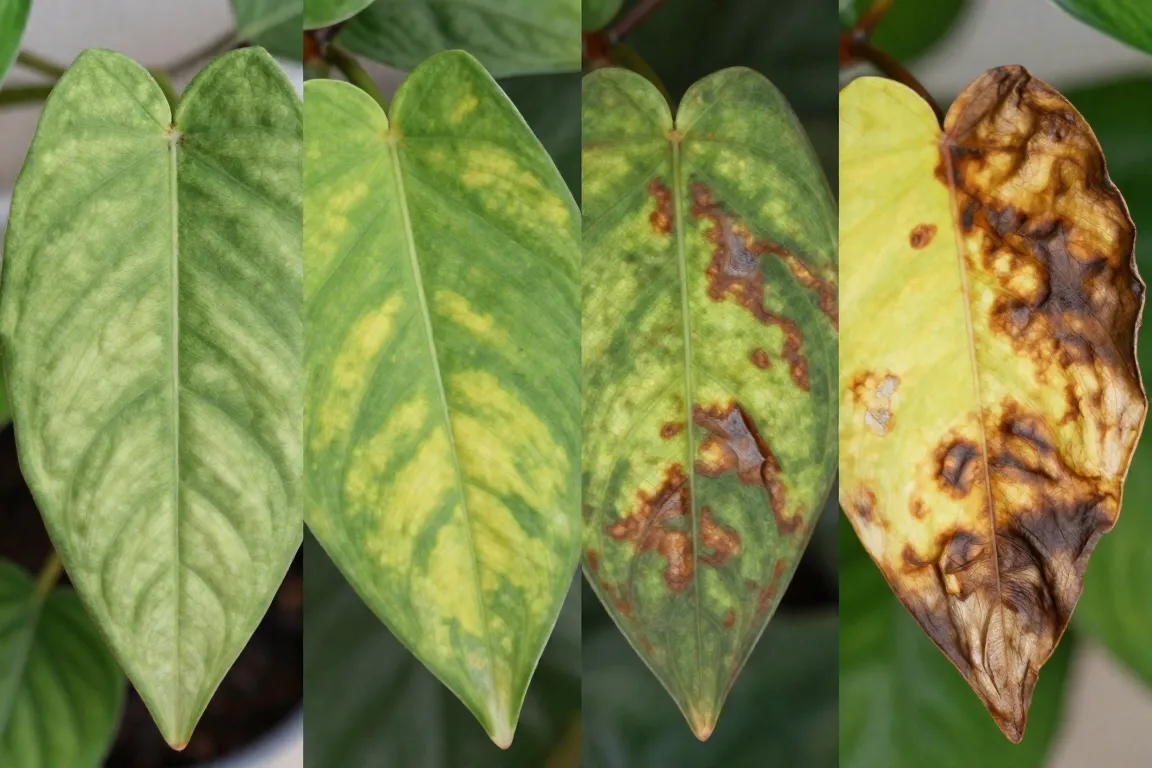
Excessive sunlight can cause pale, bleached, faded, brown, or brittle areas on exposed leaves, especially when strong sun combines with dry soil. The pattern of the damage matters, because not every brown leaf means too much sunlight.
Look at where the damage appears
Sun damage often affects the parts of a leaf or plant that receive the strongest exposure.
University of Maryland Extension explains that strong sun and heat can break down chlorophyll, producing pale or bleached areas that later become brown and brittle. It further notes that dry soil can make the symptoms more severe.
That gives a useful diagnostic clue. If the plant looks normal on the shaded side but damaged where the strongest light lands, exposure becomes a stronger suspect.
What to do when leaves scorch
- Move the plant farther from the glass.
Don’t keep exposing damaged foliage to the same harsh conditions while it recovers.
- Filter strong sunlight with a sheer curtain.
This helps when the room has enough light but direct exposure is excessive.
- Check the soil before watering.
Crispy leaves can occur alongside dry soil, but extra water isn’t automatically the answer.
- Observe new growth instead of expecting damaged leaves to turn green again.
Existing scorched tissue does not simply repair itself.
- Reintroduce stronger light gradually when appropriate.
Plants adapted to lower light can suffer sunburn after sudden exposure to much stronger conditions.
When the problem isn’t too much light
A damaged leaf can send people straight to the wrong conclusion.
Underwatering, root problems, temperature stress, and sudden environmental changes can produce symptoms that overlap with sun damage. Before making a major correction, check the damage location, any recent placement changes, and the pot’s moisture level.
For readers searching south facing window plants reddit, Reddit can be useful for seeing real descriptions of what other growers observe. Still, those discussions are anecdotal rather than a substitute for species-specific horticultural guidance.
The useful lesson isn’t that every south-facing window causes scorch. It’s that the combination of plant, glass, exposure, and placement matters.